
The U.S. Department of the Treasury’s Office of Foreign Assets Control (OFAC) 50 Percent Rule, and similar rules in the EU, U.K., and beyond, highlight a critical risk: sanctions can apply to a company even if its name does not appear on a public government sanctions list. The 50 Percent Rule introduces a unique compliance challenge, as entities majority owned by sanctioned parties are often owned through dynamic, indirect ownership structures. Ownership chains frequently cross jurisdictions, introducing additional complexity for determining ownership.
Regulators and enforcement agencies increasingly expect companies to show that they can identify and mitigate sanctions evasion risks that extend beyond majority ownership thresholds, including exposure that arises through complex webs of minority ownership, control, and affiliation. As a result, institutions are dedicating more resources to understanding and managing sanctions risks associated with entities that are owned by sanctioned parties but are not specifically named on sanctions lists.
Here, we discuss the intricacies of global sanctions ownership rules, compare regulatory variations, and show how an intelligence-led approach can help navigate complex ownership dynamics and ensure effective compliance.
Regulators and enforcement agencies increasingly expect companies to show that they can identify and mitigate sanctions evasion risks that extend beyond majority ownership thresholds, including exposure that arises through complex webs of minority ownership, control, and affiliation. As a result, institutions are dedicating more resources to understanding and managing sanctions risks associated with entities that are owned by sanctioned parties but are not specifically named on sanctions lists.
Here, we discuss the intricacies of global sanctions ownership rules, compare regulatory variations, and show how an intelligence-led approach can help navigate complex ownership dynamics and ensure effective compliance.
Understanding OFAC’s 50 Percent Rule
OFAC mandates that any entity owned 50% or more, individually or in the aggregate, directly or indirectly, by one or more sanctioned parties is itself considered blocked, even if it isn’t explicitly listed on the Specially Designated Nationals and Blocked Persons List (SDN List). This 50 Percent Rule is intended to extend sanctions to entities that are majority-owned by designated persons or entities.Indirect ownership refers to a sanctioned party’s ownership of an entity through one or more intermediary entities, versus holding the ownership stake directly. If Sanctioned Company A owns 50% or more of Company B, and Company B owns 50% or more of Company C, then Company C is also considered blocked.
Aggregate ownership refers to cases where multiple sanctioned parties hold a combined ownership stake equal to or greater than 50% in total. For example, if two SDNs each own 25% of a company, that company is also considered blocked under the OFAC rule.
OFAC’s rule is applicable to ownership and not to control. If a company is controlled, but not owned 50% or more, by a sanctioned party, that company is not considered to be automatically blocked. However, OFAC does urge caution when dealing with entities where sanctioned parties exercise significant control as they can still be deemed to hold an interest in sanctioned property or become the subject of future designations or enforcement actions by OFAC.
Comparing 50 Percent Rules Across Jurisdictions: EU and UK Perspectives
The sanctions frameworks of the EU and UK share similar principles to that of the U.S., but with notable differences in both definition and application.European Union
The EU recommends that its Member States block the funds and assets of entities that are owned or controlled by sanctioned parties. EU best practices state that if a designated person or entity holds 50% or more of the proprietary rights of an entity, the entity should, in principle, be considered as owned by a designated party and must be subject to an asset freeze.Aggregated ownership of the entity should also be taken into account. If a sanctioned party owns 30% of the entity, and another sanctioned party owns 25% of the entity, the entity should be considered as owned by a sanctioned party and thereby blocked.
The EU also takes control into consideration and offers various ways in which a sanctioned party can control another entity. Some examples of control include the right to change a majority of board members, or the right to exercise dominant influence over an entity. The EU Sanctions Helpdesk advises that each situation must be assessed individually, on a case-by-base basis. Other criteria of control, as well as examples, can be found in an Update of the EU Best Practices for the effective implementation of restrictive measures.
United Kingdom
The U.K.’s Office of Financial Sanctions Implementation (OFSI) states that an entity owned more than 50%, directly or indirectly, by a sanctioned party is also subject to sanctions. An exact 50% ownership interest does not meet the threshold, but an ownership stake of 50.001% will meet the criteria.Similar to the EU, the U.K. also takes control into consideration when determining which property and interests of a sanctioned party should be blocked. If a sanctioned party can exert dominant influence or has the right to change a majority of board appointments, then that entity is also considered blocked. OFSI provides a broad interpretation of control, as outlined in its financial sanctions general guidance.
Unlike the U.S. and EU, the U.K. does not take aggregation into account. The U.K. does not combine different designated persons’ ownership in a company, unless, for example, the shares or rights are subject to a joint arrangement between the designated parties or one party controls the rights of another.
The U.S., EU, and U.K. maintain their own sanctions lists, regulatory frameworks, and enforcement standards. As a result, organizations must be aware of which sanctions regimes apply to them based on where they operate. Organizations cannot assume that adherence to one regime ensures compliance with others. An entity may be sanctioned under one jurisdiction’s program, but not named under another, making it critical for organizations to screen and assess exposure against the full set of sanctions regimes that are relevant to their business activities.
Sanctions Compliance and Complex Ownership Structures
Effective sanctions compliance requires assessing elaborate, multi-jurisdictional, and multi-tiered ownership structures that may fall outside explicit list-based designations and may expose businesses to reputational damage, disrupted operations, and regulatory penalties.Determining the interest of sanctioned parties in entities requires an ability to aggregate ownership percentages across distinct chains, which can be intricate and sometimes include multiple tiers of direct ownership and multiple parent companies.
An entity may be owned by one or more sanctioned parties through ownership chains that span multiple jurisdictions, which sometimes are unexpected or opaque. Additionally, sanctioned entities may have subsidiaries in many jurisdictions, increasing the risk of inadvertent exposure through indirect or non-obvious corporate relationships.
Sanctioned parties may hold majority stakes in other entities through long or convoluted ownership chains. In some instances, the chains may be engineered to disguise the ownership stakes by the sanctioned parties.
Capturing Sanctions Risk Beyond Ownership Rules: Additional Situations for Scrutiny
Organizations must also look beyond global 50% ownership rules when managing sanctions risk. Entities owned or controlled by, or affiliated with, sanctioned parties may still present sanctions-related exposure, even when they do not meet the formal ownership or control threshold.Designated individuals and companies may deliberately reduce ownership stakes below the 50% threshold to avoid subsidiaries also becoming blocked, which can create additional complexities in assessing ownership and control. For example, a sanctioned party may reduce their ownership stake in an entity to 49.99% soon after their designation to be below the legal threshold. Regulators urge caution when dealing with a company that is owned less than 50% by a sanctioned party. In the case of the EU and U.K., it would be necessary to consider whether a sanctioned party may control or otherwise influence that entity, such as through maintaining a senior leadership role at the organization. Meanwhile, OFAC states that minority-owned entities may become the subject of future designations or enforcement actions by OFAC.
In other instances, sanctioned parties may transfer assets or corporate control to business associates or family members to circumvent sanctions and maintain access to interests or property that would otherwise more plainly be seen as subject to blocking or other legal prohibitions, further complicating compliance efforts.
Using Kharon to Comply with Global Sanctions Ownership Rules
In order to accurately identify entities that are majority owned or controlled by sanctioned parties, organizations must implement and maintain intelligence-driven, risk-based sanctions compliance controls.The practice of uncovering all relevant ownership and control information may be challenging, as entities majority owned by sanctioned parties are often embedded within elaborate and shifting ownership structures. That’s where Kharon’s Sanctions 50-Plus and Control datasets come in, which enable organizations to accurately identify entities around the world that may be considered blocked under U.S., EU, and U.K. regulations.
Kharon’s insightsaddress challenges introduced by global 50% ownership rules through advanced data and analytics capabilities. It includes:
- Mapping of complex global ownership and control structures: Kharon systematically collects and analyzes reliable open-source documentation—including corporate records, securities and regulatory filings, company websites and press releases, global media, and social media—to trace ownership chains to their deepest extent across all global jurisdictions.
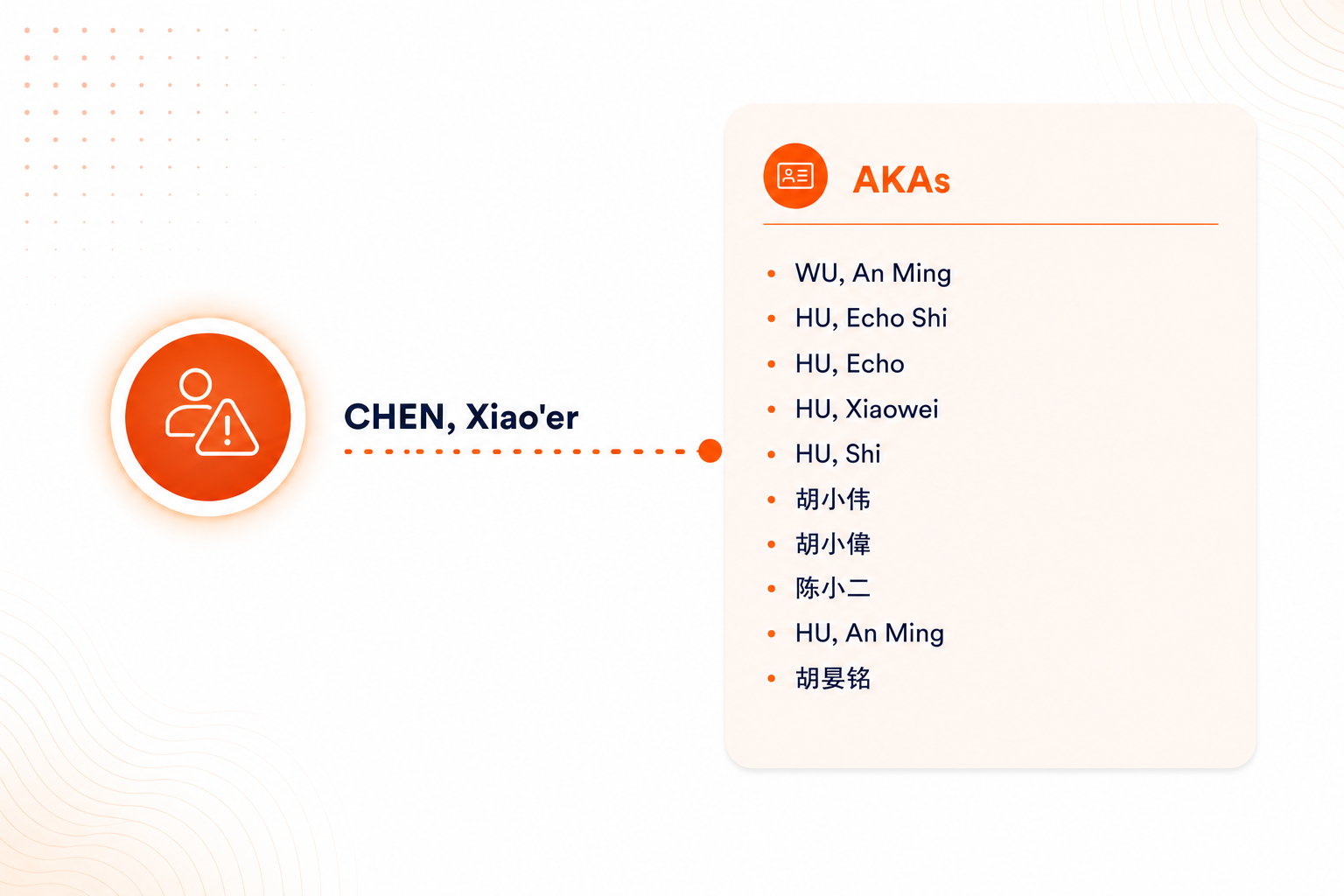
- Data enhancement: Kharon’s data includes enhanced identifiers, such as aliases, former names, addresses, and registration numbers to provide the most accurate and comprehensive coverage on entities majority owned by sanctioned actors.
Stay ahead of enforcement risks with deeper intelligence. Learn more about Kharon’s Sanctions 50-Plus and Control solutions.