
The Bureau of Industry and Security’s (BIS) 50% rule put a sharp spotlight on the affiliates of U.S.-blacklisted firms, which the rule would sweep under automatic export controls.
One aspect of the rule that got less attention: Affiliates-based compliance risks extend from U.S.-listed individuals as well as companies. That’s true even while BIS’s rule is now on pause.
BIS’s enforcement focus here concerns the risk of diversion, or the indirect routing of restricted items to restricted users. And BIS has increasingly used the Entity List to designate individuals linked to military, proliferation or illicit procurement activities, meaning that their majority-owned affiliates can pose comparable exposure.
As Kharon research shows, some of these individuals shuffle their corporate assets in a way that can blur those connections.
As it also shows, diversion risks tied to individuals not only can arise from an entity’s current owners or management but from closely linked former owners, whose influence may persist long after formal control has changed.
But a Kharon review of corporate records found that Avery transferred ownership of several of his companies to associates and family members before and after his BIS listing, including one shortly after the Affiliates Rule’s announcement. He continues to hold an interest in over a dozen other entities, across the aviation and financial services sectors.
The details:
One aspect of the rule that got less attention: Affiliates-based compliance risks extend from U.S.-listed individuals as well as companies. That’s true even while BIS’s rule is now on pause.
BIS’s enforcement focus here concerns the risk of diversion, or the indirect routing of restricted items to restricted users. And BIS has increasingly used the Entity List to designate individuals linked to military, proliferation or illicit procurement activities, meaning that their majority-owned affiliates can pose comparable exposure.
As Kharon research shows, some of these individuals shuffle their corporate assets in a way that can blur those connections.
As it also shows, diversion risks tied to individuals not only can arise from an entity’s current owners or management but from closely linked former owners, whose influence may persist long after formal control has changed.
Case No. 1: A British Businessman’s Transferred Ownership
BIS added PremiAir Aerospace Limited and its owner, the U.K. entrepreneur Graham Avery, to the Entity List in September 2020 for having been “involved in a scheme to illicitly procure Bell 412 helicopters on behalf of” an Iranian military end-user. Avery’s aviation-heavy portfolio had contained more than 15 companies in all, including a helicopter charter service whose website lists the BBC, SkyNews and Formula 1 among “who we work with.”But a Kharon review of corporate records found that Avery transferred ownership of several of his companies to associates and family members before and after his BIS listing, including one shortly after the Affiliates Rule’s announcement. He continues to hold an interest in over a dozen other entities, across the aviation and financial services sectors.
The details:
- Avery transferred ownership in February 2020 of GMCL 2000 Limited to Alan Peter Howard, a board member and the finance director of PremiAir Aviation International, an aviation charter, management, and sales firm that Avery still majority-owns. This transfer occurred six days after Avery filed a civil claim surrounding the funds and helicopter that the U.S. seized in connection with the alleged procurement scheme. (Avery denied any knowledge of such a scheme.)
- Several of Avery’s share transfers after his listing by BIS went to Michelle Bloomfield (née Avery), whom social media posts identify as his daughter. According to U.K. corporate records, Avery transferred full ownership of Orcas Properties to Bloomfield in 2022, followed by Jetmore Developments and P.C.C. Int’l in 2024. Avery also transferred ownership of a fourth firm, now named QFFA Ltd., in 2023 to a company that Bloomfield wholly owned.
- This fall, the corporate reshuffling kicked back into motion. On Oct. 1, two days after the Affiliates Rule’s announcement, Avery transferred his full ownership of The Pine Estate Management into a 50/50 ownership arrangement between Bloomfield and another close associate.
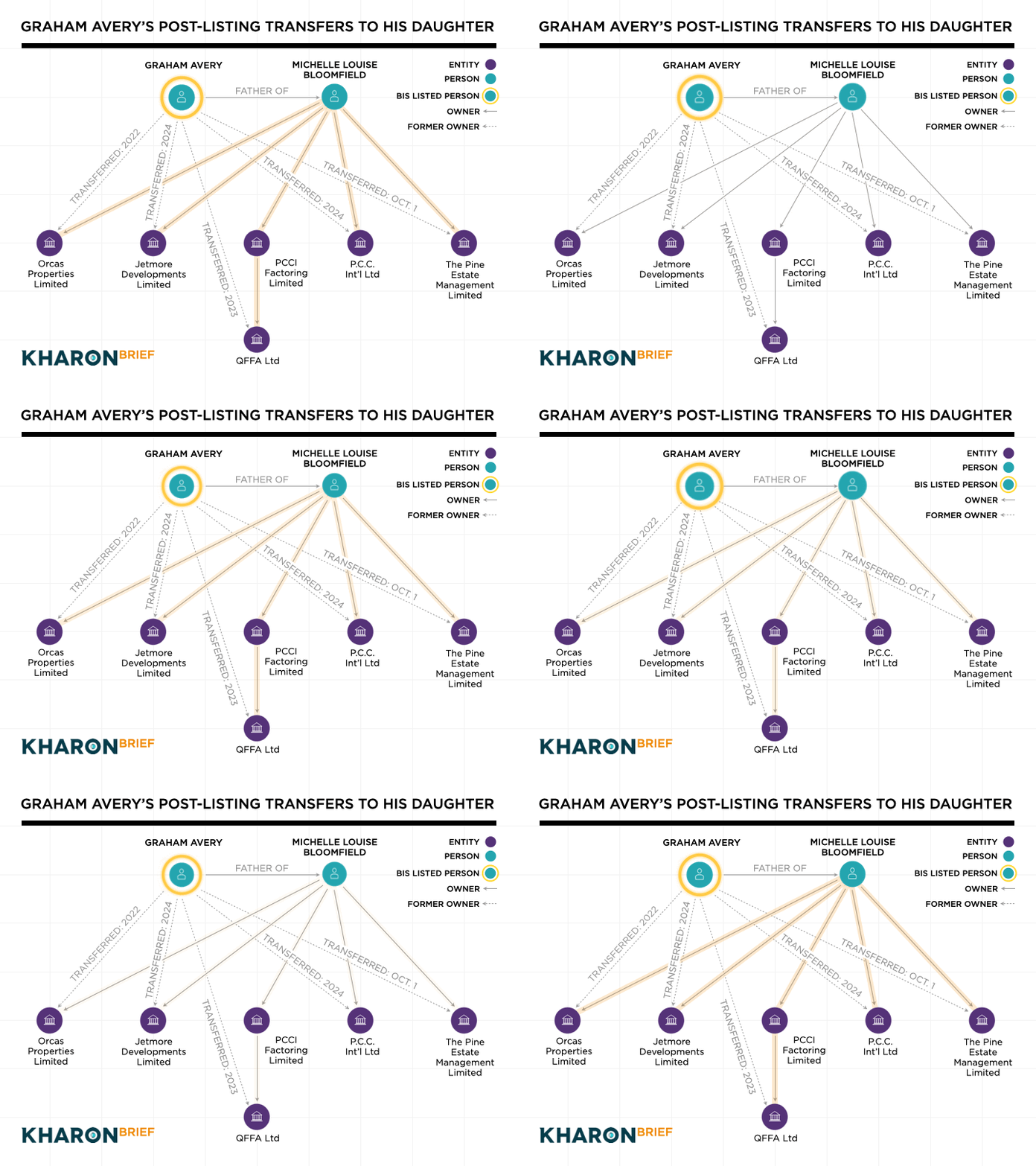
Kharon analysis: Avery’s close proximity to the new owners of his former firms adds the kind of extra layer of complexity that counterparties must factor into their risk assessments.
BIS’s Entity List FAQs make clear that if a company “acts as an agent, a front, or a shell company for the listed entity in order to facilitate transactions that would not otherwise be permissible with the listed entity,” that would likely trigger a violation of U.S. export controls. BIS also encourages exporters and financial institutions to apply heightened due diligence to ensure restricted exports “are not ultimately destined for the listed entity.”
The pattern of transferring ownership to family members or close associates, while maintaining shared addresses and overlapping functions, illustrates one way that BIS-listed persons can retain influence over corporate networks, creating the kind of opaque structures that U.S. regulators view as high risk for diversion.
That risk of indirect influence underscores why BIS in the Affiliates Rule emphasizes looking beyond listed names to the broader network of ownership.
One of them, Kharon found, was established just one week after Beijing E-Science was Entity Listed.
The details:
BIS’s Entity List FAQs make clear that if a company “acts as an agent, a front, or a shell company for the listed entity in order to facilitate transactions that would not otherwise be permissible with the listed entity,” that would likely trigger a violation of U.S. export controls. BIS also encourages exporters and financial institutions to apply heightened due diligence to ensure restricted exports “are not ultimately destined for the listed entity.”
The pattern of transferring ownership to family members or close associates, while maintaining shared addresses and overlapping functions, illustrates one way that BIS-listed persons can retain influence over corporate networks, creating the kind of opaque structures that U.S. regulators view as high risk for diversion.
That risk of indirect influence underscores why BIS in the Affiliates Rule emphasizes looking beyond listed names to the broader network of ownership.
Case No. 2: A Web of Military-tied Firms in China
BIS added Hong Kong-based Info Rank Technology, Beijing E-Science Co., Ltd. and E-Science manager Wingel Zhang to the Entity List in July 2021, for supplying restricted technology to parties sanctioned by the U.S. Treasury Department without the necessary licenses. But BIS did not list the companies’ owner, Minxian Kong, who has co-owned and managed several companies with Zhang.One of them, Kharon found, was established just one week after Beijing E-Science was Entity Listed.
The details:
- Kong is also E-Science’s board chairman, according to its disclosures and annual returns. He holds a majority interest in the company through his 80% ownership stake in its direct parent, Beijing Hileed Solutions Co., Ltd., which the U.S. has long blacklisted: The Treasury Department designated Hileed Solutions back in 2006 for supporting entities involved in Iran’s ballistic missile programs.
- Seven days after BIS added Beijing E-Science to the Entity List, Kong established a new firm, Microblox Technology (Beijing) Co., Ltd. The company appears to operate in a similar niche space to Beijing E-Science, specialized lab equipment and microfluidics, and shares the same Beijing address with both E-Science and sanctioned Hileed Solutions. Microblox’s Chinese corporate disclosures show that Kong wholly owns it and serves as its executive director, while Zhang holds a supervisory role.
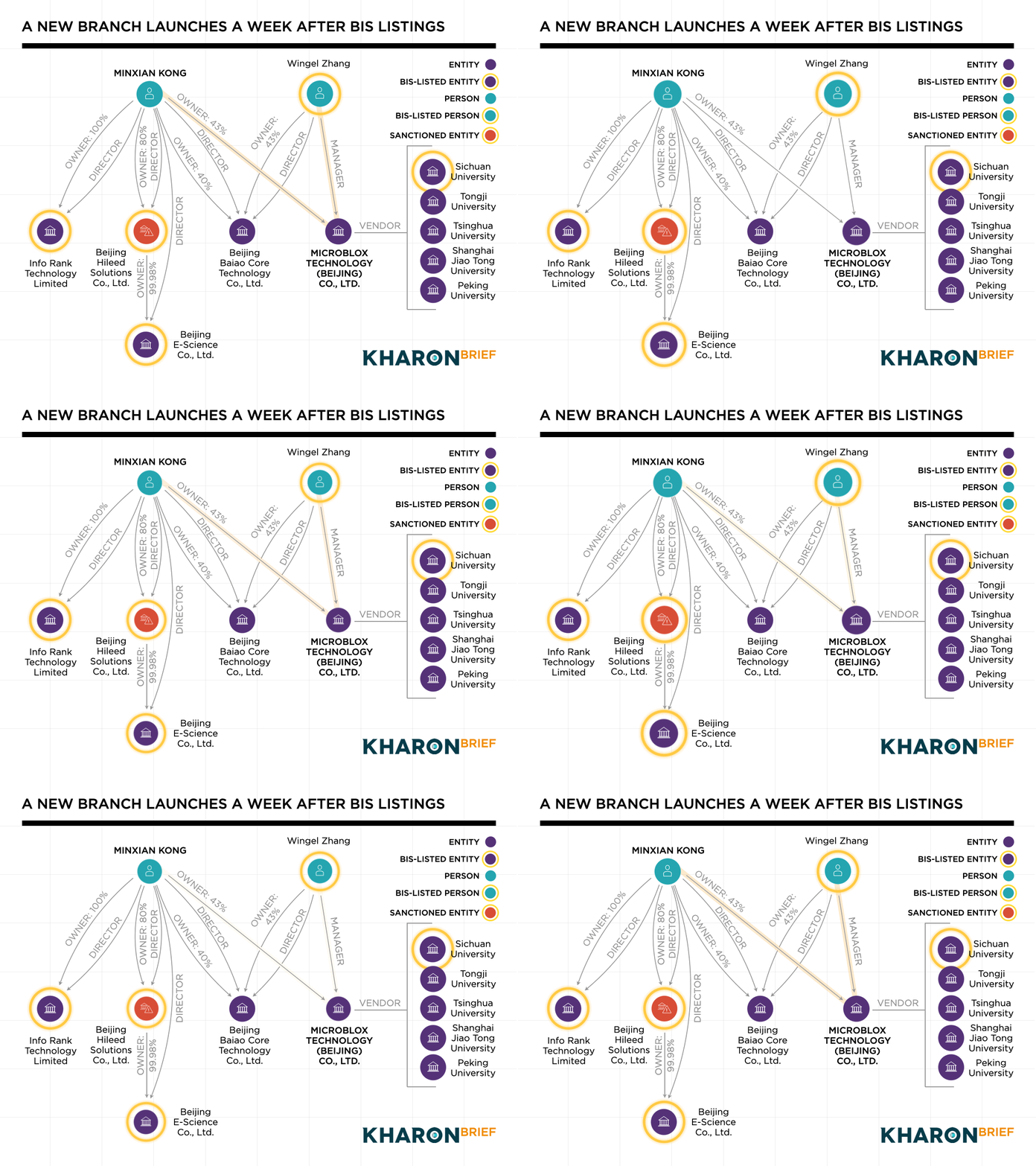
Yet despite its affiliations, Microblox has attracted commercial partnerships with Western companies. In August 2024, a German firm announced a distribution agreement with Microblox, which it called “a premier provider of comprehensive microfluidics laboratory solutions in China.”
Kharon analysis: Microblox’s ownership and management connections, combined with the timing of its founding, raise potential concerns that it could serve as a conduit for channeling U.S.-restricted items to blacklisted end-users.
It’s not the only company in its network that presents such risks, either. According to corporate disclosures, Zhang and Kong also hold the two largest ownership stakes in an additional non-listed firm at the same location: Beijing Baiao Core Technology Co., Ltd., which holds Chinese government patents related to chip fabrication technologies.
Kharon analysis: Microblox’s ownership and management connections, combined with the timing of its founding, raise potential concerns that it could serve as a conduit for channeling U.S.-restricted items to blacklisted end-users.
It’s not the only company in its network that presents such risks, either. According to corporate disclosures, Zhang and Kong also hold the two largest ownership stakes in an additional non-listed firm at the same location: Beijing Baiao Core Technology Co., Ltd., which holds Chinese government patents related to chip fabrication technologies.