

The Pentagon is reshaping how it buys weapons in an effort to repair fragile defense supply chains strained by labor shortages, aging factories and China's dominance in global manufacturing, a senior official said at an event in Washington this week.
Rather than spreading funding across short-term contracts, the Defense Department plans to make larger multiyear bets on critical production lines, from missile systems to hypersonic weapons, to stabilize demand and unlock private investment, said Michael Cadenazzi, assistant secretary of defense for industrial base policy.
“We’re accepting acquisition risk to lessen operational risk,” Cadenazzi said, speaking Tuesday at the Hudson Institute.
Cadenazzi, who joined the Pentagon in September after two decades in the private sector, delivered his remarks as the department implements its Acquisition Reform strategy, announced in November, as well as the 2026 National Defense Authorization Act (NDAA), the $901 billion bill that granted the Pentagon sweeping new authorities to rebuild the U.S. defense-industrial base.
“We spent billions on the DIB [defense industrial base] over the past decade,” Cadenazzi said. “The problems that existed 10, 15 years ago are sometimes worse. That’s a terrible investment.”
Big picture: China accounts for roughly 30% of global manufacturing output, compared with the United States’ 17%, and its shipbuilding capacity is roughly 200 times greater, Cadenazzi noted. The gap underscores the Trump administration’s push to reshore or “near-shore” manufacturing, including most prominently through tariffs, as it noted in December in its new National Security Strategy.
But that U.S. urgency comes as the defense industry’s workforce remains under pressure. Keith DeVries, then the managing director of manufacturing technology for the Office of the Secretary of Defense, said in September 2023 that there were more than 800,000 open jobs in U.S. manufacturing, with projections of a four-million-job shortfall over the next decade. Cadenazzi cited both numbers again Tuesday.
The problem, as he later cast it in conversation with Hudson Institute senior fellow Nadia Schadlow, isn’t just recruitment—it’s challenging cultural expectations.
“Twenty-five years ago, they said, ‘You got to go to college,’” Cadenazzi said. “What we need to do is convince those parents that they need to go ahead and convince that kid that [a manufacturing career] is a good thing for them.”
It would take, he said, “an all-American effort to go ahead and drive a fundamental transformation in how we view defense production.”
Why it matters: China’s manufacturing output “allows them to go ahead and scale production and delivery, not just in the naval domain but across multiple domains,” Cadenazzi said.
“We need some radically different outcomes, and that means we need some radically different approaches.”
“The key element here is the demand signal,” he said. “Why would anyone bet on this if funding goes up one year and down the next?”
Zoom in: That’s a strategy the new NDAA empowers, as the White House touted before its passage.
Rather than spreading funding across short-term contracts, the Defense Department plans to make larger multiyear bets on critical production lines, from missile systems to hypersonic weapons, to stabilize demand and unlock private investment, said Michael Cadenazzi, assistant secretary of defense for industrial base policy.
“We’re accepting acquisition risk to lessen operational risk,” Cadenazzi said, speaking Tuesday at the Hudson Institute.
Cadenazzi, who joined the Pentagon in September after two decades in the private sector, delivered his remarks as the department implements its Acquisition Reform strategy, announced in November, as well as the 2026 National Defense Authorization Act (NDAA), the $901 billion bill that granted the Pentagon sweeping new authorities to rebuild the U.S. defense-industrial base.
Critical U.S. Manufacturing Gaps
Government Accountability Office reports reflect some of that base’s yearslong shortfalls: how Army vehicles have consistently missed readiness targets, Army ammunition has gone untracked and F-35 fighter jets have been delivered on average 238 days late.“We spent billions on the DIB [defense industrial base] over the past decade,” Cadenazzi said. “The problems that existed 10, 15 years ago are sometimes worse. That’s a terrible investment.”
Big picture: China accounts for roughly 30% of global manufacturing output, compared with the United States’ 17%, and its shipbuilding capacity is roughly 200 times greater, Cadenazzi noted. The gap underscores the Trump administration’s push to reshore or “near-shore” manufacturing, including most prominently through tariffs, as it noted in December in its new National Security Strategy.
But that U.S. urgency comes as the defense industry’s workforce remains under pressure. Keith DeVries, then the managing director of manufacturing technology for the Office of the Secretary of Defense, said in September 2023 that there were more than 800,000 open jobs in U.S. manufacturing, with projections of a four-million-job shortfall over the next decade. Cadenazzi cited both numbers again Tuesday.
The problem, as he later cast it in conversation with Hudson Institute senior fellow Nadia Schadlow, isn’t just recruitment—it’s challenging cultural expectations.
“Twenty-five years ago, they said, ‘You got to go to college,’” Cadenazzi said. “What we need to do is convince those parents that they need to go ahead and convince that kid that [a manufacturing career] is a good thing for them.”
It would take, he said, “an all-American effort to go ahead and drive a fundamental transformation in how we view defense production.”
Why it matters: China’s manufacturing output “allows them to go ahead and scale production and delivery, not just in the naval domain but across multiple domains,” Cadenazzi said.
“We need some radically different outcomes, and that means we need some radically different approaches.”
Multiyear Contracts, More Targeted Bets
One such approach is rethinking how the Pentagon buys weapons, by accepting greater upfront commitments to secure faster, more reliable deliveries. Central to the strategy, Cadenazzi said, is stabilizing defense supply chains by inking contracts that last five to seven years, designed to reduce the unpredictability that can discourage private investment.“The key element here is the demand signal,” he said. “Why would anyone bet on this if funding goes up one year and down the next?”
Zoom in: That’s a strategy the new NDAA empowers, as the White House touted before its passage.
- Section 804, for example, authorizes multi-year contracts beginning in fiscal 2026 for major weapons systems and munitions. That approach supplants traditional annual contracting cycles, “providing the certainty needed to expand industrial capacity and delivering cost savings for the taxpayer,” the White House said in December.
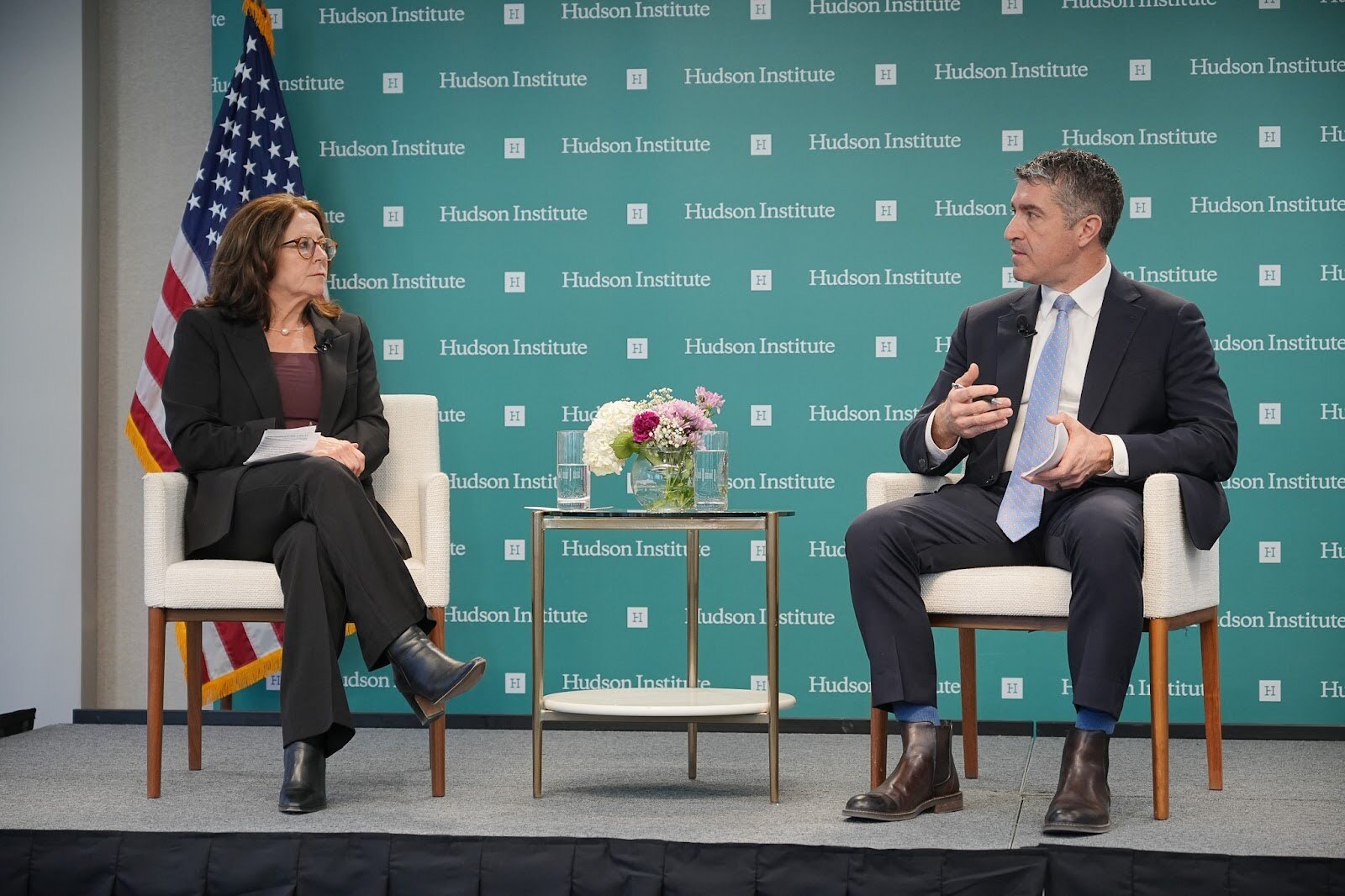
Michael Cadenazzi, assistant secretary of defense for industrial base policy, speaks Tuesday with Nadia Schadlow, a senior fellow at the Hudson Institute. (Courtesy of the Hudson Institute)
Focal points: Rather than spreading limited funds across many projects—a practice that Cadenazzi said produced little lasting impact—the Defense Department will concentrate on larger, longer-term investments in priority supply chains, including solid rocket motors, critical minerals and batteries. It also is aiming, he said, to fix the “fragility” of the energetics industrial base, which produces, among others, the chemicals used in explosives and propellants.
“We used to put five million dollars down when we really needed 55,” Cadenazzi said. “We’re peanut-butter-spreading less and focusing on fewer, bigger wins.”
“This year, we are intensifying our analysis under our Section 805 authorities, targeting companies that do business with 1260H-listed entities,” Cadenazzi said. “We urge all defense firms to assess these relationships internally and get ahead of potential risks.”
Read more from The Brief:
“We used to put five million dollars down when we really needed 55,” Cadenazzi said. “We’re peanut-butter-spreading less and focusing on fewer, bigger wins.”
Screening Foreign Investment
Beyond production capacity, he said his office is closely monitoring foreign capital flows into the defense sector, particularly from China.- For context: The new NDAA codified a Trump-backed expansion of the U.S. outbound investment rule, adding additional “countries of concern” and broadening the list of national-security-related transactions it covers.
“This year, we are intensifying our analysis under our Section 805 authorities, targeting companies that do business with 1260H-listed entities,” Cadenazzi said. “We urge all defense firms to assess these relationships internally and get ahead of potential risks.”
Read more from The Brief:
- 2026 NDAA Fortifies Outbound Investment Rule, Fentanyl Enforcement, China Lists
- White House’s 2025 National Security Strategy Puts Supply Chains on the Front Lines
- Hypersonic Secret: ‘China’s MIT’ Worked with U.S. while Developing Weapons to Use Against It
- ‘The Robot Dog’s Time to Kill’: At China’s Star Robotics Firm, the Military Ties Keep Mounting