Update, 4/23/26: The U.S. Treasury Department on Thursday sanctioned a number of Cambodian individuals and entities detailed in this story, including senator Kok An, businessman Rithy Raksmei, and Raksmei’s casino-owning K99 Group. Treasury described Kok An as a scam center “kingpin” whose network had “stolen millions of dollars from U.S. victims while operating under the protection of Kok An and his political connections.”
This story was previously updated earlier this month to reflect that China had repatriated Li Xiong, a businessman whom this story connected to Huione Group and the Cambodian government, for serving as a “core member” of the “Chen Zhi criminal network.”
Read The Brief’s original story, published Jan. 15, below.
The U.S., U.K. and South Korea are ramping up action against the criminal networks behind a wave of cyberscams that have drained more than $60 billion from victims around the world since 2020. And Congress is naming names.
The Dismantle Foreign Scam Syndicates Act, which was introduced in September and passed the House Foreign Affairs Committee last month, identifies 32 individuals and 11 entities for mandatory sanctions review over their alleged roles in Southeast Asian “pig-butchering” scams.
But he’s far from the only power player implicated.
This story was previously updated earlier this month to reflect that China had repatriated Li Xiong, a businessman whom this story connected to Huione Group and the Cambodian government, for serving as a “core member” of the “Chen Zhi criminal network.”
Read The Brief’s original story, published Jan. 15, below.
The U.S., U.K. and South Korea are ramping up action against the criminal networks behind a wave of cyberscams that have drained more than $60 billion from victims around the world since 2020. And Congress is naming names.
The Dismantle Foreign Scam Syndicates Act, which was introduced in September and passed the House Foreign Affairs Committee last month, identifies 32 individuals and 11 entities for mandatory sanctions review over their alleged roles in Southeast Asian “pig-butchering” scams.
- That term is Chinese criminal slang, describing how scammers build fake relationships over weeks or months before persuading victims to invest in fraudulent cryptocurrency platforms. Victims are emotionally “fattened” and then financially “slaughtered,” often losing their life savings.
- The House bill describes these operations as “joint ventures between Chinese criminal organizations and autocratic governments” in Southeast Asian countries where, it says, “transparency is absent and rule of law is anemic.”
But he’s far from the only power player implicated.
Tracing the family, corporate and physical ties of those named in the House bill, a Kharon investigation shows how Cambodia’s cyberscam apparatus weaves together the country’s political elite, casino operators and Chinese criminal partners.
A Cambodian senator, he controls at least 11 companies spanning real estate, finance and utilities, according to Ministry of Commerce records. One of his companies, Anco Brothers Co., Ltd., owns at least three casinos in Cambodia—two along the Vietnam border and one along the Thailand border—under licenses issued in 2022 and reviewed by Kharon. Cambodian casinos have emerged as hubs for pig-butchering schemes because they provide scam centers, which often operate nearby, with an avenue to launder their illicit proceeds.
Cambodia’s Casino Senator
Kok An, one of the 25 individuals named in the bill who has not been targeted by sanctions, operates at the nexus of political power and the infrastructure that pig-butchering scams commonly rely on.A Cambodian senator, he controls at least 11 companies spanning real estate, finance and utilities, according to Ministry of Commerce records. One of his companies, Anco Brothers Co., Ltd., owns at least three casinos in Cambodia—two along the Vietnam border and one along the Thailand border—under licenses issued in 2022 and reviewed by Kharon. Cambodian casinos have emerged as hubs for pig-butchering schemes because they provide scam centers, which often operate nearby, with an avenue to launder their illicit proceeds.
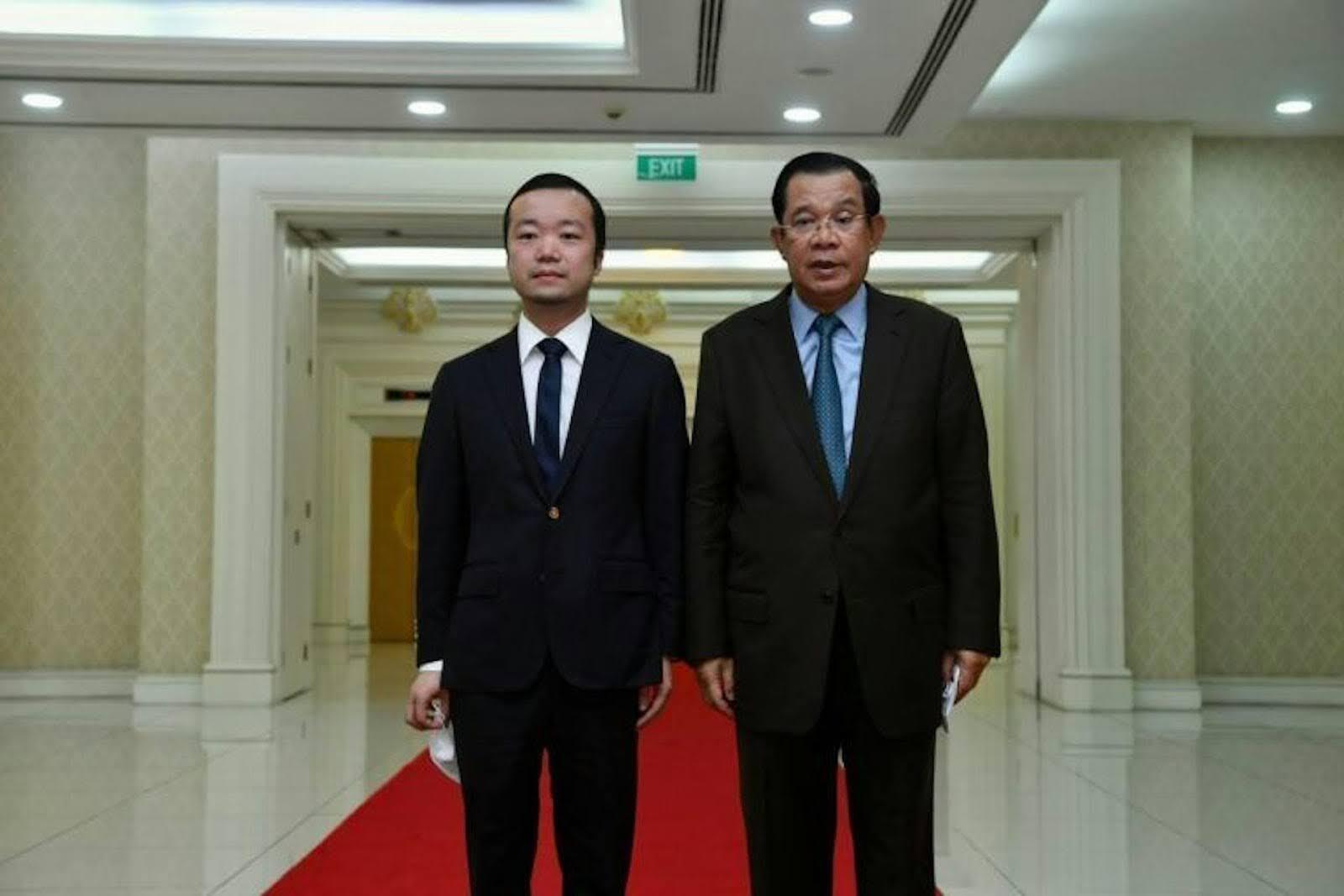
Then-Prime Minister Hun Sen, right, meets with Prince Group Chairman Chen Zhi and a delegation of Chinese enterprises in 2022. Others named in the U.S. bill also connect to the Huns and to Chinese interests. (Prince Group)
Thai authorities have increasingly zeroed in on Kok’s activities, including by investigating human-trafficking cases at his Cambodia-Thailand border casino complex. In July they issued a warrant alleging that he had facilitated cyberscam activity spanning both countries, and in December they confiscated some of his properties.
- Cambodian authorities had first linked Kok’s casinos to criminal operations a decade ago, arresting more than 100 Chinese nationals accused of operating extortion scams out of one of them.
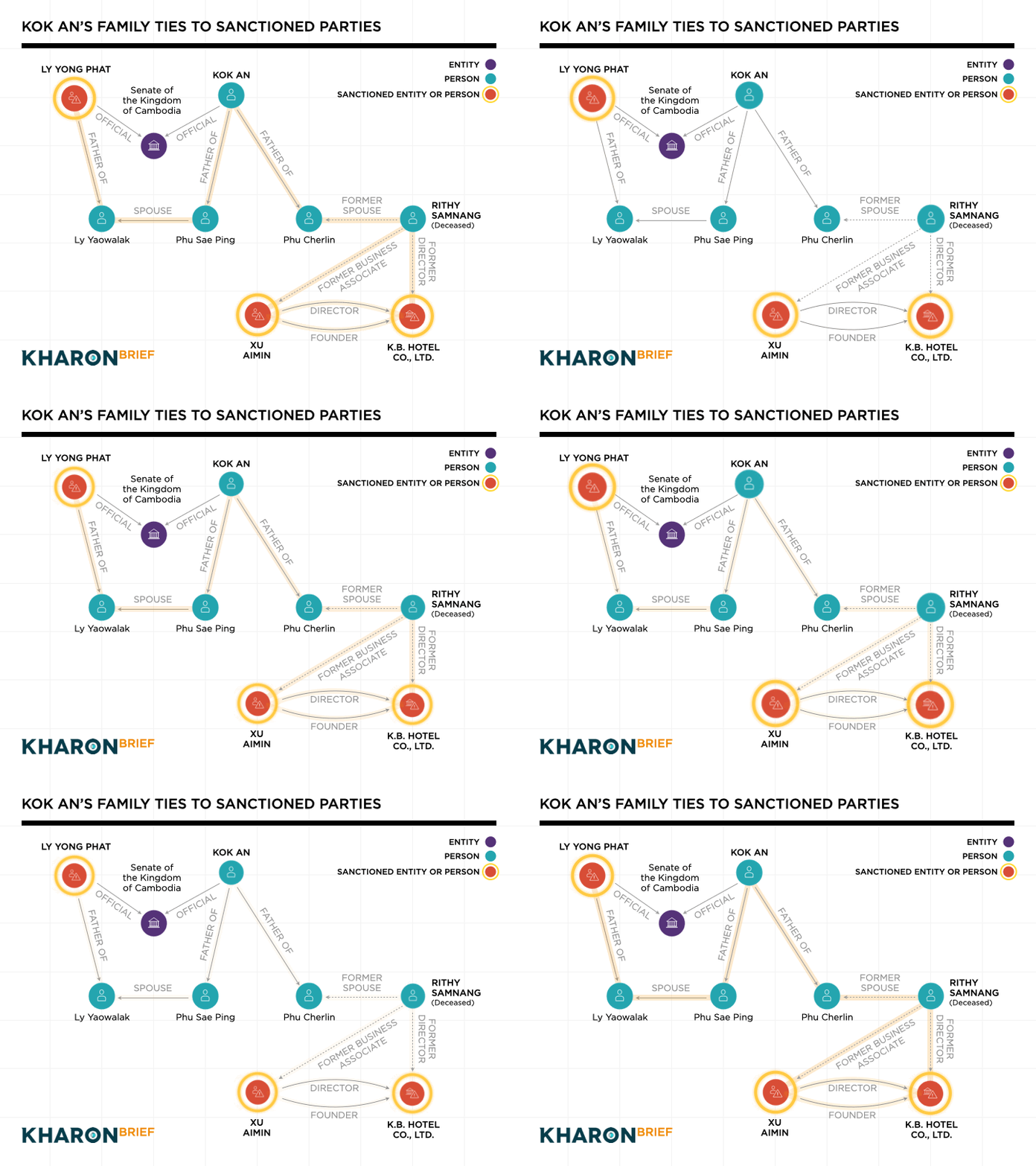
- One of Kok’s daughters married the son of prominent Cambodian businessman Ly Yong Phat, a fellow senator and a longtime ally of Cambodia’s ruling Hun family. The U.S. sanctioned Ly Yong Phat in 2024 for his role in “serious human rights abuse related to the treatment of trafficked workers subjected to forced labor in online scam centers.”
- Another of Kok’s daughters married Rithy Samnang. Before his death in 2022, Rithy served as the chair of K.B. Hotel Co. Ltd. and as a director at two other companies where Kok also held director positions. The U.K. and U.S. sanctioned K.B. Hotel in 2023 and in September, respectively, for its role in facilitating transnational scam operations using forced labor. In that same designation, the Treasury Department also sanctioned K.B. Hotel co-founder Xu Aimin, who previously was sentenced to a 10-year prison term in China for operating a billion-dollar online gambling ring.
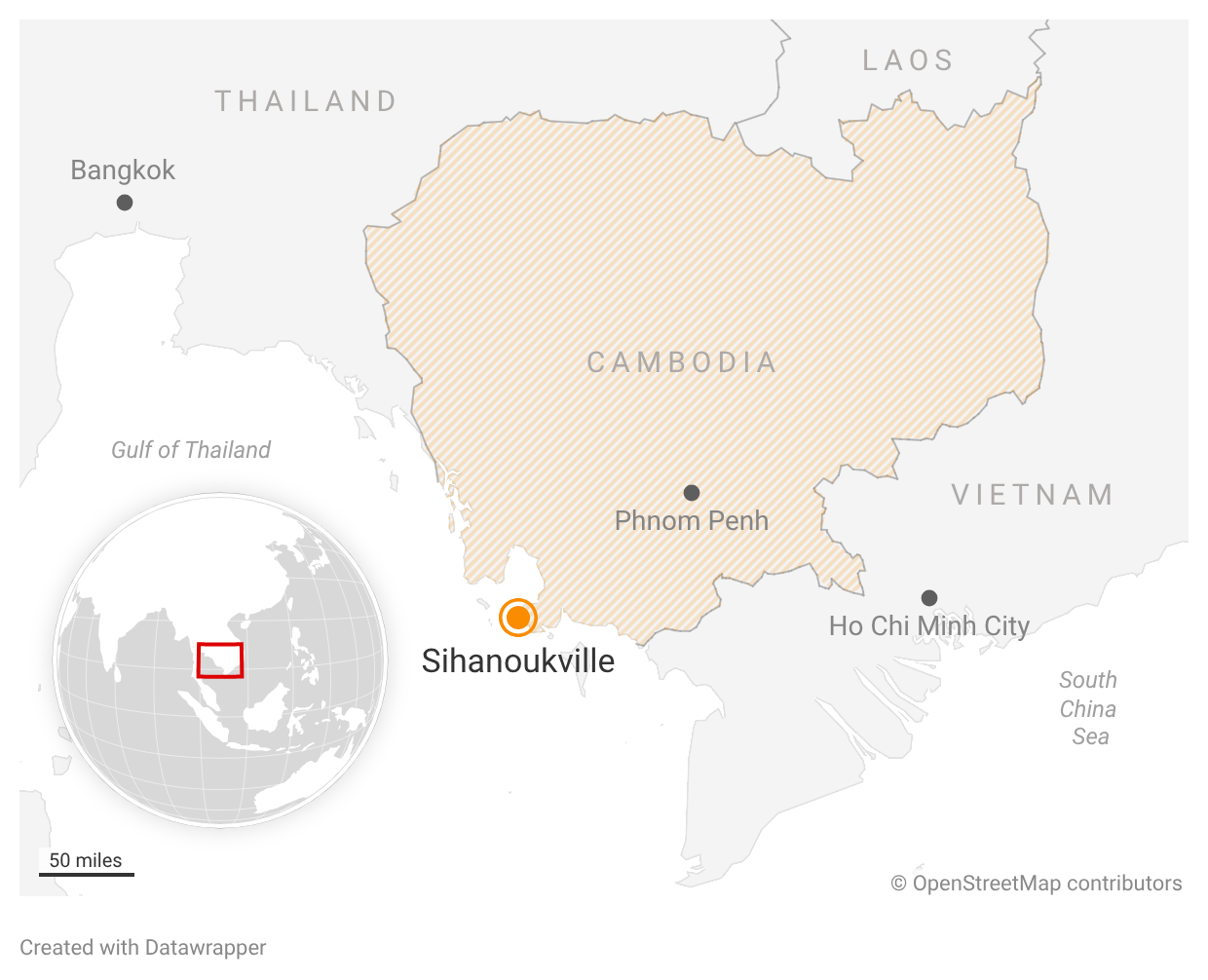
Key location: K.B. Hotel is in Sihanoukville, a beach town that has become a hot spot for online scam operations. Since China launched the Belt and Road Initiative in 2013, the Chinese government vowed to build Sihanoukville, a deep-water port, into a “model of practical China-Cambodia cooperation,” attracting massive Chinese investment.
K99 Group owns Xing Tian Di Casino, which sits directly next to T.C. Capital Co., Ltd. (also known as Golden Sun Sky Casino and Hotel), another cyberscam compound hit with U.S. and U.K. sanctions. The properties are clustered within a half-mile of K.B. Hotel, along Otres Beach.
A Beachfront Scam Corridor
Rithy Raksmei, brother of the late Rithy Samnang and another name listed in the congressional bill, chairs the Sihanoukville-based K99 Group, which the bill names as well. K99 Group describes itself as an investor in media, hotels, casinos and real estate; ProPublica reporting in 2022 tied it to compounds running cyberscams similar to those perpetrated at K.B. Hotel.K99 Group owns Xing Tian Di Casino, which sits directly next to T.C. Capital Co., Ltd. (also known as Golden Sun Sky Casino and Hotel), another cyberscam compound hit with U.S. and U.K. sanctions. The properties are clustered within a half-mile of K.B. Hotel, along Otres Beach.
- Of note: T.C. Capital’s founder, the real estate investor Dong Lecheng, was convicted of money laundering in China before he moved to Cambodia, Treasury said in sanctioning him in September. According to Chinese state media, Dong once served as a member of an advisory body to the Chinese Communist Party.
The company has close ties to Cambodia’s government, including a formal cooperation agreement with its Ministry of Defense aimed at “promoting Cambodia’s national image and attracting foreign investors.”
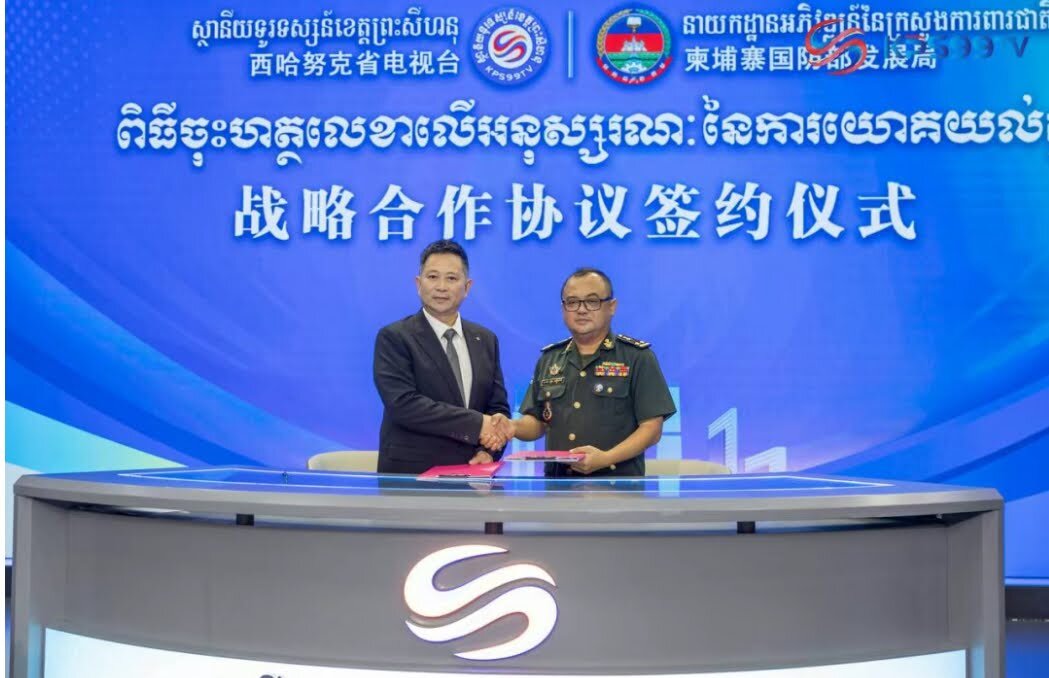
Liu Xiao, station manager of KPS99 Media Television, shakes hands with a Cambodian Ministry of Defense official at a signing ceremony Oct. 1. (KPS99)
As an apparent part of those promotional efforts, KPS99 Media has downplayed scam-compound allegations in the region. Last month, for instance, the outlet published a story celebrating Cambodia-based crypto platform Huione Pay’s return to operations under the headline “Good News.” The broader Huione Group conglomerate has come under international scrutiny since the House bill highlighted it in September, too.
Businessmen Li Xiong and Hun To, a cousin of Prime Minister Hun Manet and a nephew of former long-ruling leader Hun Sen, both serve as directors of Huione Pay and Huione Life Insurance, according to corporate filings. (Neither has been targeted by sanctions.)
- In October, the U.S. Treasury Department cut Huione Group off from the U.S. financial system for laundering billions of dollars on behalf of virtual currency scammers and “malicious cyber actors.”
- South Korea followed in December by sanctioning four Huione entities, including Huione Pay, for facilitating “money laundering for transnational criminal organizations such as the Prince Group.”
The Huione Connections
Two last men named in the bill have direct, overlapping ties to Huione’s corporate structure.Businessmen Li Xiong and Hun To, a cousin of Prime Minister Hun Manet and a nephew of former long-ruling leader Hun Sen, both serve as directors of Huione Pay and Huione Life Insurance, according to corporate filings. (Neither has been targeted by sanctions.)
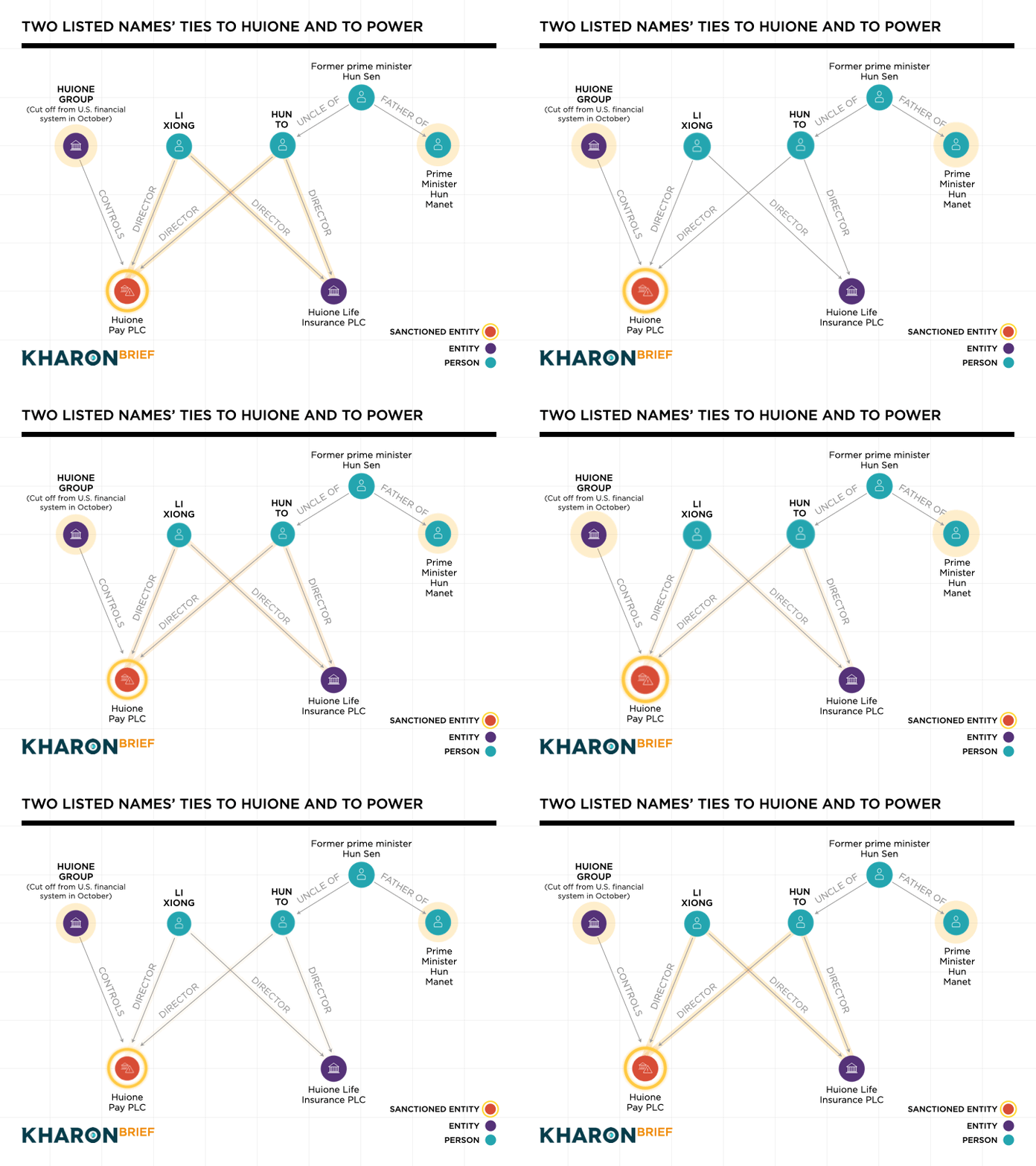
Hun To owns or directs at least 14 companies in all, spanning banks, real estate and logistics in Cambodia and Australia, corporate records reviewed by Kharon show. His political connections would make him an appealing ally for Chinese conglomerates and individuals seeking to establish footholds in Cambodia, which has a less restrictive business environment.
And corporate records indeed appear to reflect several such Chinese connections in his network.
And corporate records indeed appear to reflect several such Chinese connections in his network.
- While Cambodian filings list Li Xiong as a Cambodia resident, his business registration lists an address in mainland China.
- Hun To directs two businesses alongside former K.B. Hotel director Chen Al Len, with whom he previously directed Cambodia’s HH Bank. Treasury sanctioned both the bank and Chen, a Chinese-born businessman, in September—10 days before the House bill’s introduction—for supporting “cyber-enabled activities.”
- How Chinese Networks Are Using US Banks to Launder Drug Cartels’ Cash
- Supercharged by AI, Scammers in 2025 Became Crypto’s ‘Dominant Illicit-Finance Threat’
- The Cyberscam-Tied Cambodian Network That Treasury Just Cut Off from the US Financial System
- Hypersonic Secret: ‘China’s MIT’ Worked with U.S. while Developing Weapons to Use Against It