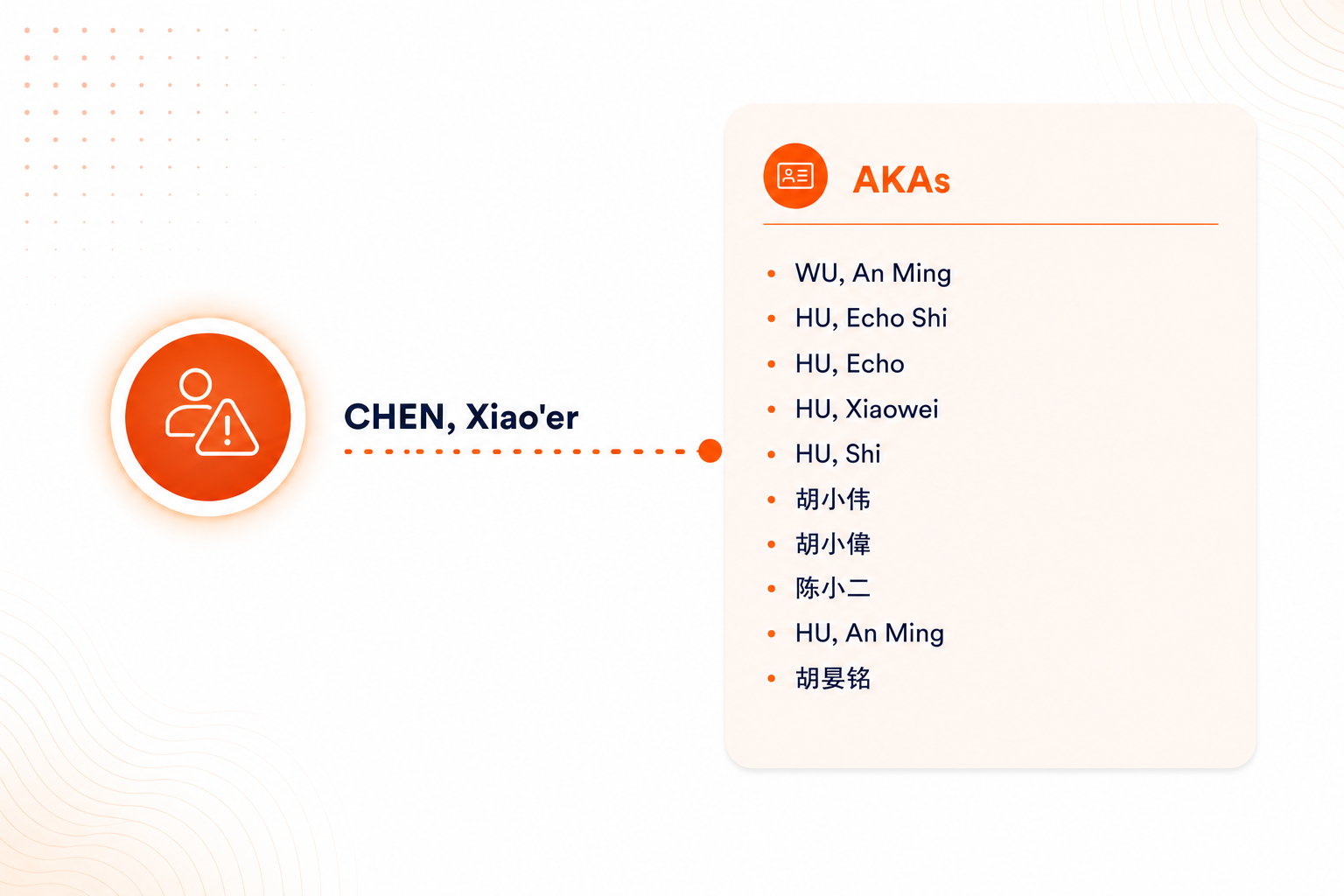
Kharon had connected those aliases in December 2025, six months prior to OFAC’s action. At the time, Kharon’s record on this individual already listed Hu Xiaowei alongside Chen Xiao’er, Wu An Ming, Hu Shi, Hu Echo, and the Chinese variants 胡小伟,, 陳小二, 胡晏銘.
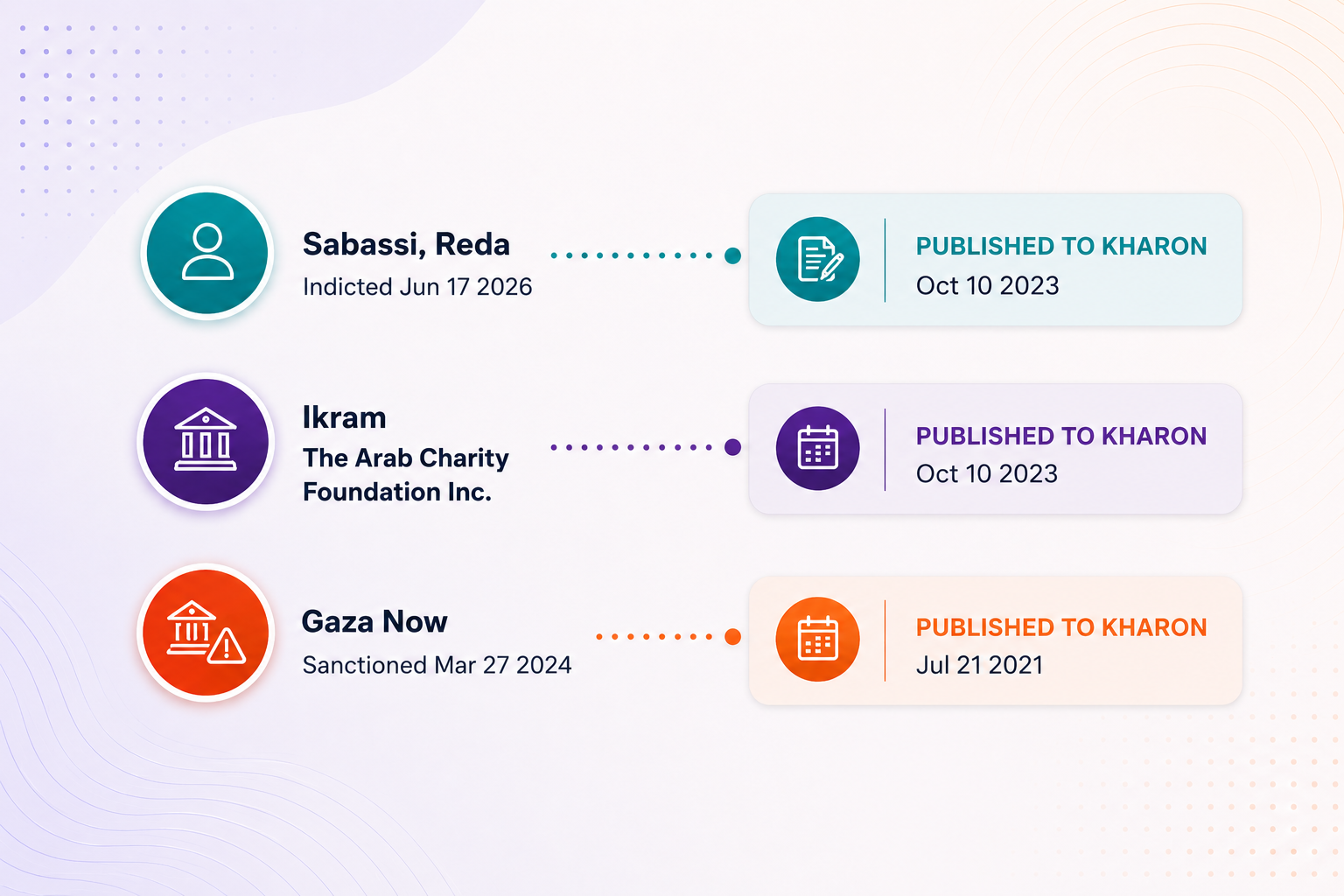
On October 14, 2025, the U.S. and U.K. first imposed sanctions targeting the vast Prince Group ecosystem. Within days, Kharon flagged Prince Foundation — the group's charitable arm, still undesignated — as blocked under OFAC's 50 Percent Rule via its ownership by Prince Holding Group. In October 2025, Kharon flagged Chen Bo for TCO exposure as a director of six designated Prince Group entities. In mid-December 2025, Kharon flagged five entities in Hu Xiaowei's Hong Kong and British Virgin Islands asset management cluster — including Future Wing Financial Company Limited, since renamed Denton Trust Limited — six months before OFAC directly designated those entities. Kharon flagged Cambodia-based CCU Commercial Bank PLC in December 2025, and Kong Ka On — via his connection to Hu Xiaowei — later that month.
Inside the Network
The Prince Group TCO runs scam compounds — Southeast Asia-based facilities where workers, often trafficked under false pretenses and held under debt bondage, are forced to scam victims around the world through digital asset investment fraud (“pig butchering”). A U.S. government estimate cited in OFAC’s June press release reported American losses to Southeast Asia-based scam operations to have been at least $10 billion in 2024. The Prince Group network owns and profits from the compounds and operates a worldwide money laundering apparatus, with criminal proceeds invested across real estate, aviation, financial services, and luxury cigars. In January 2026, Chen Zhi, the Prince Group leader, was stripped of his Cambodian citizenship and extradited to China.
The June 2026 OFAC action targets the layer just below Chen Zhi. Hu Xiaowei controls three British Virgin Islands holding companies — Eagle Fortitude Limited, Leisure Focus Limited, and Future King Inc. — and through Future King owns a Hong Kong financial cluster including China Reserve Securities Limited and Denton Trust Limited. All of these entities had been identified by Kharon as being part of the Prince Group network six months prior to the OFAC designations.
The U.S. Treasury said Future Wing received millions of dollars in funds assessed to have been derived from cryptocurrency investment scam victims. Hu Xiaowei’s Hong Kong-based subordinates Ho Ho Ming, Kong Ka On, and Li Hui — two of whom had also been previously identified by Kharon — run the corporate web. Chen Bo — the director of six Prince Group companies designated in October 2025 — is the majority owner of CCU Commercial Bank PLC, the Cambodian bank now under U.S. sanctions. Wind-down transactions involving the bank and its majority-owned subsidiaries are temporarily authorized under an OFAC-issued general license.
Kharon mapped the Prince Group network and its core alias chain using corporate filings, securities disclosures, website photos, social media videos, U.S. court documents, and more.
By cross-referencing three critical public records, Kharon linked Chen Xiao’er to the alias Wu An Ming:
April 2020: A corporate notice recording the director's name shift.
November 2025: An annual report confirming both identities.
December 2025: A filing with a partial passport matching OFAC data.
This analysis surfaced over 20 additional entities across six jurisdictions owned or controlled by Chen, many of which are now legally blocked under OFAC’s 50 Percent Rule.
What This Triggers
Following the June OFAC sanctions, U.S. banks and other institutions must confirm they are not dealing with any sanctioned person or entity, or with any entity those parties majority own. Those that have correspondent relationships with CCU Commercial Bank PLC need to wind down transactions by July 23, as outlined in the general license, and assess exposure. Crypto exchanges may have heightened exposure — Future Wing Financial reportedly received millions in scam-derived crypto funds, meaning on-chain flows touching this network may surface in many institutions’ historical wallet activity.
For institutions monitoring Prince Group through Kharon, none of that work begins from scratch. Kharon largely mapped the corporate network in October 2025 and flagged Chen Bo for TCO exposure in November. By December 2025, Kharon had also documented Hu Xiaowei's alias chain, flagged five entities in his Hong Kong and BVI asset management cluster, and added CCU Commercial Bank for TCO exposure. Kong Ka On followed in February 2026.
The Bigger Picture
The Prince Group isn't unique — it sits inside a Southeast Asia scam compound economy that continues to grow. Kharon continuously identifies the entities sustaining these networks: scam compound investors, money laundering vehicles, front-company architectures, and the alias chains that connect leaders to their offshore financial infrastructure. The next Prince Group is already in the data. The risk is in the relationships, not just the regulatory action.
Kharon continuously monitors the networks that matter — flagging exposure before it reaches your desk. Request a briefing to learn more today.