


Network intelligence
Continuous mapping of beneficial owners, shell companies, and financial intermediaries where sanctions exposure and global security threat actors can put your enterprise at risk

Industry Solutions
Proven at Scale
7 out of 10
Largest U.S. Banks
6 of the 10
Largest EU banks
35+
Fortune 100 companies
U.S. Treasury
Trusted by
The Problem
Regulators now expect banks to demonstrate OFAC compliance and financial crime compliance coverage well beyond official watchlists. Most screening infrastructure wasn't built for this.

01
Sanctions screening can generate an enormous volumes of false positives. Compliance teams are stretched thin clearing alerts that go nowhere — while genuine risk exposure can quietly go undetected.

02
The OFAC 50% Rule treats entities as blocked when they are owned, directly or indirectly, 50% or more in the aggregate by one or more blocked persons — even if the entity itself is not listed on the SDN List. Identifying them requires intelligent mapping of beneficial ownership across opaque jurisdictions and layered corporate structures.

03
Sanctioned actors operate through shell companies, complex ownership structures, crypto transfers, shadow fleet shipping networks and front organizations. Static screening can't track networks that continuously reinvent themselves and modify their operations.
The Kharon Approach
Kharon provides risk intelligence data - underpinned by network analysis and continuous monitoring - that helps banks identify, investigate, and manage actual sanctions and financial crimes risk — not just match names on a watchlist.
All research in the Kharon Core is led and verified by subject matter experts. Aliases are validated against source documents. Ownership linkages are sourced, documented, and traceable — giving compliance teams the defensible, auditable intelligence that regulators increasingly demand.
Continuous mapping of beneficial owners, shell companies, and financial intermediaries where sanctions exposure and global security threat actors can put your enterprise at risk

Analyst-led investigations and data sourcing create verified entity data, aliases validated, ownership linkages sourced

ClearView, GraphCast, CoreStream, and API as a connected ecosystem

Used operationally by U.S. Department of the Treasury, Department of Homeland Security, Customs and Border Protection, and dozens of other international government partners.
Compliance Workflows
 Screening
GraphCast delivers industry-leading data files that integrate directly into existing customer and transaction screening software — no rip-and-replace. Higher data accuracy reduces false positive volume.
 Investigation
GraphCast allows for risk detection in customer base and transaction activity. ClearView presents enriched entity profiles, risk indicators, and ownership data in a single, powerful tool for investigations and due diligence.
 Monitoring
CoreStream delivers tailored risk intelligence aligned to your areas of responsibility. ClearView enables precise and efficient analysis.
 Trade & Payments
In a 2024 proposed rule, the U.S. Treasury Department called for a fundamental shift in how AML/CFT program effectiveness is measured — away from rigid, low-value compliance processes and toward risk-based, outcome-driven practices that address the highest-priority national security threats. As FinCEN noted, too many compliance resources remain directed toward formulaic reviews of immaterial risk, while the practices that actually generate actionable intelligence are undervalued. Kharon enables this shift. High-quality open-source intelligence — the kind Treasury has identified as central to effective AML/CFT — is what Kharon delivers across transaction screening, transaction monitoring, and customer due diligence. GraphCast and ClearView give compliance teams the tools to redirect resources from low-value process toward detecting and reporting real exposure.
The Platform
Each tool is optimized for seamless integration within your workflow: from detection, to deep investigation, to operational screening, to automation at scale. Together, our technology allows teams to move fluidly from signal to understanding to action.
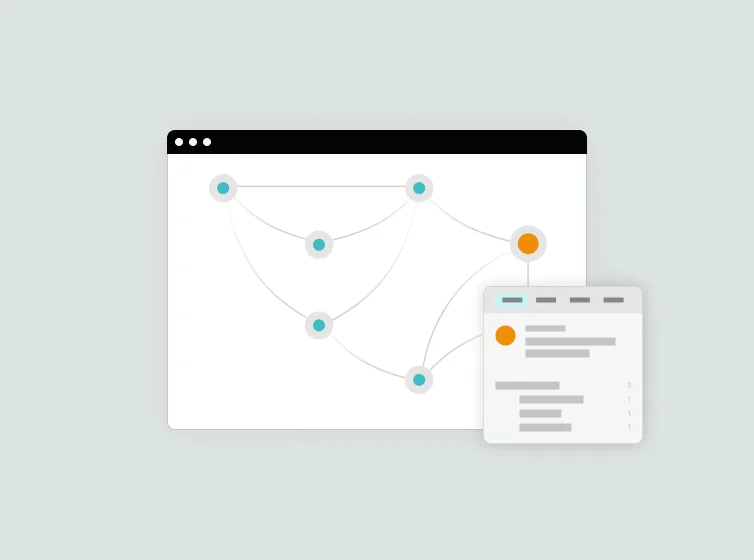
Kharon ClearView is an interactive tool for analyzing and visualizing complex entity relationships and associated risk at global scale, supporting the most demanding due diligence, KYC, and investigative workflows.
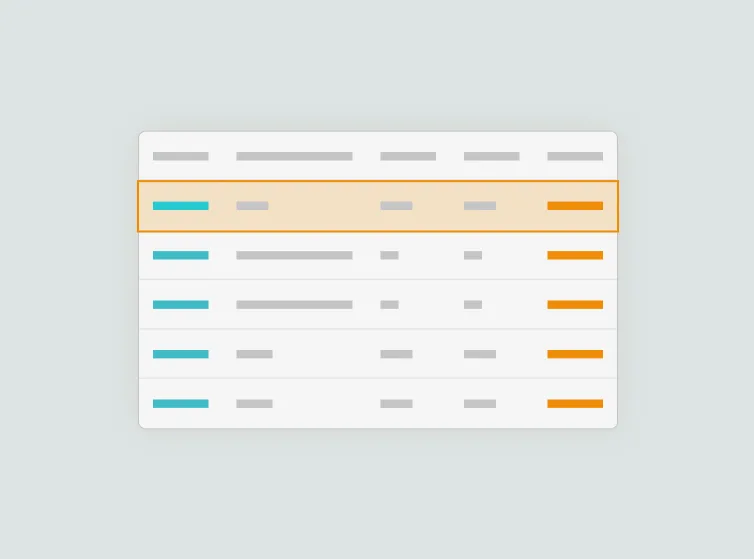
Kharon GraphCast provides curated, continuously maintained datasets aligned to specific risk typologies, including OFAC sanctions ownership and sanctioned securities, designed to power complex global screening and monitoring systems for sanctions, KYC and financial crimes compliance.
The Kharon API enables custom applications and workflows built directly on Kharon insights and risk scores, integrating seamlessly into internal systems to power analysis, automation, and decision-making at scale.
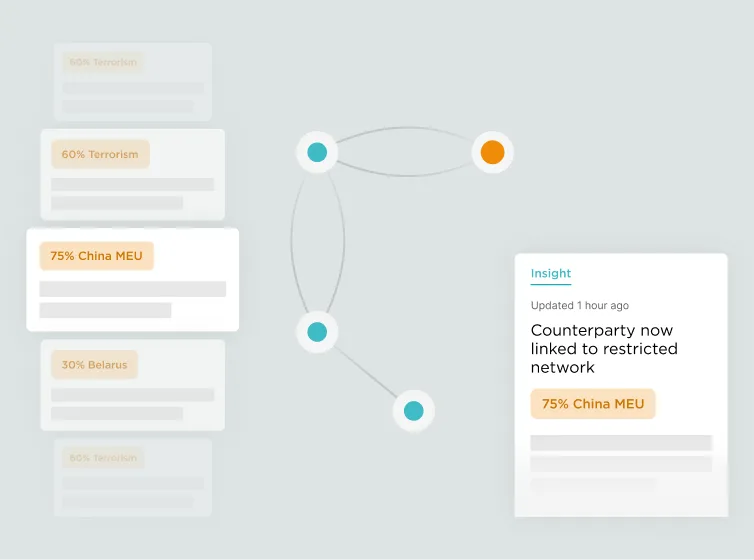
Kharon CoreStream turns fragmented global signals into continuous, personalized streams of insight, establishing a new standard for situational awareness in a complex world.
Solutions by Role

Kharon extends coverage past standard practice, building defensibility into your sanctions compliance program and daily operations. When regulators ask what intelligence your program relies on, Kharon is a name they recognize and trust.

High-quality risk data via GraphCast or the Kharon API reduces false positive volume. ClearView consolidates investigation work. Your team resolves alerts and investigations faster, and reclaims capacity consumed by fragmented tooling.

Consolidated entity profiles and network visualization in one interface. Cases that took days to complete in hours, with documentation detailed enough to pass review.

Simple, easy-to-use, web-based tools that streamline decisions, align with policies, and reduce risk to the enterprise.
FAQ
From compliance professionals evaluating sanctions intelligence solutions.
Sanctions screening in banking is the process of checking customers, counterparties, and transactions against government sanctions lists — including OFAC's SDN List, EU consolidated lists, and UN sanctions — to identify prohibited parties. Effective sanctions screening goes beyond name-matching to identify entities connected to sanctioned parties through ownership or control. Banks must screen across the customer lifecycle — at onboarding, during ongoing transactions, and as part of periodic KYC reviews.
The five pillars, per OFAC's Framework for Compliance Commitments: (1) Management Commitment, (2) Risk Assessment, (3) Internal Controls, (4) Testing and Auditing, and (5) Training. Kharon supports multiple pillars — providing the risk intelligence data that strengthens internal controls, enables testing and auditability, and elevates management reporting.
Any entity owned 50 percent or more, directly or indirectly, by one or more blocked persons is itself considered blocked property — even if that entity does not appear on OFAC's SDN List. This blocking obligation means banks cannot rely on watchlist matching alone. Banks must trace ownership structures across multiple corporate layers and jurisdictions to identify these unlisted but blocked entities.
Most GRC data providers aggregate watchlists, de-duplicate public ownership records, and/or scan media for negative news. The Kharon platform embodies subject matter expertise, using all sources of reliable, publicly available information to continuously map the networks surrounding sanctioned entities — beneficial owners, shell companies, logistics facilitators, financial intermediaries and more. Many never appear on any watchlist but represent material sanctions exposure. Kharon's data is sourced and verified by subject matter experts with backgrounds in intelligence, open source investigations, and financial regulation — not scraped or aggregated from public records.
Yes. Most institutions receive targeted data files via GraphCast that integrate directly into existing transaction and customer screening software — no rip-and-replace. The Kharon API enables customizable integration with screening engines and case management systems.
OFAC civil penalties can exceed $377,000 per violation under IEEPA (adjusted annually for inflation) or twice the transaction value. Criminal penalties include fines up to $1 million and imprisonment of up to 20 years. Recent enforcement actions have produced penalties in the billions, with individual cases involving major global banks drawing heightened regulatory scrutiny across multiple jurisdictions. Beyond direct penalties: reputational damage, loss of correspondent relationships, and increased scrutiny.
Sanctions screening checks customers and transactions against government-designated lists of prohibited parties. AML (anti-money laundering) screening is broader — it includes transaction monitoring, suspicious activity reporting, and risk-based customer due diligence designed to detect money laundering, terrorist financing, and other financial crimes. In practice, modern compliance programs require both — and the data infrastructure supporting them increasingly overlaps. Kharon provides intelligence that strengthens both sanctions screening accuracy and the investigative depth of AML programs.
Beneficial ownership screening is the process of identifying the true individuals who ultimately own or control a legal entity — especially when ownership is layered across multiple jurisdictions and corporate structures. It matters for sanctions compliance because OFAC's 50 Percent Rule requires banks to treat entities owned 50% or more by sanctioned parties as blocked — even when those entities appear on no watchlist. Without robust beneficial ownership screening, banks face material compliance gaps. Kharon maps beneficial ownership networks tied to sanctioned parties across opaque jurisdictions, tracing ownership chains that standard screening tools cannot resolve.
The Bank Secrecy Act (BSA) and its implementing regulations require banks to maintain anti-money laundering (AML) programs that include internal controls, independent testing, designated compliance officers, and ongoing employee training. Banks must also maintain OFAC sanctions screening programs alongside these BSA/AML obligations. Regulators — including FinCEN, the OCC, the FDIC, and state banking authorities — increasingly expect banks to demonstrate that their BSA/AML and sanctions compliance capabilities extend beyond basic list matching to include risk-based monitoring, network analysis, and evidence of ongoing due diligence. Kharon provides the data infrastructure that supports these expanded expectations.
Leading banks are integrating AI and advanced data analytics into sanctions compliance workflows — from reducing false positive volumes in screening to detecting complex evasion patterns across transaction networks. The most effective approaches combine machine learning with human expertise: technology surfaces anomalies and risk signals, while trained analysts validate findings and make decisions. Kharon's platform reflects this hybrid approach — human subject matter experts paired with proprietary technology ensure comprehensive, relevant, verified intelligence, where all data is readable by AI and LLM-powered systems to ground results in a reliable source of truth.
Key evaluation criteria include data quality and coverage, false positive rates, integration flexibility with existing screening infrastructure, update frequency for new designations and risk signals, and auditability — the ability to demonstrate your screening methodology to examiners. Banks should also assess whether a vendor's data extends beyond official watchlists to cover the ownership networks, shell companies, and financial intermediaries that sanctioned actors use to evade detection. The strongest sanctions screening software integrates continuously maintained, human-verified intelligence directly into existing compliance workflows.
Get Started
Talk to our team about your screening infrastructure, coverage gaps, and compliance priorities — and see how Kharon's data and technology can strengthen what you've already built.