
Publicly listed on both the Hong Kong and Shanghai stock exchanges, Andre Juice ranks among China’s three largest producers and exporters of apple juice concentrate, an ingredient used across beverages, baked goods, candies, and dairy products. The company’s annual reports as recently as 2023 had named large Western multinational brands among its principal customers; exports still accounted for about 70% of its core business revenue last year.
But as Andre Juice has expanded into China’s Xinjiang region, a Kharon review found, its supply chain has shown increasing red flags under the Uyghur Forced Labor Prevention Act.
Why that matters: Under the UFLPA, goods produced wholly or in part in Xinjiang are presumed to have been made with forced labor and are barred from U.S. import unless an importer can provide clear and convincing evidence to rebut that presumption.
An expanding business and expanding risks
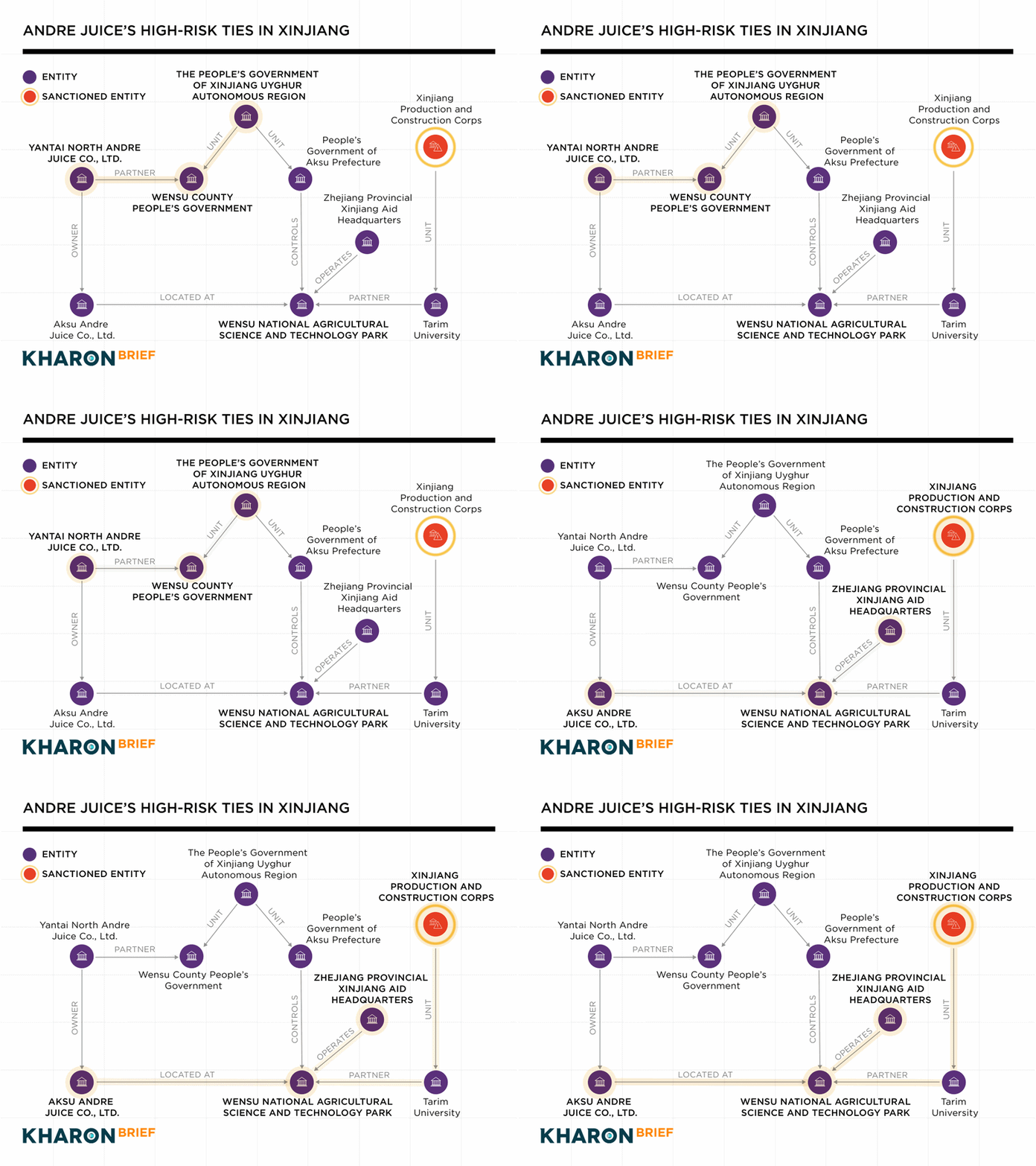
In April 2023, Andre Juice established a wholly owned subsidiary, Aksu Andre Juice Co., Ltd., at Xinjiang’s Wensu National Agricultural Science and Technology Park, taking over an existing juice-processing facility. The company framed the move as a response to the “national call to support Xinjiang’s development,” saying the deal would “benefit the long-term development of the company and its subsidiaries.”Andre Juice’s Xinjiang commitment then deepened that November, when it signed a 150 million yuan ($21 million) investment contract with the Wensu County government to build a concentrated-juice production line there.
Those bets appear to have paid off quickly. Within just over two years, Aksu Andre Juice was shipping to “markets across Europe and the Americas” and generating $40 million in annual export revenue, according to a report in January from a state-run newspaper.
But the expansion also rooted the company in a region that U.S. regulators flag for forced labor risk. Corporate filings, state media, and government records raise warning signs on two fronts.
Risk category #1: A location built on “poverty alleviation” and tied to sanctioned entities.
The Wensu park was established in 2016, under Xinjiang government control, as an officially designated “poverty alleviation industrial project.” State media reported in 2020 that the park planned to recruit “nearly 3,000 local workers” to the site.
- Red flags: Initiatives associated with forced labor practices in the Xinjiang region have consistently employed the same euphemisms across government notices, corporate filings, procurement records, and state media reports. References to “poverty alleviation” programs have been a common one — though the term has been supplanted more recently by a sunnier emphasis on “economic revitalization.”
- Red flags: Xinjiang Aid and the XPCC both are associated with significant forced labor risk exposure under U.S. enforcement frameworks. The Treasury Department sanctioned the XPCC in 2020 for its “connection to serious human rights abuse against ethnic minorities in Xinjiang.”
A November 2023 state-media report highlighted Aksu Andre Juice’s impact on the local economy since its establishment in Xinjiang. The report said the company had employed more than 160 workers, approximately 90% of whom were farmers and university graduates from Wensu County and surrounding areas.
A year later, official government messaging focused on the company’s role in workforce management. During a November 2024 inspection visit to Aksu Andre Juice, the prefecture’s Communist Party secretary praised the facility’s contribution to local employment and instructed the company to “strengthen employees’ proficiency in China’s standard national language” while “vigorously promoting ethnic unity.”
- Red flags: Both of those goals are commonly associated with state-directed Uyghur assimilation programs and forced labor risks.
A continued international supply chain
Trade records reviewed by Kharon did not show shipments from Xinjiang-based Aksu Andre Juice to the United States. But its affiliates have shipped to North American buyers continuously, and trade data shows that parent Andre Juice has also supplied Southeast Asian branches of international brands.
From December 2023 to March 2026, Andre Juice shipped over $37 million worth of apple juice concentrate to North Andre Juice (USA), Inc., its wholly-owned subsidiary in California.
Since its 2023 expansion into Xinjiang, Andre Juice’s annual reports have no longer touted major Western brands among its principal customers. But trade records from as recently as December show that Andre Juice had shipped apple juice concentrate to a Philippine bottler and distributor for one of those brands, a U.S.-based beverage company.
Records show that subsidiaries of major food and beverage companies elsewhere have also imported apple juice concentrate from Andre Juice as recently as late 2025, including two Canadian subsidiaries of a Quebec-based firm and the Vietnamese subsidiaries of two Danish and South Korean companies.
This week, the office reported that all 60 had — laying a new groundwork to reestablish U.S. tariffs.
Read more from The Brief: