On September 17, 2026, the U.S. Department of the Treasury’s Office of Foreign Assets Control (OFAC) designated BitBank, an Iranian digital asset exchange controlled by sanctioned Iranian financier Babak Zanjani (Zanjani). Alongside BitBank, OFAC designated its software developer, Pishtaz Simorgh Electronic Trade Company (Pishtaz Simorgh), and three Zanjani associates: Hossein Ali Zaker Hossein, Mohammad Mahdi Zaker Hossein, and Seyed Adel Heidari. Treasury said Zanjani used BitBank in June and July 2026 to transfer hundreds of millions of dollars in Bitcoin to Iran’s Islamic Revolutionary Guard Corps (IRGC), and that Hormuz Safe Marine Services Authority, designated in July, has used the platform since June to move payments to the Iranian regime. OFAC issued the designations under Executive Order 13902, as part of Operation Economic Outcast, Treasury's economic campaign against the Iranian regime and its enablers. This same authority was used to designate Zanjani’s holding company, DotOne Value Creation Group (DotOne), in July.
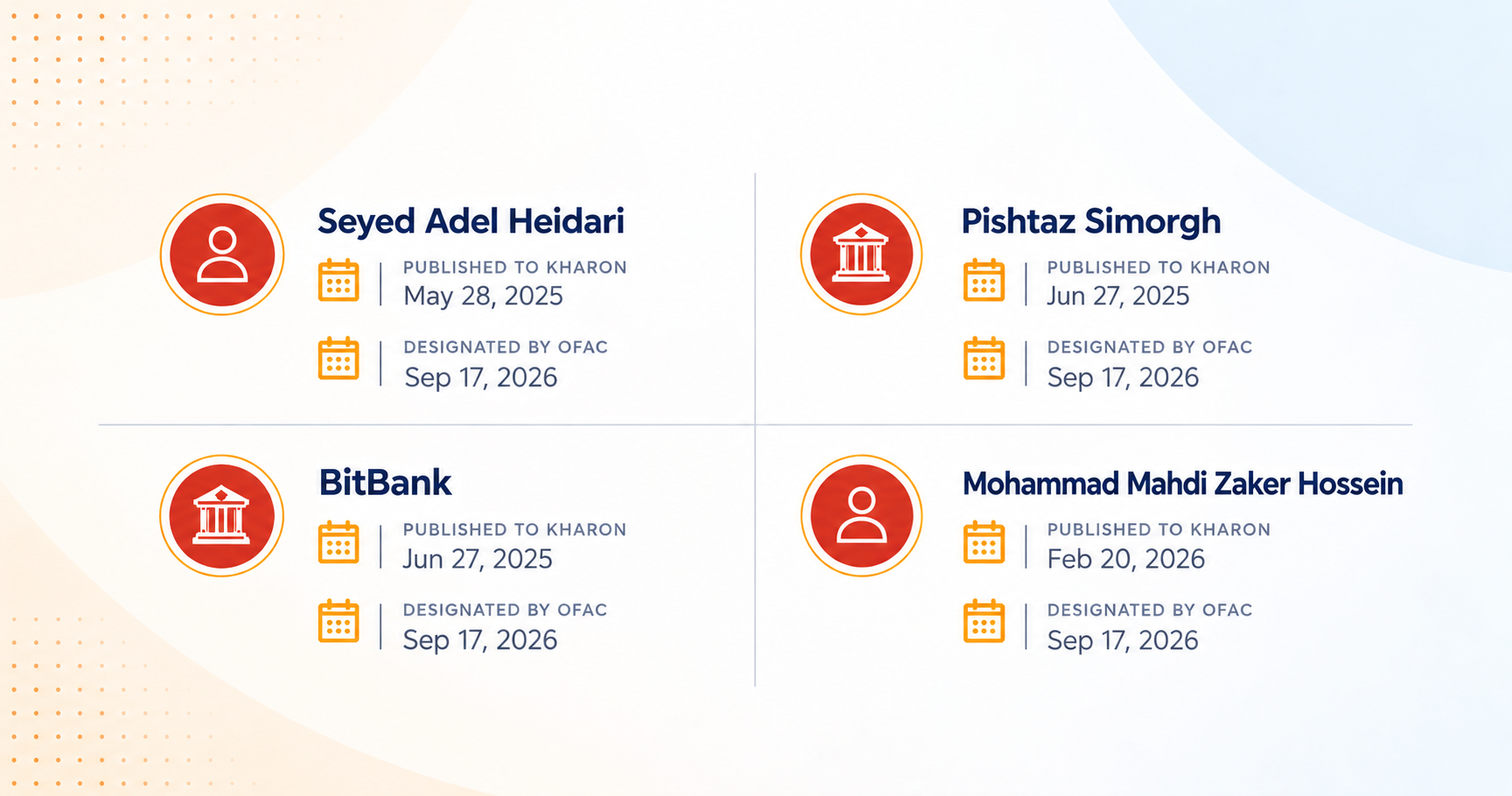
Kharon had already flagged four of the five newly designated parties for risk well before September 17. Three of them — BitBank, Pishtaz Simorgh, and Seyed Adel Heidari — were flagged more than a year prior.
Inside the Network
Kharon identified Pishtaz Simorgh and BitBank as part of Zanjani’s network on June 27, 2025. DotOne previously held 49.5% of Pishtaz Simorgh directly. Iranian corporate filings reviewed by Kharon show DotOne holding 98% of Farabin Sarmayeh Investment Company (Farabin Sarmayeh), which is not on OFAC’s Specially Designated Nationals (SDN) List and in turn owns 98% of Pishtaz Simorgh.
Kharon linked Seyed Adel Heidari to the DotOne group on May 28, 2025. Kharon’s research has since identified him as a representative of Farabin Sarmayeh and as the chairman of a number of entities in the DotOne group, some of which are now sanctioned by name and some of which are not.
Kharon connected Mohammad Mahdi Zaker Hossein, the managing director of Pishtaz Simorgh, to the network on February 20, 2026, about seven months before his designation.
What This Triggers
The September 17 action put BitBank and Pishtaz Simorgh on the SDN List, but Kharon's mapping indicates that Pishtaz Simorgh may have been blocked by operation of law since at least July. Under OFAC's 50 Percent Rule, an entity owned 50 percent or more (directly or indirectly, individually or in the aggregate) by one or more blocked persons is itself blocked, whether or not it appears on the SDN List. When OFAC designated DotOne, Farabin Sarmayeh, 98% owned by DotOne, may have become blocked, and Pishtaz Simorgh, 98% owned by Farabin Sarmayeh, may have become blocked in turn.
The same logic applies to other parts of the network that OFAC has not named. Kharon's mapping shows that Farabin Sarmayeh holds majority stakes in a number of other Iranian DotOne companies. Although these companies are not on the SDN List, they may be blocked under the 50 Percent Rule.
The Bigger Picture
Treasury has now designated parts of Zanjani's network three times in 2026, and Kharon's research had tied four of the five parties designated on September 17 to Zanjani before OFAC acted. Kharon's data covers high-risk parties as well as the facilitation networks surrounding them, including companies, executives, and intermediaries that are not on any government list.
Kharon continuously monitors the networks that matter — flagging exposure before it reaches your desk. Request a briefing to learn more today.