

A leading European bank with global operations needed to enhance its screening data. An increased pace of sanctions designations and heightened regulatory scrutiny on controls to identify sanctioned ownership rendered the status quo untenable. The bank tested a legacy provider’s sanctioned ownership and control list in a pre-deployment environment and found that it generated high volumes of false positive alerts – with much of the spike driven by out-of-scope records and unqualified identifiers. The noise was undermining straight-through processing (STP) objectives and holding up legitimate business activity.
It became clear that the alert and escalation teams would be operationally strained — mostly because the legacy provider's list was loaded with information that was out of scope for the bank's obligations. Each alert linked back to static, text-heavy reports that made tracing ownership and control structures a slow, fragmented process. That inefficiency put the compliance function into a reactive posture — absorbing alert volume instead of managing exposure.
The testing made clear that real-time payments screening requires high-integrity data. The bank needed a provider that could deliver multi-jurisdictional coverage with fewer false positives — actionable insights, not data it had to decode.
The bank evaluated alternative providers against clear criteria: broader multi-jurisdictional coverage, measurable reduction in false positives, and investigative tooling that surfaces risk-relevant information teams can act on immediately. In a side-by-side test against the legacy provider's data, Kharon delivered a 60% reduction in false positive alerts.
Kharon GraphCast now feeds the bank's screening systems with the continuously maintained Sanctions 50-Plus and Control datasets, covering the ownership and control rules that extend sanctions beyond listed parties under the OFAC 50 Percent Rule and its EU and U.K. equivalents. The bank can set ownership thresholds for screening and structure alerts by jurisdiction through regime-specific files, rather than applying a single global standard across its operations.
Alongside GraphCast, the bank’s compliance teams use Kharon LensView to examine and contextualize the network around each alert. LensView displays automated, pre-configured charts for each record — giving first-line reviewers the context to escalate true hits with confidence.
For complex investigations and due diligence, Kharon ClearView replaced the legacy provider's static reports. Investigators gained a complete view of risk networks — ownership chains, commercial linkages, and more — and could move from alert to assessment to escalation in a single workflow.
It became clear that the alert and escalation teams would be operationally strained — mostly because the legacy provider's list was loaded with information that was out of scope for the bank's obligations. Each alert linked back to static, text-heavy reports that made tracing ownership and control structures a slow, fragmented process. That inefficiency put the compliance function into a reactive posture — absorbing alert volume instead of managing exposure.
The testing made clear that real-time payments screening requires high-integrity data. The bank needed a provider that could deliver multi-jurisdictional coverage with fewer false positives — actionable insights, not data it had to decode.
Closing gaps in coverage and investigations
The bank evaluated alternative providers against clear criteria: broader multi-jurisdictional coverage, measurable reduction in false positives, and investigative tooling that surfaces risk-relevant information teams can act on immediately. In a side-by-side test against the legacy provider's data, Kharon delivered a 60% reduction in false positive alerts.Kharon GraphCast now feeds the bank's screening systems with the continuously maintained Sanctions 50-Plus and Control datasets, covering the ownership and control rules that extend sanctions beyond listed parties under the OFAC 50 Percent Rule and its EU and U.K. equivalents. The bank can set ownership thresholds for screening and structure alerts by jurisdiction through regime-specific files, rather than applying a single global standard across its operations.
Alongside GraphCast, the bank’s compliance teams use Kharon LensView to examine and contextualize the network around each alert. LensView displays automated, pre-configured charts for each record — giving first-line reviewers the context to escalate true hits with confidence.
For complex investigations and due diligence, Kharon ClearView replaced the legacy provider's static reports. Investigators gained a complete view of risk networks — ownership chains, commercial linkages, and more — and could move from alert to assessment to escalation in a single workflow.
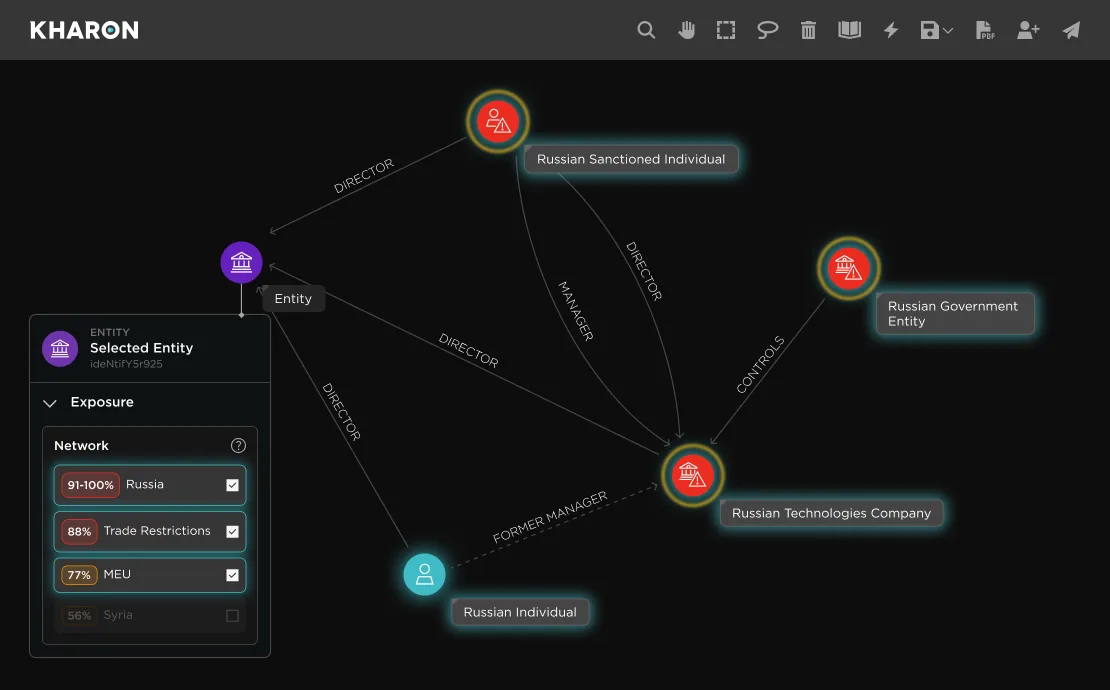
Kharon ClearView's Dynamic Exposure Scores feature instantly quantifies how deeply connected any entity is to specific sources of risk.
Structured deployment and ongoing support
GraphCast datasets are engineered for direct ingestion into enterprise screening systems. The bank integrated Kharon’s data into its existing infrastructure without disrupting established workflows. The rollout was deliberately phased: impact testing and record-level optimization in batches, a limited-scope go-live, then steady expansion of screening coverage. Kharon’s engagement didn't end at deployment — the Customer Success and Product teams provided structured onboarding tailored to individual business units, with data deliveries configured to each regional unit’s screening requirements.The bank also adopted Kharon’s Rapid Response offering, which delivers data on the majority-owned entities of newly sanctioned parties within three business days of a government action. When new sanctions are announced, the bank’s compliance teams now have updated data to act on immediately — no fire drills, no waiting on the next scheduled delivery, and a clear record of timely action for regulators or internal audit. For a global institution operating under multiple sanctions frameworks, this level of responsiveness is a requirement.
Reduced false positives and improved operational scalability
The 60% reduction in false positives held in live screening: alert volumes fell, and what remained was easier for teams to manage and escalate. What began with transaction screening has since expanded into account screening across the bank’s operations.This bank’s experience reflects a structural challenge across financial crimes compliance. As sanctions programs expand and risk networks grow more complex, imprecise screening data becomes a material operational and financial risk – driving up manual remediation costs and delaying legitimate payments.
Many financial institutions built their screening programs on providers designed for an era when the volume of sanctioned entities was smaller and evasion methodologies were less sophisticated. Today’s designated entities operate through layered corporate structures, front companies, and jurisdictional arbitrage to evade detection. Keeping up requires intelligence that is backed by subject matter experts, structured for immediate decision-making, and purpose-built for sanctions compliance.
As real-time STP requirements take hold, risk leaders understand the increasing importance of reducing operational friction. By identifying excess noise from its former provider and implementing Kharon’s data solutions instead, the bank positioned its screening function to support faster real-time processing. Moving forward, this kind of shift toward decision-ready intelligence will determine how well compliance programs scale with regulatory complexity.