The day after President Trump pardoned Binance founder and owner Changpeng Zhao for sweeping violations of U.S. anti-money-laundering laws, Zhao was hustling again, halfway across the world.
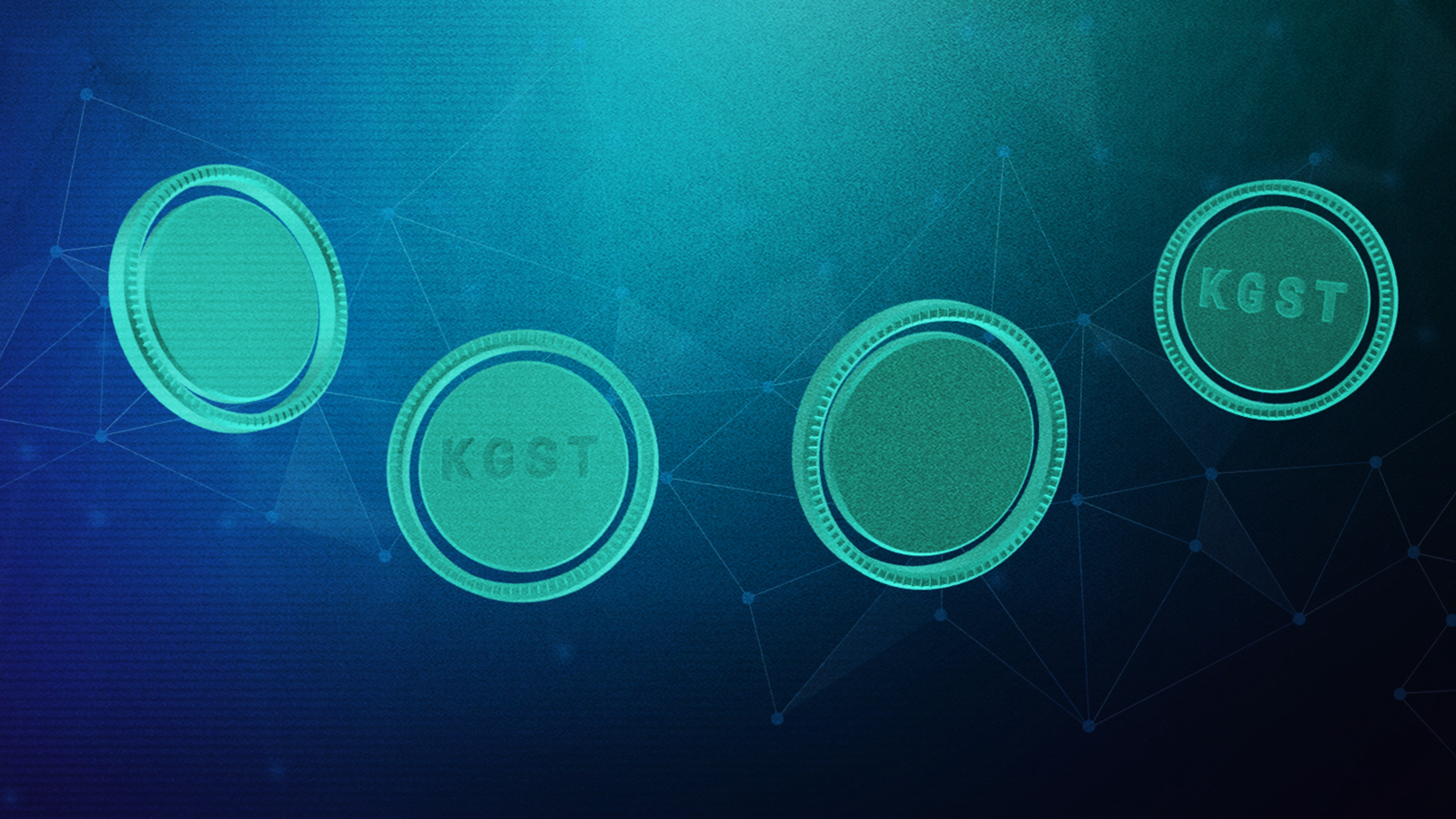
As a top crypto advisor to Kyrgyzstan, Zhao had jetted into its capital to herald the October 2025 launch of its first national stablecoin, KGST, on his exchange. Joining him were Kyrgyzstan’s president and its crypto czar, Farkhat Iminov, who together are leading a crypto charge in a Central Asian country that Western authorities and analysts have identified as a hive for Russian sanctions evasion.
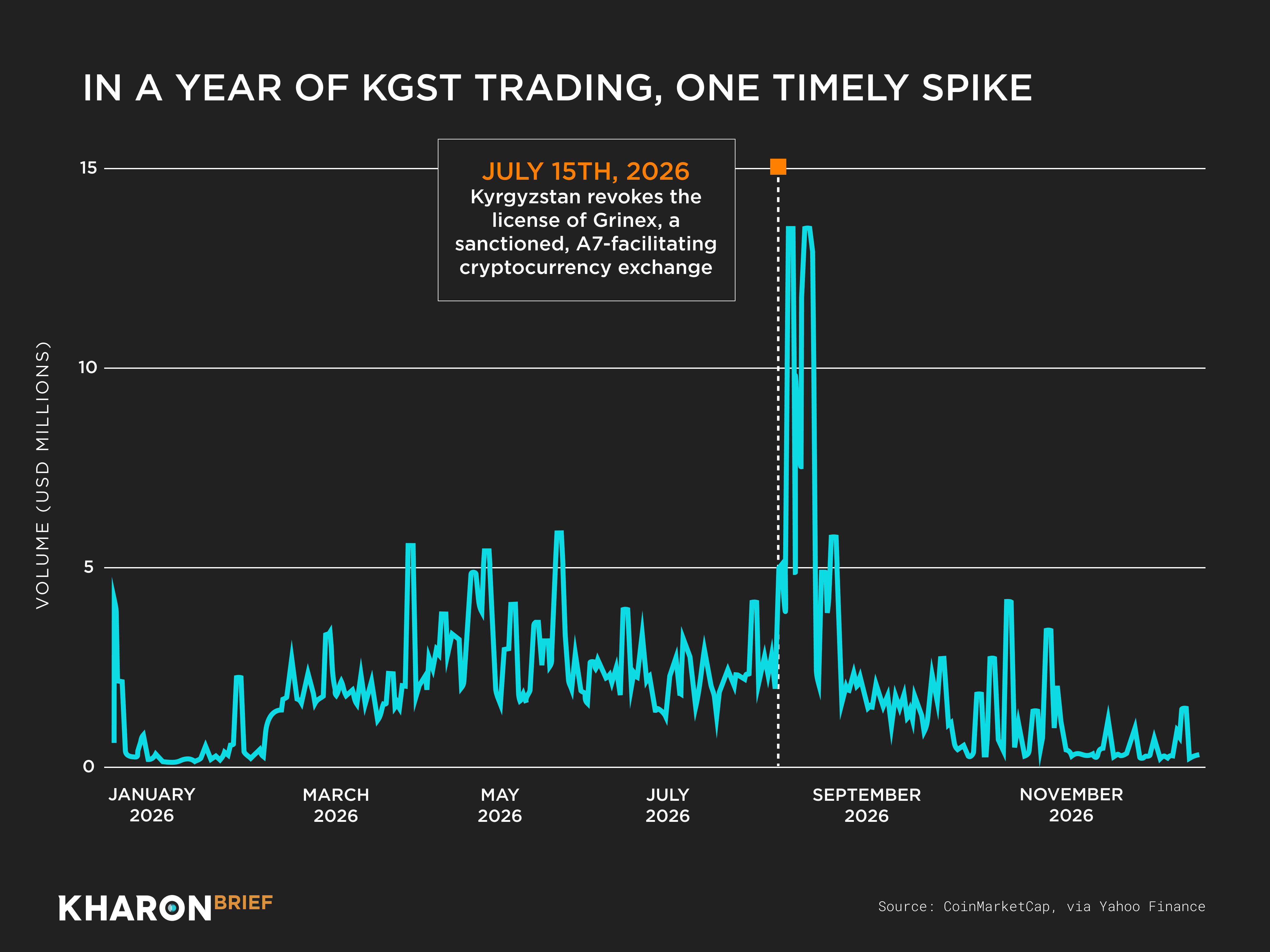
KGST has recorded more than $500 million in trading volume since, according to a Kharon analysis of platform data.
But Iminov’s government roles promoting and regulating KGST appear to raise conflict-of-interest concerns, experts say — including that, until about eight weeks before KGST’s Binance launch, he was the registered controlling owner of a U.K. company linked to the coin’s issuer.
And Kharon’s investigation found that the network behind KGST doesn’t just tie to its own state regulator. It also connects to A7, the Kremlin-orchestrated network helping Russia and Iran move illicit billions through the global financial system.
The U.S. Treasury Department last month took major enforcement action against the A7 apparatus, adding several companies to its sanctions roster, designating it as a transnational criminal organization, and declaring its sub-agents a primary money laundering concern.
Market blockchain data shows that daily trading in KGST spiked on Binance and other platforms in mid-July, immediately after Kyrgyzstan revoked the license of the widely sanctioned Grinex crypto exchange. Western authorities have called Grinex, like its predecessor, Garantex, a primary vehicle for A7 cross-border flows.
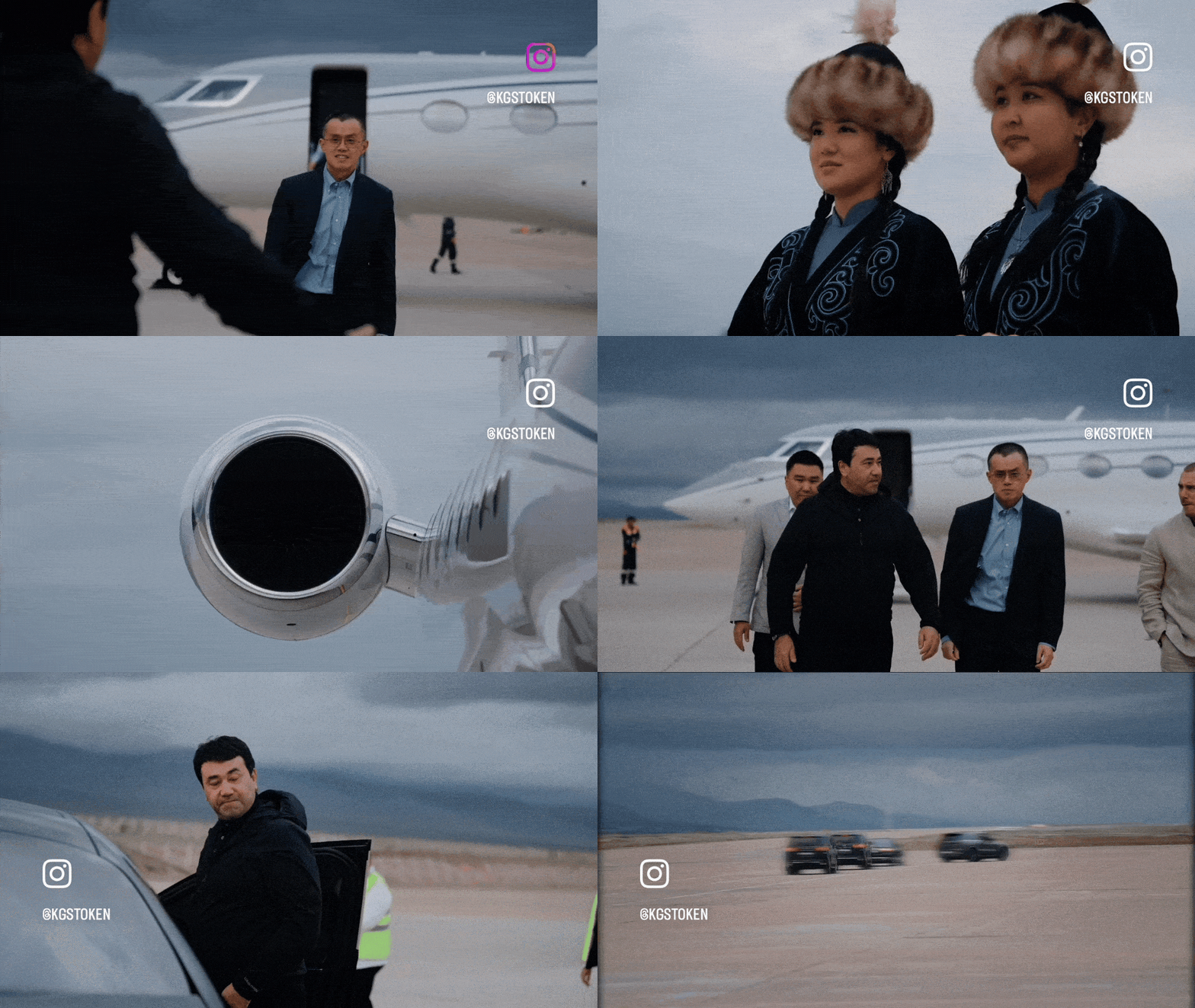
Kyrgyzstan crypto czar Farkhat Iminov greets Changpeng Zhao at an airport, in a loop from a video that KGST issuer KGSToken posted to Instagram in September.
“Binance conducts due diligence on all stablecoin issuers listed on its platform as part of its global financial crime and sanctions compliance programme, both before listing and on an ongoing basis,” Binance said in a statement to The Brief. The company added that it “takes compliance with applicable international sanctions seriously.”
Anti-corruption experts said Iminov’s corporate activities smack of state capture, in which private interests become so entrenched through political corruption that they can shape a state’s policies to their own advantage.
That kind of environment, the experts said, can also give foreign powers such as Russia an opportunity to steer policy toward their own strategic interests.
“You don’t get more blaring red lights for corruption than this,” Casey Michel, director of the Combating Kleptocracy Program at the Human Rights Foundation, said in an interview.
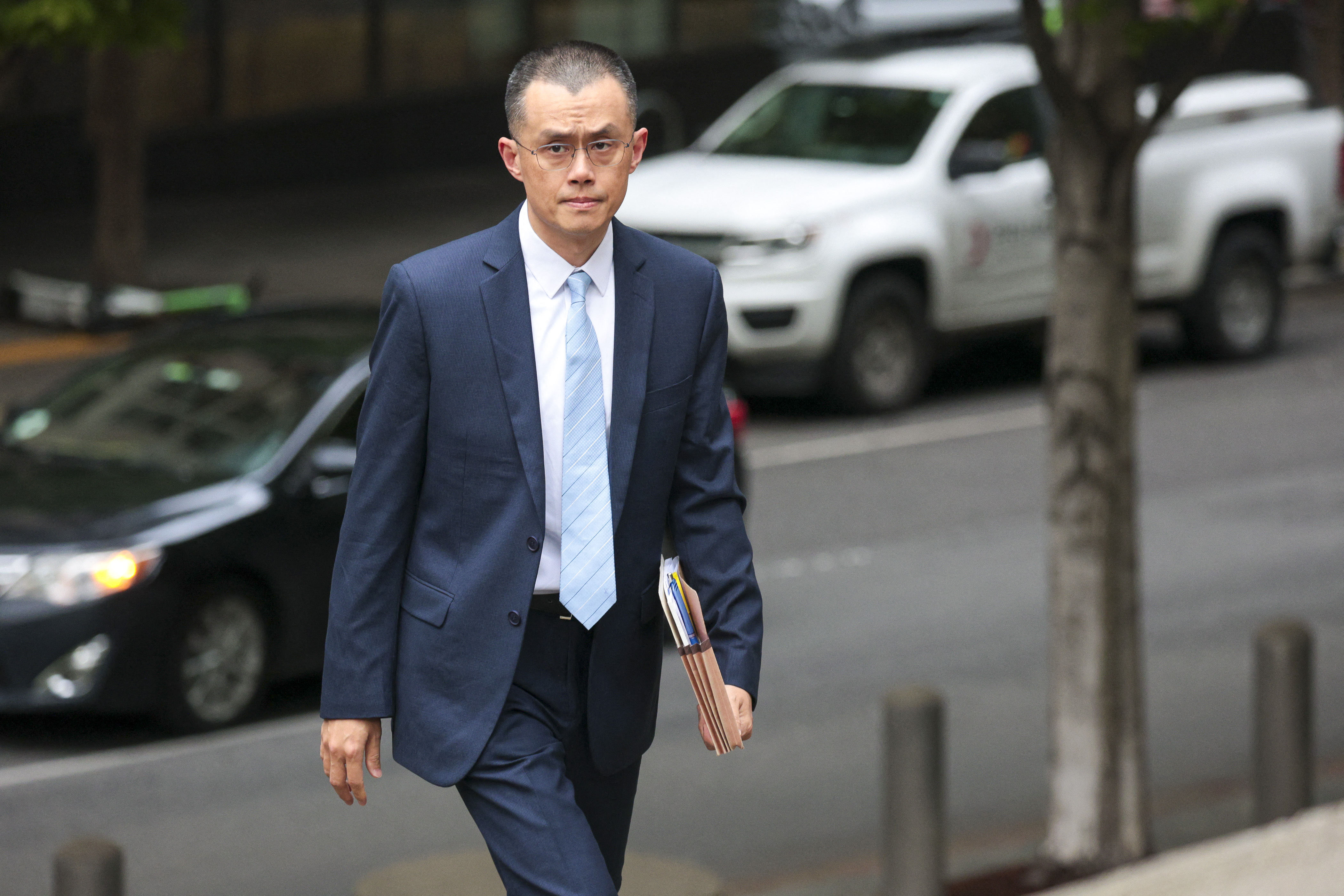
Binance founder Changpeng Zhao arrives at federal court in Seattle in 2024. Pleading guilty to violations of U.S. anti-money-laundering laws, he ultimately served four months. (Jason Redmond/AFP via Getty Images)
The official on both sides
Iminov and Zhao became Kyrgyz crypto collaborators in April of last year, when Zhao began his government advisor role and Iminov, four days later, took over the National Investment Agency, which at the time oversaw crypto policy.Since then, Iminov has headed each of the primary crypto bodies Kyrgyzstan has created, including the presidential council’s crypto secretariat and, later, the national agency that regulates KGST.
On the surface, Iminov’s documented private-sector background had reflected little to do with cryptocurrency. Dating to 2018, he had controlled more than 75% of Gewor Trading LLP, an oil-trading and logistics firm registered in Northern Ireland, according to corporate records. On its website, Gewor advertises partnerships with some of Russia’s most heavily sanctioned energy companies, including Lukoil and Rosneft.
Gewor told The Brief, in response to emailed questions, that the site was outdated and that it stopped those Russia dealings in 2022.
Yet Gewor Trading LLP also lists an address in Bishkek, the Kyrgyz capital. And, according to corporate records, it shares that address with KGST’s issuer, KGSToken, which is owned by a foreign company with a nearly identical name: Gewor Trading Corp.
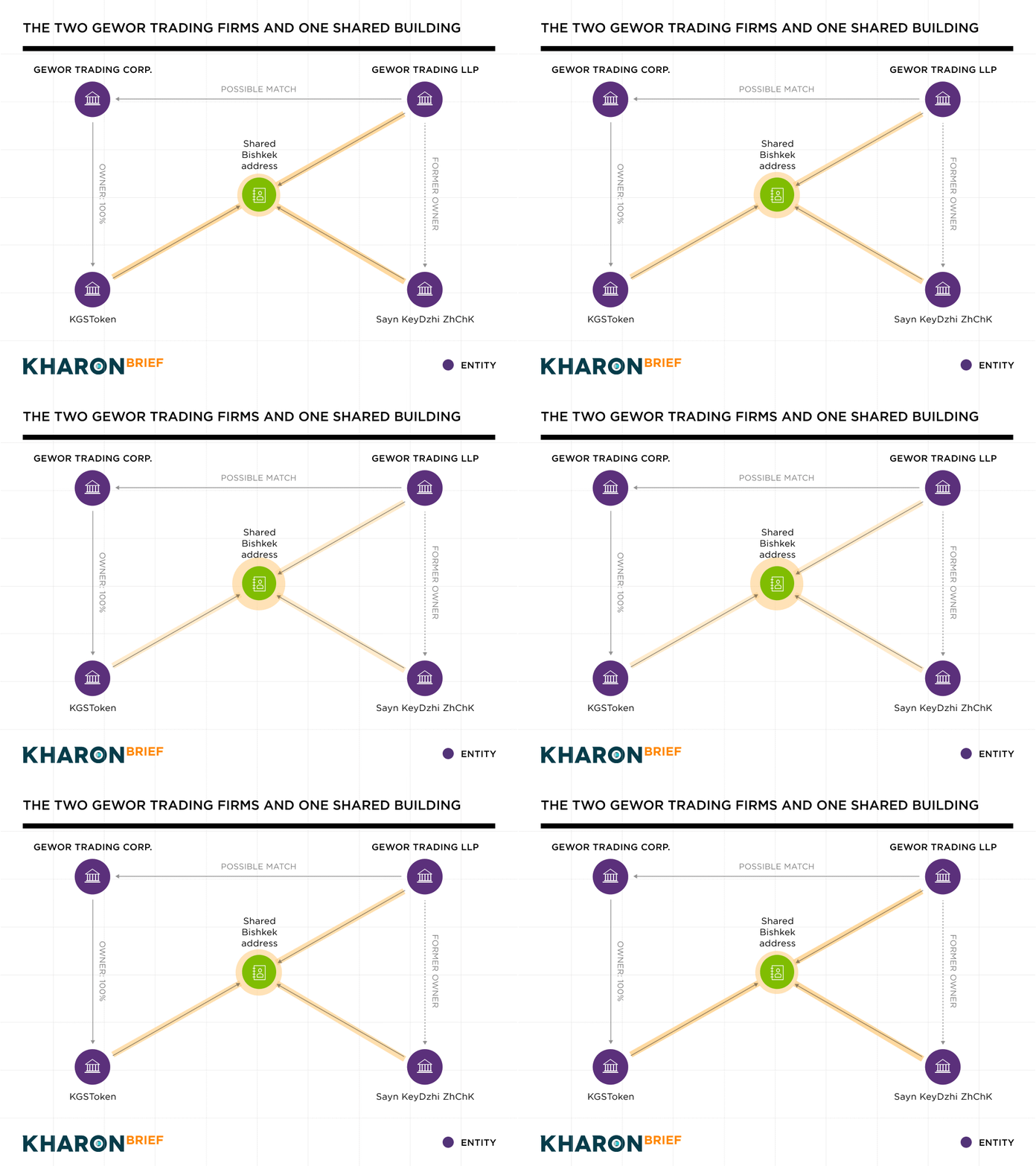
Kharon users can explore this network in greater detail through the ClearView platform.
Binance said Gewor Trading LLP was “a separate legal entity” from KGSToken-owning Gewor Trading Corp. and that “[n]one of the entities or individuals associated with these entities are sanctioned.” Gewor Trading LLP called the registration of several legal entities at the same office “common practice in the Kyrgyz Republic.”
David Szakonyi, a political science professor at George Washington University and co-founder of the Anti-Corruption Data Collective, said the Gewor trail was one of several red flags around the KGST stablecoin.
“It suggests that the Kyrgyz state has no problem with a foreign [company] owning, or at least benefiting financially from, a public product or tool that the government is behind,” Szakonyi said.
[What Banks Need to Know About Treasury’s Crackdown on A7, Russia’s Sanctions-Evasion Machine]
Kyrgyzstan’s financial regulator announced the official registration of KGST in late June 2025, while Iminov was running the national investment agency and still controlled U.K.-registered Gewor LLP.
That August, Iminov left the investment agency to lead the president’s crypto secretariat, which was being spun off as an independent unit. Three days later, corporate records show Iminov dropped his stake in Gewor LLP; a low-profile Uzbek national picked it up.
The Brief could not substantiate the structure of Gewor LLP’s current operations. The firm’s only listed officers over the last five years are two companies in Bermuda and the Cayman Islands, jurisdictions have faced criticism by international anti-money-laundering watchdogs for their opaque ownership transparency requirements. Binance is registered in the Cayman Islands itself.
Kyrgyzstan President Sadyr Japarov meets Russia’s Vladimir Putin on the sidelines of a Moscow summit Nov. 11. (Pavel Bednyakov/Pool/AFP via Getty Images)
Iminov’s corporate network, analysts say, raises conflict-of-interest, corruption, and national security concerns.
“Iminov held direct oversight over the exact sector in which his affiliates operate,” Transparency International, a global anti-corruption nonprofit, said in an emailed statement.
Neither Iminov, his agency, nor the president’s office responded to requests for comment for this story. The Kyrgyz embassy in Washington also did not respond.
Gewor Trading LLP said Iminov had not been “a person with significant control over” the company since August 2025 and “has held no direct or indirect interest” since that time.
Gewor Trading LLP and Gewor Trading Corp. are not the only firms operating under the Gewor Trading brand, however, nor the only potential conflict of crypto interests for Iminov.
According to corporate records, the listed owner of a Kazakhstan branch, Gewor Trading KZ TOO, is a longtime Iminov business associate who also co-owns the firm that holds Kyrgyzstan’s first crypto-mining license. The Kyrgyz investigative outlet Kloop reported in 2023 that that firm, SolarCoin, was among the country’s biggest electricity buyers, even though crypto miners had been restricted from the public grid as the government rationed power.
Iminov, at the time, sat on the board of Kyrgyzstan’s state power producer.
A controversial, year-long Binance lobbying campaign, directed at the most crypto-friendly U.S. administration to date, had culminated in Zhao’s pardon the day before the Bishkek meeting. Trump would tell “60 Minutes” that he didn’t know Zhao but that the Biden administration had “sent him to jail and they really set him up.”
Kyrgyzstan had promoted Zhao after his four-month prison sentence, which came alongside billions of dollars in fines for Binance, after the company admitted to processing transactions for users in sanctioned jurisdictions and failing to report suspicious activity.
Now, Zhao and his exchange were promoting Kyrgyzstan in turn.
“I encourage more crypto companies to explore the country too,” he posted on X on Oct. 25. Alongside KGST’s launch, Zhao touted the rollouts of a “fully localized” Kyrgyz Binance app, university partnerships for the “Binance Academy” platform, and a “National Cryptocurrency Reserve” that included Binance Coin.
Speaking to Kyrgyzstan’s state news agency, Iminov touted how the KGST stablecoin would allow for direct international settlements. A Binance listing paired with USD-pegged Tether and other leading tokens, he explained, would now “open up access to liquidity,” providing markets with more opportunities to use the asset.
That meant anyone holding Kyrgyz som could turn it essentially into dollars quickly, and in volume, outside the Western banking system.
“Iminov held direct oversight over the exact sector in which his affiliates operate,” Transparency International, a global anti-corruption nonprofit, said in an emailed statement.
Neither Iminov, his agency, nor the president’s office responded to requests for comment for this story. The Kyrgyz embassy in Washington also did not respond.
Gewor Trading LLP said Iminov had not been “a person with significant control over” the company since August 2025 and “has held no direct or indirect interest” since that time.
Gewor Trading LLP and Gewor Trading Corp. are not the only firms operating under the Gewor Trading brand, however, nor the only potential conflict of crypto interests for Iminov.
According to corporate records, the listed owner of a Kazakhstan branch, Gewor Trading KZ TOO, is a longtime Iminov business associate who also co-owns the firm that holds Kyrgyzstan’s first crypto-mining license. The Kyrgyz investigative outlet Kloop reported in 2023 that that firm, SolarCoin, was among the country’s biggest electricity buyers, even though crypto miners had been restricted from the public grid as the government rationed power.
Iminov, at the time, sat on the board of Kyrgyzstan’s state power producer.
National and corporate connections to A7
Several roles later, in October 2025, Iminov and his council convened to announce KGST’s launch on Binance, the world’s largest cryptocurrency exchange, with Zhao at the table.A controversial, year-long Binance lobbying campaign, directed at the most crypto-friendly U.S. administration to date, had culminated in Zhao’s pardon the day before the Bishkek meeting. Trump would tell “60 Minutes” that he didn’t know Zhao but that the Biden administration had “sent him to jail and they really set him up.”
Kyrgyzstan had promoted Zhao after his four-month prison sentence, which came alongside billions of dollars in fines for Binance, after the company admitted to processing transactions for users in sanctioned jurisdictions and failing to report suspicious activity.
Now, Zhao and his exchange were promoting Kyrgyzstan in turn.
“I encourage more crypto companies to explore the country too,” he posted on X on Oct. 25. Alongside KGST’s launch, Zhao touted the rollouts of a “fully localized” Kyrgyz Binance app, university partnerships for the “Binance Academy” platform, and a “National Cryptocurrency Reserve” that included Binance Coin.
Speaking to Kyrgyzstan’s state news agency, Iminov touted how the KGST stablecoin would allow for direct international settlements. A Binance listing paired with USD-pegged Tether and other leading tokens, he explained, would now “open up access to liquidity,” providing markets with more opportunities to use the asset.
That meant anyone holding Kyrgyz som could turn it essentially into dollars quickly, and in volume, outside the Western banking system.
It’s a similar type of channel to others that Western authorities have moved to shut down. Russia’s A7 network, they say, has been used to convert its ruble-pegged A7A5 token into Tether and regain access to Western markets, helping finance the country’s war against Ukraine.
Kyrgyzstan is a key hub. A7A5 is issued by a Kyrgyz company and was traded prolifically on Garantex and Grinex, a Bishkek-registered exchange, before each was forced offline.
Treasury said in an alert last month that it found more than 180 entities had processed A7A5 transactions totaling more than $179 billion dollars between February 2025 and June 2026, a period largely under Iminov’s regulatory tenure.
[Treasury Is Going After the A7 Money-Laundering Network. These Companies Show Red Flags.]
One of the A7-linked companies the U.K. designated in October was Tsunami Payments, a Bishkek-registered payment platform that services the A7A5 digital wallet. The manager who headed Tsunami Payments until earlier this year now runs a company called Prizma Konnekt, which until July 31 was partly owned by Iminov’s Gewor Trading LLP, according to corporate records and Gewor’s statement to The Brief.
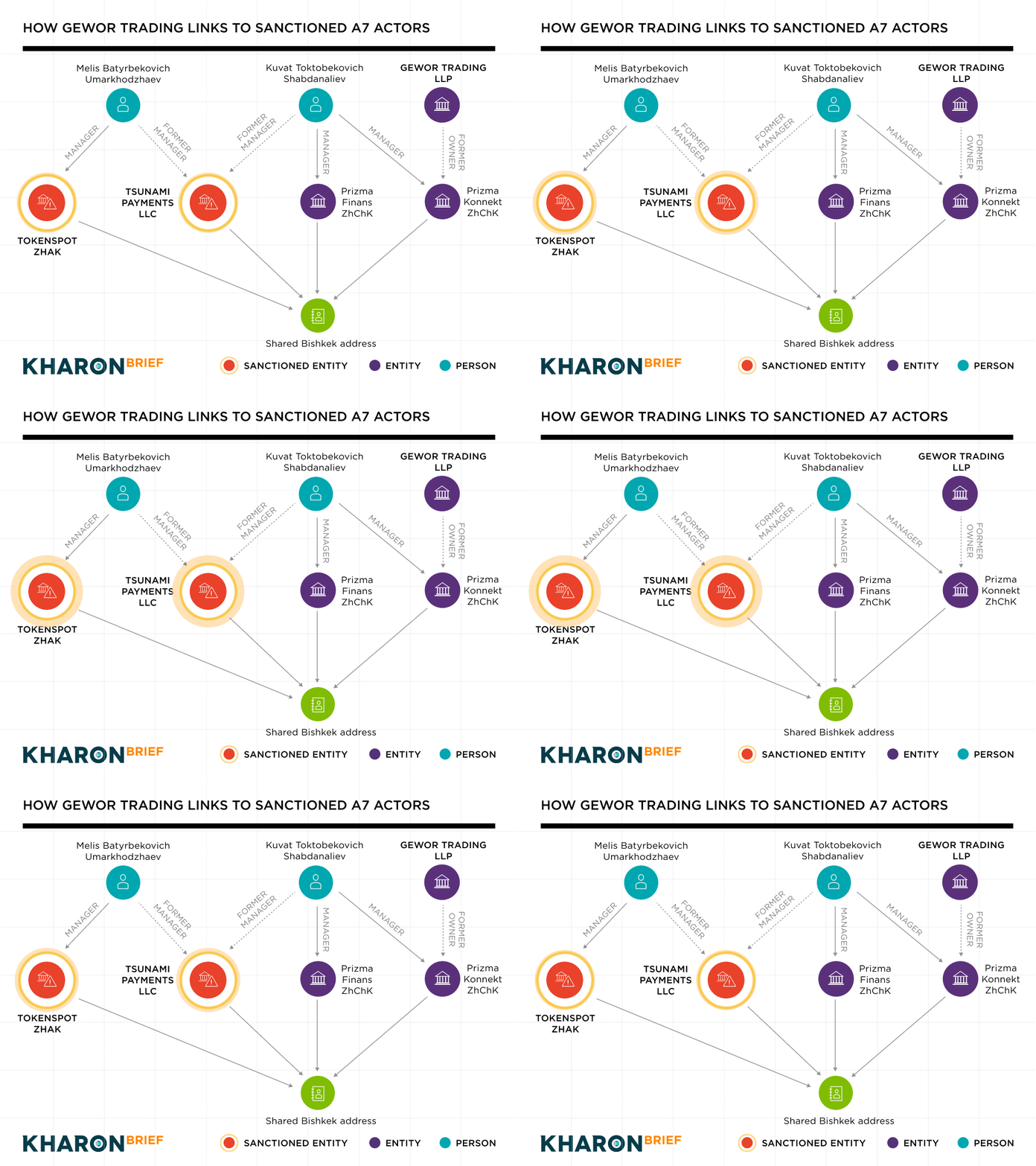
Prizma Konnekt’s current listed owner is Keydzhiestipey, which spells out “KGST Pay” in Cyrillic lettering. Keydzhiestipey is registered at the same Bishkek address as Gewor Trading LLP and KGSToken, the issuer of KGST.
“Gewor Trading LLP has never had and does not have any contractual, corporate, financial, or other relationships with the A7 network, the A7A5 stablecoin, the Grinex exchange, or Tsunami Payments,” the company said. “Gewor Trading LLP is not a participant, operator, or authorized representative of KGSToken and does not bear any responsibility for the activities of KGSToken.”
Gewor LLP declined to comment on the entities sharing its brand. KGSToken did not respond to requests for comment.
Linking Kyrgyz-registered trading and crypto structures to Russian sanctions-evasion networks like A7 presents risks not only for the West but for Kyrgyzstan itself, Transparency International said.
It “exposes Kyrgyzstan’s broader financial and banking sector to severe secondary sanctions from the U.S. and EU, posing a direct threat to national economic security,” the organization said.
Japarov, a strongman who has cultivated a friendship with Moscow, had previously led Kyrgyzstan’s national anti-corruption agency, during a late-aughts period that critics have said was characterized by rampant embezzlement and asset seizures.
Earlier this year, Kyrgyzstan media took note that his youngest son, Nurdoolot Japarov, was frequently accompanying him to official meetings; Sadyr Japarov said it was to act “as a translator” and so the two could spend time together. Nurdoolot “is not involved in any government affairs and does not conduct business with government agencies,” Sadyr Japarov said.
Unmentioned was that Nurdoolot co-founded and owns the new, crypto-focused Bereket Bank, according to an archived version of the bank’s website and Ministry of Justice records. One of the bank’s founding directors, records say, managed sanctioned Tsunami Payments — and is the current listed manager of another A7 company, Tokenspot, that the U.K. sanctioned alongside it.
Kyrgyzstan’s presidential office did not respond to a request for comment.
“The current Kyrgyz government has shown a willingness to cooperate with corrupt, kleptocratic, and authoritarian regimes around the world, whether it be through the formal financial sector or through crypto,” Szakonyi said. “Their interest in self-enrichment and their openness to corruption has made them a partner in a lot of authoritarian cooperative schemes that have unfolded over the last couple decades.”
Sun, like Zhao, has faced government scrutiny for his business practices, including a $10 million settlement with the U.S. Securities and Exchange Commission in March over serious allegations of securities fraud through TRON. He also advised and promoted the exchange HTX, “whose ecosystem is closely linked to TRON,” Kyrgyzstan’s state news website said after the Sun-Iminov meeting.
By the end of May, HTX notified markets that it had completed integration of KGST onto the TRON network.
Thirteen minutes later, the U.K. announced it had sanctioned HTX, as part of an A7-linked network.
The exchange, the U.K. said, had “channelled over $1.5 billion back into the Kremlin’s hands.”
Read more from The Brief:
“Gewor Trading LLP has never had and does not have any contractual, corporate, financial, or other relationships with the A7 network, the A7A5 stablecoin, the Grinex exchange, or Tsunami Payments,” the company said. “Gewor Trading LLP is not a participant, operator, or authorized representative of KGSToken and does not bear any responsibility for the activities of KGSToken.”
Gewor LLP declined to comment on the entities sharing its brand. KGSToken did not respond to requests for comment.
Linking Kyrgyz-registered trading and crypto structures to Russian sanctions-evasion networks like A7 presents risks not only for the West but for Kyrgyzstan itself, Transparency International said.
It “exposes Kyrgyzstan’s broader financial and banking sector to severe secondary sanctions from the U.S. and EU, posing a direct threat to national economic security,” the organization said.
The Kyrgyzstan president’s son
The anti-corruption watchdogs said the state-capture concerns extend to President Sadyr Japarov through ties between Tsunami Payments and his son’s bank.Japarov, a strongman who has cultivated a friendship with Moscow, had previously led Kyrgyzstan’s national anti-corruption agency, during a late-aughts period that critics have said was characterized by rampant embezzlement and asset seizures.
Earlier this year, Kyrgyzstan media took note that his youngest son, Nurdoolot Japarov, was frequently accompanying him to official meetings; Sadyr Japarov said it was to act “as a translator” and so the two could spend time together. Nurdoolot “is not involved in any government affairs and does not conduct business with government agencies,” Sadyr Japarov said.
Unmentioned was that Nurdoolot co-founded and owns the new, crypto-focused Bereket Bank, according to an archived version of the bank’s website and Ministry of Justice records. One of the bank’s founding directors, records say, managed sanctioned Tsunami Payments — and is the current listed manager of another A7 company, Tokenspot, that the U.K. sanctioned alongside it.
Kyrgyzstan’s presidential office did not respond to a request for comment.
“The current Kyrgyz government has shown a willingness to cooperate with corrupt, kleptocratic, and authoritarian regimes around the world, whether it be through the formal financial sector or through crypto,” Szakonyi said. “Their interest in self-enrichment and their openness to corruption has made them a partner in a lot of authoritarian cooperative schemes that have unfolded over the last couple decades.”
Questionable company
From his perch as the nation’s crypto chief, Iminov has continued to champion the token tied to his business interests. In one virtual meeting in February, he discussed leveraging KGST on the TRON platform with its founder, Justin Sun.Sun, like Zhao, has faced government scrutiny for his business practices, including a $10 million settlement with the U.S. Securities and Exchange Commission in March over serious allegations of securities fraud through TRON. He also advised and promoted the exchange HTX, “whose ecosystem is closely linked to TRON,” Kyrgyzstan’s state news website said after the Sun-Iminov meeting.
By the end of May, HTX notified markets that it had completed integration of KGST onto the TRON network.
Thirteen minutes later, the U.K. announced it had sanctioned HTX, as part of an A7-linked network.
The exchange, the U.K. said, had “channelled over $1.5 billion back into the Kremlin’s hands.”
Read more from The Brief: