
The EU in April identified Kyrgyzstan as a key enabler of Moscow’s war against Ukraine, levying for the first time its “anti-circumvention” tool designed to stem the transshipment of dual-use goods to Russia.
Its justification? A 12-fold surge in Kyrgyzstan’s exports to Russia of “common high-priority” technologies and other items its military seeks, corresponding with an eight-fold increase in such imports from the EU. The pattern “demonstrates a continuing and particularly high risk of [sanctions] circumvention,” the EU said.
Analysts say the EU’s action is a warning to other governments, especially those in other former Soviet states — because trade data reviewed by Kharon shows Kyrgyzstan is far from an isolated case:
Its justification? A 12-fold surge in Kyrgyzstan’s exports to Russia of “common high-priority” technologies and other items its military seeks, corresponding with an eight-fold increase in such imports from the EU. The pattern “demonstrates a continuing and particularly high risk of [sanctions] circumvention,” the EU said.
Analysts say the EU’s action is a warning to other governments, especially those in other former Soviet states — because trade data reviewed by Kharon shows Kyrgyzstan is far from an isolated case:
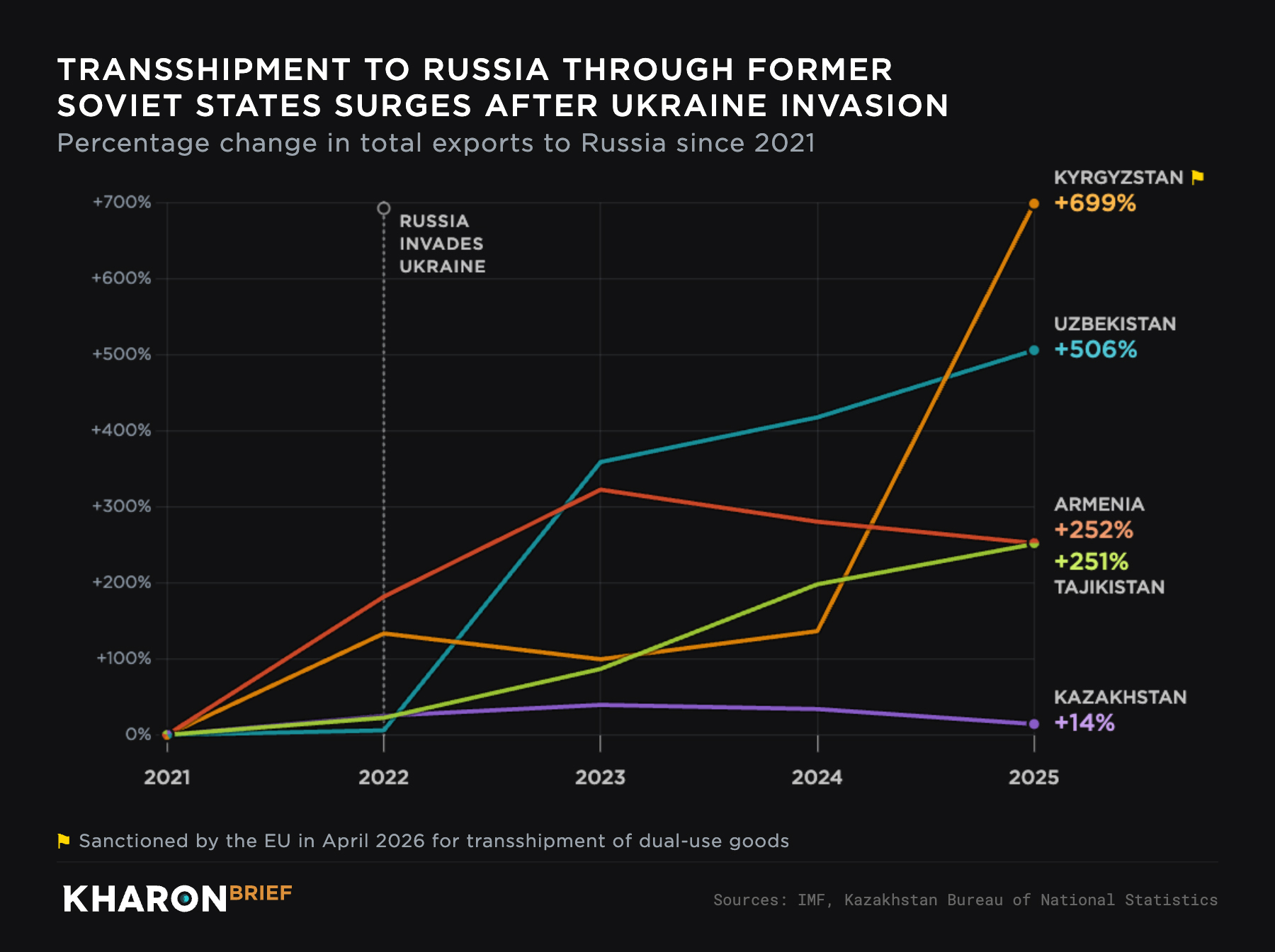
Behind the numbers: The surges in exports to Russia shown above correspond with a 70% drop in Russia sales from Western nations since Moscow’s 2022 invasion, as the U.S. and its allies imposed sanctions and broad trade bans.
A swell in EU exports to countries in the Eurasian Economic Union also strongly correlates with those countries’ exports to Russia, according to an October report from the Bulgaria-based Center for the Study of Democracy. That trade data highlights “these countries as key re-export hubs for Russian trade aiding sanctions evasion practices,” the center said.
Hidden risks: The scale of evasion could actually be far higher than the EU figures suggest. While Kyrgyzstan’s statistics bureau reported only $4.8 billion in trade from China last year, a key source of sanctioned exports to Russia, Beijing recorded nearly $22 billion in exports to the Central Asian nation.
“Both figures are likely wrong,” argued a Foreign Policy Research Institute report published in May. “It is likely that the figure lies between the two, with the Kyrgyz government trying to cover up the smuggling of goods into Russia through its territory.”
Official trade data, for instance, shows only a 14% increase in Kazakhstan’s exports to Russia … while its imports from the EU have risen nearly 70%. That disparity, analysts say, masks the extent of that country’s likely role in providing material support to Moscow, too.
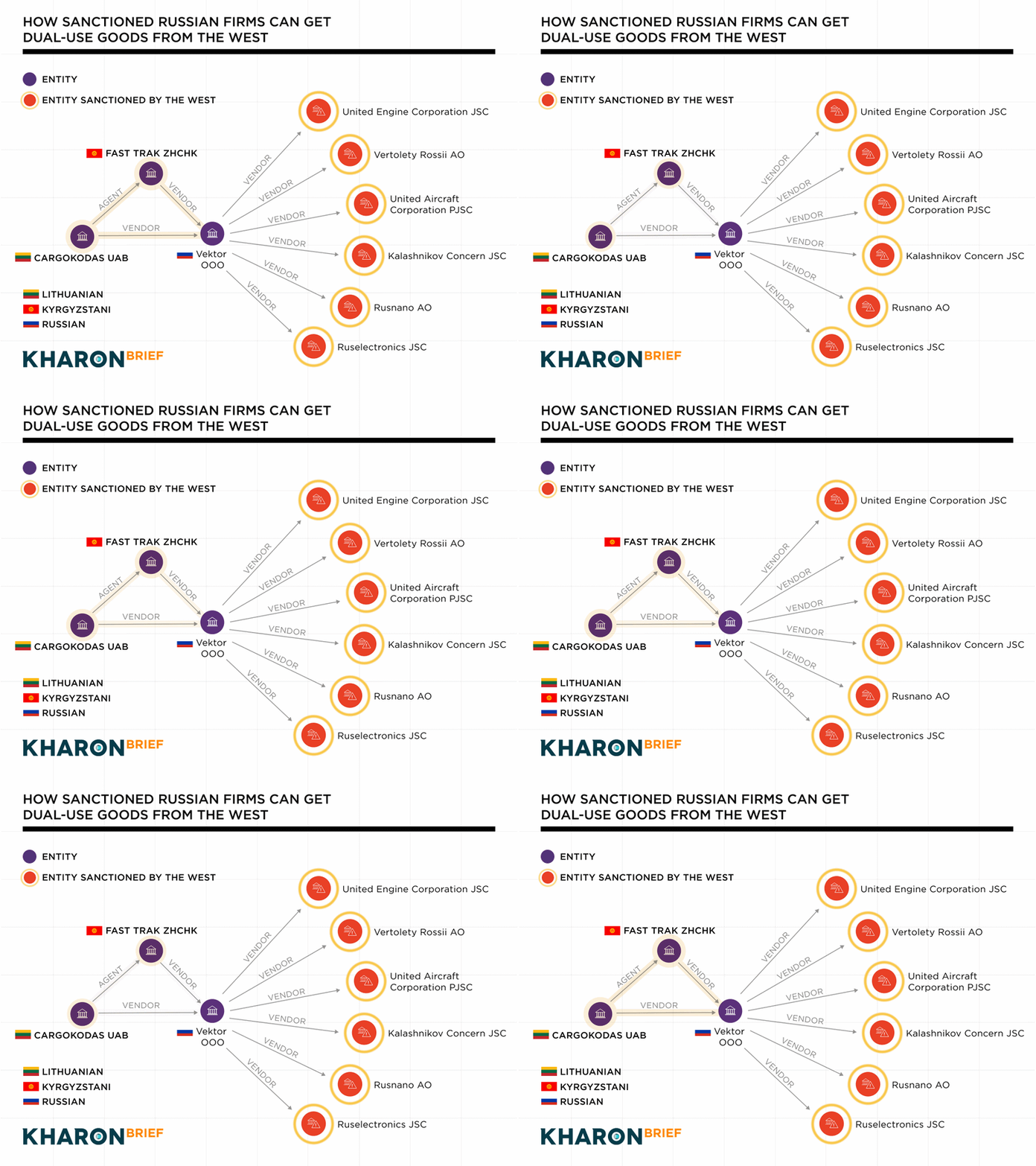
In practice: Lithuanian authorities in April last year raided a logistics company called Cargokodas UAB over suspected sanctions violations, according to local media reports, seizing cash, weapons, and approximately $1.75 million in goods. (The company did not respond to a Brief request for comment.)
Trade records show that Cargokodas facilitated shipments to Russia of dual-use goods, including computer chips and components for metalworking machinery, after they were listed by the U.S. and the EU as common high-priority items. One of the Russian firms that Cargokodas shipped those goods to was Vektor OOO, which Ukraine sanctioned in January for its business dealings with the state military-industrial complex.
Vektor, in turn, boasts on its website more red-flagged clients of its own, including:
A swell in EU exports to countries in the Eurasian Economic Union also strongly correlates with those countries’ exports to Russia, according to an October report from the Bulgaria-based Center for the Study of Democracy. That trade data highlights “these countries as key re-export hubs for Russian trade aiding sanctions evasion practices,” the center said.
Hidden risks: The scale of evasion could actually be far higher than the EU figures suggest. While Kyrgyzstan’s statistics bureau reported only $4.8 billion in trade from China last year, a key source of sanctioned exports to Russia, Beijing recorded nearly $22 billion in exports to the Central Asian nation.
“Both figures are likely wrong,” argued a Foreign Policy Research Institute report published in May. “It is likely that the figure lies between the two, with the Kyrgyz government trying to cover up the smuggling of goods into Russia through its territory.”
- Zoom in: The EU specifically banned exports to Kyrgyzstan of two types of sensitive goods: metal-cutting machines that are used widely for defense materiel and electronics components that can be used for field communication and drone guidance.
Official trade data, for instance, shows only a 14% increase in Kazakhstan’s exports to Russia … while its imports from the EU have risen nearly 70%. That disparity, analysts say, masks the extent of that country’s likely role in providing material support to Moscow, too.
In practice: Lithuanian authorities in April last year raided a logistics company called Cargokodas UAB over suspected sanctions violations, according to local media reports, seizing cash, weapons, and approximately $1.75 million in goods. (The company did not respond to a Brief request for comment.)
Trade records show that Cargokodas facilitated shipments to Russia of dual-use goods, including computer chips and components for metalworking machinery, after they were listed by the U.S. and the EU as common high-priority items. One of the Russian firms that Cargokodas shipped those goods to was Vektor OOO, which Ukraine sanctioned in January for its business dealings with the state military-industrial complex.
Vektor, in turn, boasts on its website more red-flagged clients of its own, including:
- the sanctioned Kalashnikov Concern, which makes the titular assault rifles and most of Russia’s small arms.
- the sanctioned Rusnano, a state-owned venture capital and technology firm that specializes in advanced technology.
- the sanctioned Vertolety Rossii, a company that designs, tests, and manufactures modern military helicopters.
Kharon users can explore this Insight in greater detail through the ClearView platform.
State of play: Angela Howard, a research analyst at the Foundation for Defense of Democracies’ Center on Economic and Financial Power, called the EU’s targeting of Kyrgyzstan a “test case” for confronting Russia’s transshipping enablers.
It’s shown at least one early sign of success: Late last month, Kyrgyzstan’s Ministry of Justice responded to the pressure by suspending the operations of 50 firms it said were involved in risky transactions.
Olga Kiyan contributed to this report.
Read more from The Brief:
It’s shown at least one early sign of success: Late last month, Kyrgyzstan’s Ministry of Justice responded to the pressure by suspending the operations of 50 firms it said were involved in risky transactions.
Olga Kiyan contributed to this report.
Read more from The Brief: