After the United States withdrew from the Iran nuclear agreement, the Treasury Department revived or added more than 700 sanctions in one swoop in November 2018, marking what it called at the time “the highest-ever level of U.S. economic pressure on Iran.”
“Treasury’s imposition of unprecedented financial pressure on Iran should make clear to the Iranian regime that they will face mounting financial isolation and economic stagnation until they fundamentally change their destabilizing behavior,” then-Treasury Secretary Steven Mnuchin said. “The maximum pressure exerted by the United States is only going to mount from here.”
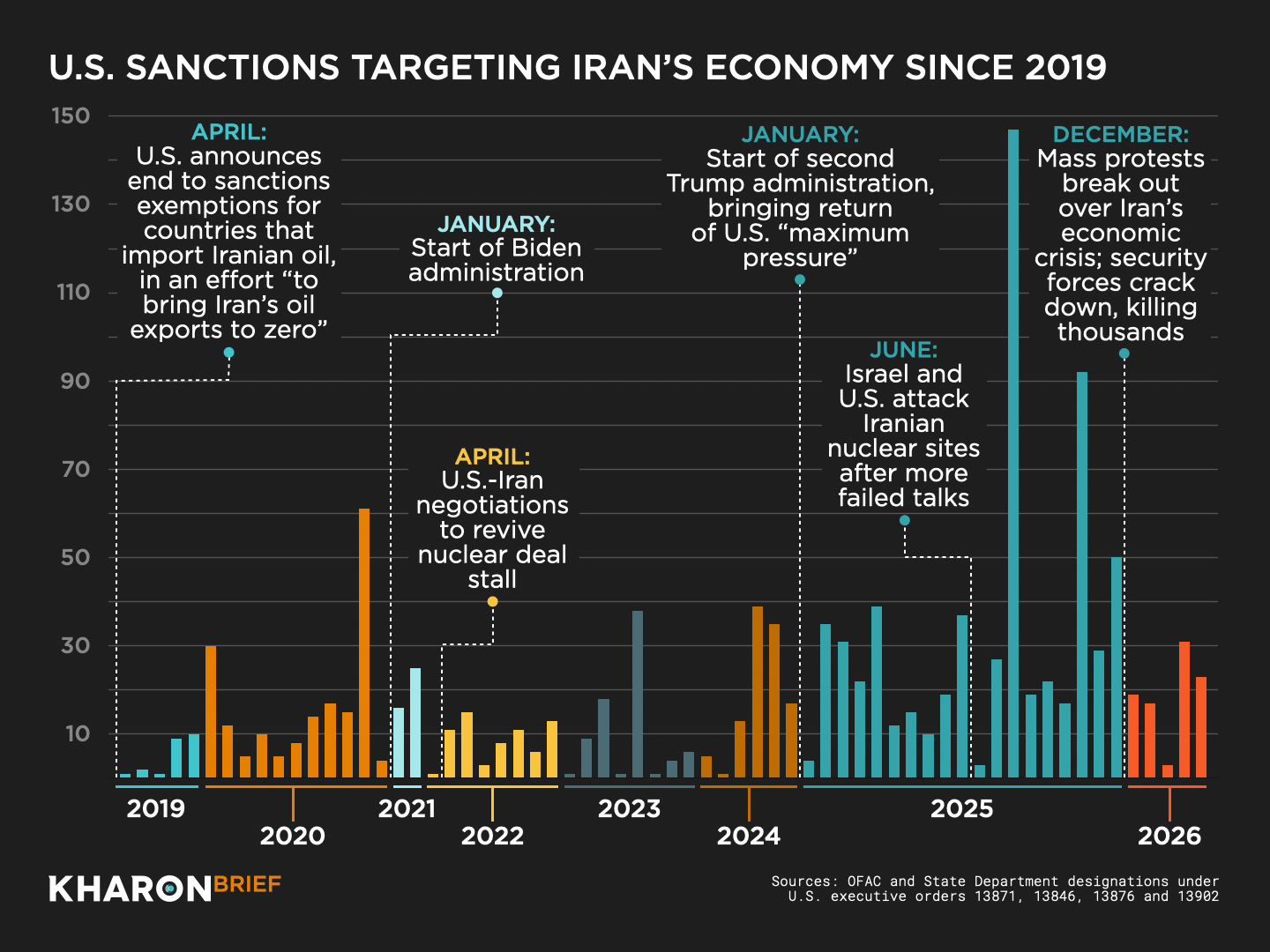
On that last point, Mnuchin was certainly right: According to a Kharon review, the U.S. has issued more than 1,200 further sanctions targeting key Iranian revenue sources since that November 2018 blast, fostering the economic crisis that fueled widespread protests and influenced the Trump administration’s decision last month to strike.
“Treasury’s imposition of unprecedented financial pressure on Iran should make clear to the Iranian regime that they will face mounting financial isolation and economic stagnation until they fundamentally change their destabilizing behavior,” then-Treasury Secretary Steven Mnuchin said. “The maximum pressure exerted by the United States is only going to mount from here.”
On that last point, Mnuchin was certainly right: According to a Kharon review, the U.S. has issued more than 1,200 further sanctions targeting key Iranian revenue sources since that November 2018 blast, fostering the economic crisis that fueled widespread protests and influenced the Trump administration’s decision last month to strike.
The main economic target: Energy revenues, particularly from oil.
The U.S. has targeted a few dozen actors involved in Iran’s metals industry since 2018 along with the country’s main financial networks, including the massive investment vehicles that back its state-owned companies. But involvement in the oil trade is the most common reason the U.S. has cited for its economy-targeting sanctions.
But Iran’s oil exports, for all the U.S. focus on them, haven’t dried up: With the regime’s dominion over the Strait of Hormuz, it’s reportedly shipping more oil now than it did before the war.
Data Points columns zero in on the trends behind global trade, international sanctions and illicit finance, in one chart.
Read more from The Brief on Iran:
The U.S. has targeted a few dozen actors involved in Iran’s metals industry since 2018 along with the country’s main financial networks, including the massive investment vehicles that back its state-owned companies. But involvement in the oil trade is the most common reason the U.S. has cited for its economy-targeting sanctions.
- “The funds generated by this oil trade are used to support Iran’s regional terrorist proxies and procure weapons systems that pose a direct threat to U.S. forces and our allies,” the State Department said last November, when it sanctioned international shipping networks for fueling “the Iranian regime’s malign activities.”
- Treasury and State have used that order to sanction everything from shadow-banking networks to the billionaire Babak Zanjani to last July’s actions against a “vast shipping empire” of Iran-connected companies, individuals and ships. (That’s the chart’s giant spike.)
But Iran’s oil exports, for all the U.S. focus on them, haven’t dried up: With the regime’s dominion over the Strait of Hormuz, it’s reportedly shipping more oil now than it did before the war.
Data Points columns zero in on the trends behind global trade, international sanctions and illicit finance, in one chart.
Read more from The Brief on Iran: