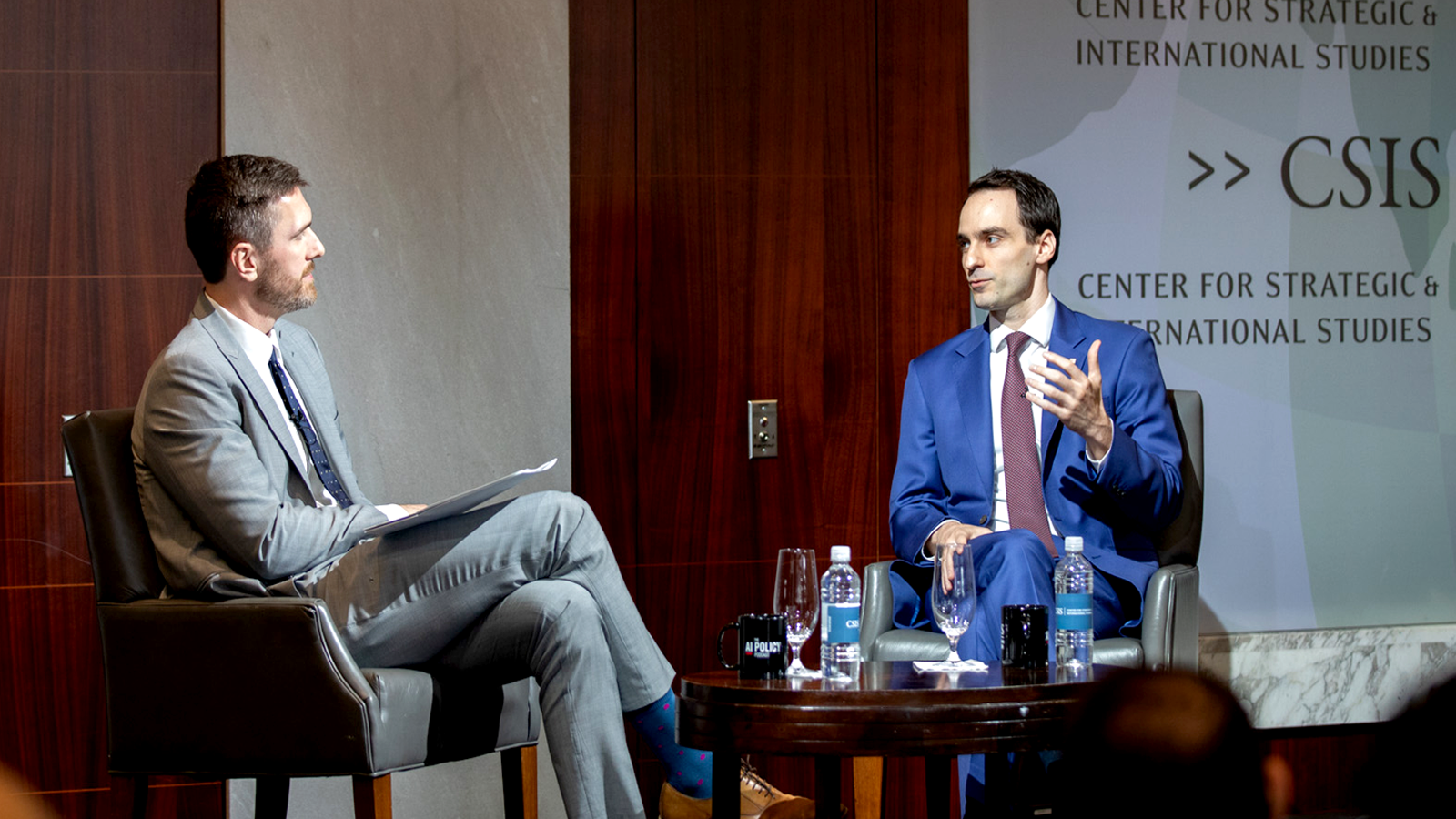
The White House’s AI Action Plan, released last week, made few direct mentions of China. But it took less than 10 minutes into tech policy chief Michael Kratsios’s appearance Wednesday at a D.C. think tank for him to make clear the role that China — and its telecoms giant Huawei — are playing in U.S. policymakers’ strategic thinking.
“If most countries around the world are running on an AI stack that isn’t American, and potentially one’s an adversary, that's a really, really big problem,” Kratsios said, during remarks at the Center for Strategic and International Studies (CSIS).
The AI Action Plan, drafted by the Kratsios-led Office of Science and Technology Policy, outlines a strategy built around three pillars: accelerating innovation, building critical infrastructure and strengthening U.S. influence abroad.
Kratsios’s comments at CSIS offered more specifics on and insights into how the second Trump White House sees export controls fitting into its AI policy vision. Here were three points he made that stood out.
1. Expanding the Scope of Controls …
“If most countries around the world are running on an AI stack that isn’t American, and potentially one’s an adversary, that's a really, really big problem,” Kratsios said, during remarks at the Center for Strategic and International Studies (CSIS).
The AI Action Plan, drafted by the Kratsios-led Office of Science and Technology Policy, outlines a strategy built around three pillars: accelerating innovation, building critical infrastructure and strengthening U.S. influence abroad.
Kratsios’s comments at CSIS offered more specifics on and insights into how the second Trump White House sees export controls fitting into its AI policy vision. Here were three points he made that stood out.
1. Expanding the Scope of Controls …
“The highest-end semiconductors need to continue to be export-controlled, if not allowed into China.”
The Trump administration’s AI export-controls plans will involve targeting more than chips, Kratsios emphasized Wednesday, in his discussion with Wadhwani AI Center senior adviser Gregory C. Allen. Kratsios detailed a potential strategy of using key American-made components to dominate broader semiconductor supply chains.
“A lot of components related to these machines are of U.S. origin, and certain export control rules you can use,” he said. “If there are certain components of these machines that are U.S.[-made], you could sort of essentially export-control the whole thing.”
In some cases, the approach will entail a scrutiny of individual company sales. At one point during the discussion, Kratsios addressed the reversal this month of a block on Nvidia’s H20 chips designed for China.
“Any sale that Nvidia wants to make to China ... will require an export license,” Kratsios said. The Commerce Department’s Bureau of Industry and Security (BIS) “has said publicly that it will be evaluating each of those license applications and weighing the cost and benefits.”
“A lot of components related to these machines are of U.S. origin, and certain export control rules you can use,” he said. “If there are certain components of these machines that are U.S.[-made], you could sort of essentially export-control the whole thing.”
In some cases, the approach will entail a scrutiny of individual company sales. At one point during the discussion, Kratsios addressed the reversal this month of a block on Nvidia’s H20 chips designed for China.
“Any sale that Nvidia wants to make to China ... will require an export license,” Kratsios said. The Commerce Department’s Bureau of Industry and Security (BIS) “has said publicly that it will be evaluating each of those license applications and weighing the cost and benefits.”
2. … But No Across-the-Board China Restriction
“We are in a race, and what’s important is that we’re not necessarily cutting everything off from China.”
That said, export controls with respect to China won’t be absolute, Kratsios said. He outlined at CSIS a more targeted approach that would distinguish between different types of AI applications.
“Are we most worried about sort of small-scale, sort of inference runs for some Chinese app? Probably not,” he said. “What you’re most worried about is large-scale runs that are for training sophisticated models that you’d be worried about.”
That means calculated trade-offs. Kratsios raised that BIS needs greater resources and tools to enforce existing measures effectively, a point that BIS leader Jeffrey Kessler, Commerce Secretary Howard Lutnick and members of Congress have made in recent months as well.
Kratsios said the administration is connecting intelligence-community resources to export-control efforts and implementing stringent Know Your Customer requirements to monitor training runs in data centers.
“You can have the best export controls in the books,” he said, “but if you’re not able to effectively enforce them because of resource constraints, that’s a challenge.”3. Learning from Huawei History
“Are we most worried about sort of small-scale, sort of inference runs for some Chinese app? Probably not,” he said. “What you’re most worried about is large-scale runs that are for training sophisticated models that you’d be worried about.”
That means calculated trade-offs. Kratsios raised that BIS needs greater resources and tools to enforce existing measures effectively, a point that BIS leader Jeffrey Kessler, Commerce Secretary Howard Lutnick and members of Congress have made in recent months as well.
Kratsios said the administration is connecting intelligence-community resources to export-control efforts and implementing stringent Know Your Customer requirements to monitor training runs in data centers.
“You can have the best export controls in the books,” he said, “but if you’re not able to effectively enforce them because of resource constraints, that’s a challenge.”
3. Learning from Huawei History
“I spent far too much time as essentially the U.S. technology minister around the world, talking to fellow ministers, trying to convince them to rip and replace Huawei. I had these very, very challenging conversations.”
Kratsios, who served as the head of research and engineering at the Department of Defense during Trump’s first term, connected the second administration’s AI strategy to some tough past lessons in the advanced-tech race.
“The West had technology which we perceived to be of higher quality,” Kratsios recalled, “and they still didn’t want to buy it, because the U.S. just was not able to create the environment and the packages necessary to export it out.”
In the years since, Huawei has pivoted aggressively into AI, developing its own chips and cloud services as it seeks to replicate its telecommunications dominance in the AI era. Huawei CEO Ren Zhengfei boasted in June that “Chinese manufacturing’s application of artificial intelligence is very rapid, and many Chinese models will emerge.”
But in the competition at present, Kratsios argued Wednesday, the U.S. holds better cards.
“We have the best chips, the best clouds, the best models, the best applications,” he said. “Everyone in the world should be using our technology, and we should make it easy for the world to use it. We want everyone in the world developing AI.”
More from the Kharon Brief:
“The West had technology which we perceived to be of higher quality,” Kratsios recalled, “and they still didn’t want to buy it, because the U.S. just was not able to create the environment and the packages necessary to export it out.”
In the years since, Huawei has pivoted aggressively into AI, developing its own chips and cloud services as it seeks to replicate its telecommunications dominance in the AI era. Huawei CEO Ren Zhengfei boasted in June that “Chinese manufacturing’s application of artificial intelligence is very rapid, and many Chinese models will emerge.”
But in the competition at present, Kratsios argued Wednesday, the U.S. holds better cards.
“We have the best chips, the best clouds, the best models, the best applications,” he said. “Everyone in the world should be using our technology, and we should make it easy for the world to use it. We want everyone in the world developing AI.”
More from the Kharon Brief: