U.S. federal agencies have used existing criminal and sanctions authorities to combat imports of illicit fentanyl, even as lawmakers aim to give law enforcement more tools to disrupt China-based synthetic opioid traffickers.
The efforts to combat the drug have led to some successes, including some cases in which the U.S. partnered with the Chinese government to act against China-based manufacturing and trafficking networks. China is “the primary source of fentanyl” coming into the U.S., according to a report by the US-China Economic and Security Review Commission.
Earlier this week, Beijing said it would ban all variants of fentanyl, declaring them all to be controlled substances. Prior to the Chinese announcement, Rep. Chris Smith (R., N.J.) introduced a bill requiring a report identifying Chinese actors involved in fentanyl trafficking, and called for sanctions against those named.
Two cases investigated by Kharon show synthetic drug trafficking activities by Chinese actors that could be subject to scrutiny under the legislation. However, it is unclear whether the legislation would substantially change the U.S. efforts already underway. In one case last year, U.S. authorities investigated, with assistance from their Chinese counterparts, a synthetic drug-manufacturing network in Shanghai. In the other, a drug network based in Xingtai, China, continues to market banned substances to English speakers in online marketplaces.
SHANGHAI NETWORK
The Shanghai network involves Chinese nationals Fujing Zheng and Guaghua Zheng, who shipped more than 16 tons of chemicals a month to countries around the world, including the U.S., prosecutors alleged in an August 2018 indictment. The Zhengs utilized numerous companies, including those listed in China, the British Virgin Islands, and the U.S. to conduct their illicit activities, prosecutors said. They also marketed fentanyl and its analogues on e-commerce platforms such as EC21.com, Trade Lead, Trade Key, and China Quality Lighting, the indictment said. After producing fentanyl in China and identifying a U.S. buyer, the Zhengs shipped the drugs to Bin Wang, a U.S.-based facilitator identified by prosecutors in a separate indictment. An employee of one of Wang’s companies, Jason Yen, listed his name and an address in Changzhou, China, as the origin point for some of the parcels, according to prosecutors. Chinese corporate records show that this address is registered to a biotechnology firm that is not named in either indictment. The company, Changzhou Aibo Biotechnology Co., Ltd., touts its ability to produce customized chemical compounds for customers on its company website.
Prosecutors also alleged that the Zhengs founded and controlled a Shanghai-based pharmaceutical company to “act as the legitimate face” of their drug trafficking operation. Though unnamed by prosecutors, Kharon research identified the company as Shanghai Qinsheng Pharmaceutical Technology Co., Ltd, which, according to 2017 Chinese corporate records, is a private chemical production company owned by the Zhengs. Shortly after the August 2018 indictment, Qinsheng Pharmaceutical posted a statement on its website denying that the company engaged in illicit drug trafficking activities. XINGTAI NETWORK
A separate Kharon investigation found that other synthetic drug networks in China continue to market banned substances to English speaking consumers online. Two companies operating out of Xingtai, China, appear to be engaged in synthetic drug distribution.
The industrial city south of Beijing was described as a potential center of synthetic opioid production in a 2016 report by a science outlet. The following year, U.S. and Chinese authorities coordinated to bust a drug outfit in Xingtai, which was selling fentanyl online to customers in the U.S. and Canada.
Despite increased law enforcement attention on synthetic drug activities in the region, Xingtai Senyang Import & Export Trading Co., Ltd. and ZhongWeiYe Biological Technology Co., Ltd., domiciled in Hong Kong with a listed address in Xingtai, market fentanyl and precursors for other synthetic opioids online, including to the U.S. The firms are owned by Xingtai residents Xia Chunbo and Xia De Wen, respectively. The firms may maintain operational ties. A ZhongWeiYe online business profile lists the company name and address information for Xingtai Senyang in the business registration section of the company listing.
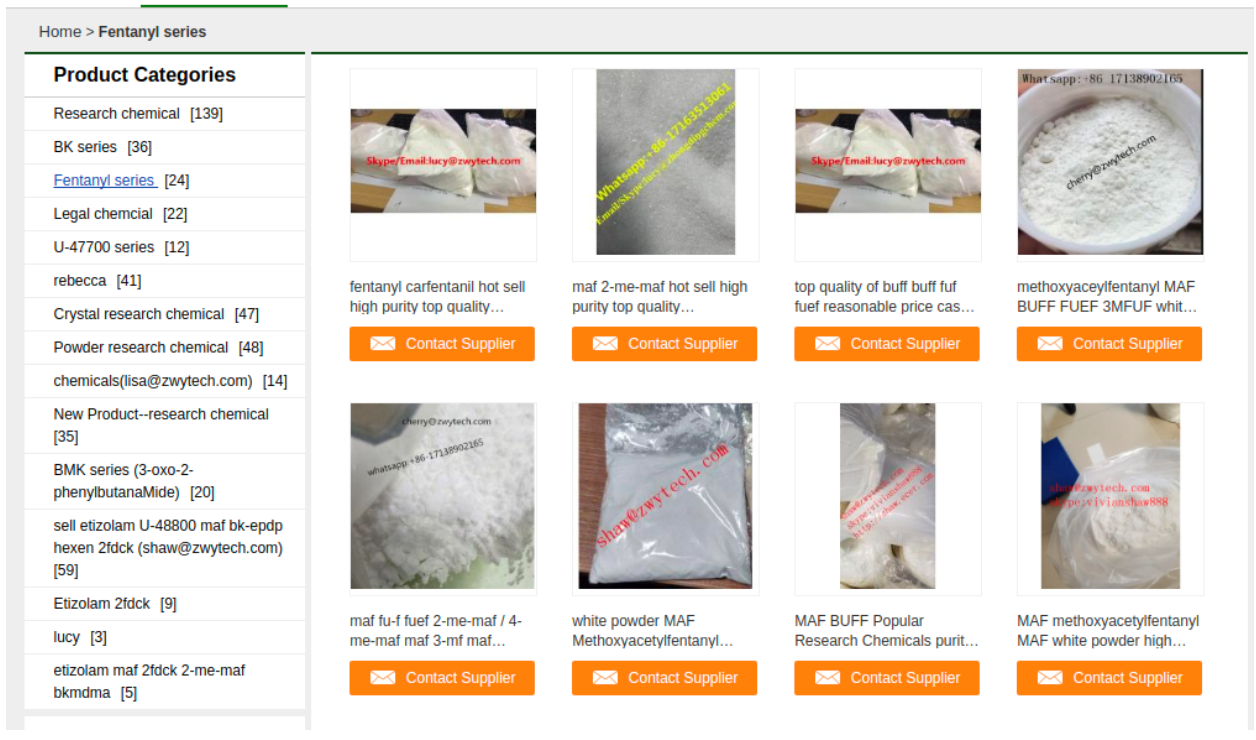
The companies offer the chemical compounds for sale on business-to-business (B2B) platforms operating out of Asia. On its profile with the Ecer.com marketplace, ZhongWeiYe advertises two dozen products as part of its “Fentanyl series” offering.
Both ZhongWeiYe and Xingtai Senyang market methoxyacetylfentanyl, a fentanyl analog used as a designer drug, on the ECRobot and eWorldTrade e-commerce platforms, respectively. Methoxyacetylfentanyl is one of the newest opioids entering the heroin market, the U.S. National Library of Medicine, a branch of the National Institutes of Health, said in November 2018. Xingtai Senyang’s eWorldTrade’s profile also advertises the sale of furanylfentanyl, a fentanyl analog classified by the U.S. Department of Justice as a Schedule I controlled substance. The dangers of furanylfentanyl were highlighted in a July 2018 health alert from the Centers for Disease Control and Prevention, which noted that the designer drug was responsible for 5 percent of fentanyl-related overdose deaths recorded in a 2016-2017 CDC study.
Beyond fentanyl and its analogs, Xingtai Senyang markets BMK and PMK, chemical compounds that the European Union says serves as the primary precursors for amphetamine and MDMA, respectively, as well as 5F-MDMB-2201, a synthetic cannabinoid. Xingtai Senyang and ZhengWeiYe’s online marketing is conducted mostly in English, and the firms touts a Western-based clientele on their advertisements.
On its website, Xingtai Senyang states that its main sales territories were the U.S., U.K., Australia, Poland and Canada. On the EC Plaza Network B2B platform operated from South Korea, Xingtai Senyang said its main target region is The Netherlands. ZhongWeiYe’s website offers delivery of furanylfentanyl to Brazil and the Czech Republic, as well as the U.S., despite its prohibition there.
Customers looking to buy fentanyl from the firms are offered a wide range of U.S. and European shipping providers. Xingtai Senyang and ZhengWeiYe also say they accept payments via major U.S. payment providers as well as Bitcoin.
Xingtai Sentang’s corporate disclosure says it is in the business of “wholesale retail” of “household goods, knitted goods, and bicycle accessories.” Xingtai Senyang shares the same phone numbers and address with the similarly-named Xingtai Senyang Food Import & Export Trade Co., Ltd., which sells food items on e-commerce sites.