
Update, 6/24/26: The U.S. Treasury Department on Tuesday sanctioned Cambodian national Chen Bo for his affiliation with the Prince Group syndicate, after this report had identified him as the current or former director of at least eight sanctioned Prince Group companies.
Treasury also sanctioned parts of Chen’s broader network that Kharon research had documented, including a Cambodian bank he majority-owns.
The Brief’s original story, from March 31, continues below.
The United Kingdom intensified the international campaign against the multibillion-dollar Southeast Asian scam economy last week, issuing new sanctions that target the networks of the Prince Group conglomerate.
The U.K.’s move builds on October’s coordinated action with the U.S. against the Cambodia-based Prince Group, as well as sanctions by South Korea and legal actions against its chairman, Chen Zhi. The U.S. has said that the Prince Group “operates a transnational criminal empire” of prolific crypto investment scams.
The latest scam sanctions are the U.K.’s first since the release of its 2026 Fraud Strategy, which marks an evolution from a focus on supporting domestic victims into a more aggressive, sanctions-backed focus on tackling international fraud at its source.
What to know: Unlike traditional organized crime, Southeast Asian cyberscam networks often hide behind a veneer of corporate legitimacy. The U.K., by targeting entities like BSquare Technology and Tian Xu International Technology, is going after the alleged technical backbone of the scam economy: the IT firms and cryptocurrency platforms that allow illicit funds to move across borders with relative ease.
Yet these actions also highlight the persistent challenge of navigating complex structures in the region. As regulators expand their scrutiny on the networks of the Prince Group, ties between seemingly independent entities can become a primary risk indicator.
And some of those risk-relevant ties won’t be immediately obvious.
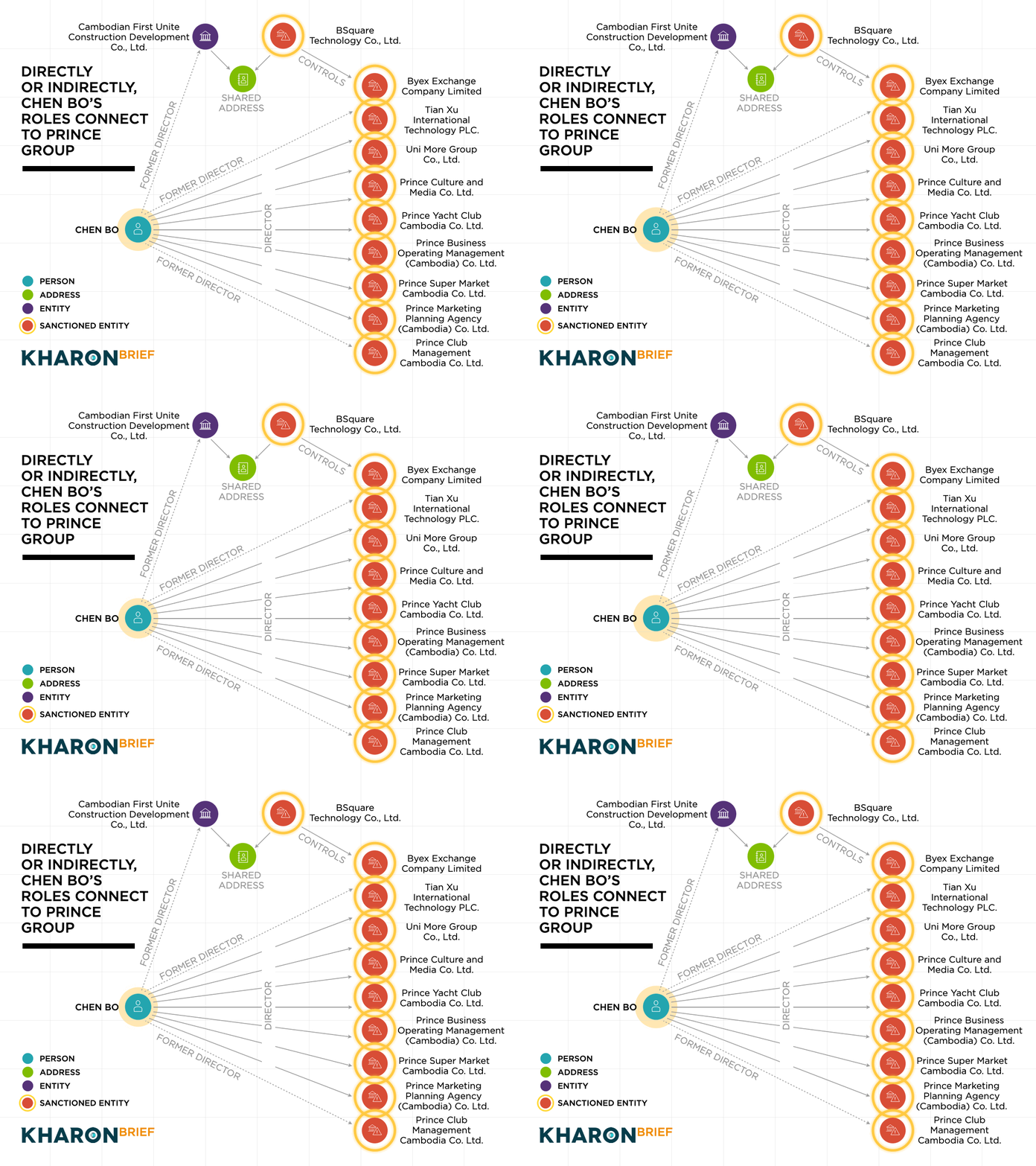
From Kharon’s research: Cambodian corporate records list Tian Xu’s director as Cambodian national Chen Bo. Chen, whom corporate records list as the current or former director of at least eight sanctioned Prince Group companies, including the BSquare subsidiary Byex Exchange, has not been targeted by sanctions himself.
But there are likely many more Prince Group connections than what the U.K., U.S. and South Korea have documented so far. One construction firm that Chen previously directed, Cambodian First Unite Construction Development Co., notably shares a listed address in Phnom Penh with newly sanctioned BSquare.
Treasury also sanctioned parts of Chen’s broader network that Kharon research had documented, including a Cambodian bank he majority-owns.
The Brief’s original story, from March 31, continues below.
The United Kingdom intensified the international campaign against the multibillion-dollar Southeast Asian scam economy last week, issuing new sanctions that target the networks of the Prince Group conglomerate.
The U.K.’s move builds on October’s coordinated action with the U.S. against the Cambodia-based Prince Group, as well as sanctions by South Korea and legal actions against its chairman, Chen Zhi. The U.S. has said that the Prince Group “operates a transnational criminal empire” of prolific crypto investment scams.
The latest scam sanctions are the U.K.’s first since the release of its 2026 Fraud Strategy, which marks an evolution from a focus on supporting domestic victims into a more aggressive, sanctions-backed focus on tackling international fraud at its source.
- The U.K. appears to be recasting scam operations as a tier-one threat to British financial security, leveraging the Global Human Rights Sanctions Regulations.
What to know: Unlike traditional organized crime, Southeast Asian cyberscam networks often hide behind a veneer of corporate legitimacy. The U.K., by targeting entities like BSquare Technology and Tian Xu International Technology, is going after the alleged technical backbone of the scam economy: the IT firms and cryptocurrency platforms that allow illicit funds to move across borders with relative ease.
Yet these actions also highlight the persistent challenge of navigating complex structures in the region. As regulators expand their scrutiny on the networks of the Prince Group, ties between seemingly independent entities can become a primary risk indicator.
And some of those risk-relevant ties won’t be immediately obvious.
From Kharon’s research: Cambodian corporate records list Tian Xu’s director as Cambodian national Chen Bo. Chen, whom corporate records list as the current or former director of at least eight sanctioned Prince Group companies, including the BSquare subsidiary Byex Exchange, has not been targeted by sanctions himself.
- According to a database of Cambodian citizenship records, published by the Mekong Independent, a Chinese national named Chen Bo received Cambodian citizenship in 2014, after immigrating from the same area as Prince Group chief Chen Zhi.
But there are likely many more Prince Group connections than what the U.K., U.S. and South Korea have documented so far. One construction firm that Chen previously directed, Cambodian First Unite Construction Development Co., notably shares a listed address in Phnom Penh with newly sanctioned BSquare.
- That kind of material tie risks exposure to—and the possibility of collaboration with—a sanctioned party.
There are also U.S. connections here:
In sanctioning Tian Xu, the U.K. listed the website for the mobile wallet CoolCash Cambodia, which remains listed on the Google Play Store, a Kharon review found. The platform’s listing describes Tian Xu as the company behind it.
The U.K. also sanctioned Xinbi Company Limited, the Colorado-registered parent company of Xinbi Guarantee, a Chinese-language online marketplace that allows users to exchange cryptocurrency for illicit services, as Elliptic reported last year. Operating primarily through Telegram, Xinbi has facilitated a scam center linked to the Prince Group and the laundering of stolen North Korean crypto assets, the U.K. said.
As countries increasingly synchronize their actions in this space, undetected ties to sanctioned actors are likely to come under scrutiny—increasing the risks for Western and Korean firms alike.
Read more from The Brief:
- The Alleged Power Players Behind the ‘Pig-Butchering’ Scams Costing Americans Billions
- How Chinese Networks Are Using US Banks to Launder Drug Cartels’ Cash
- The Cyberscam-Tied Cambodian Network That Treasury Just Cut Off from the US Financial System
- How UFLPA Risks from Xinjiang Flow into Major Automakers’ Car Seats