
The Pentagon’s biggest-name addition to its list of “Chinese military companies” last week was one of China’s biggest tech brands: Alibaba Group.
That 1260H listing means the Wall Street-traded e-commerce and AI giant will soon be blocked from doing business with the Department of Defense, with further supply-chain restrictions to take effect next year. As explanation, DOD alleged only that Alibaba was “indirectly affiliated” with China’s state assets agency and a “military-civil fusion contributor” because it was “affiliated” with a state tech regulator.
What our research shows: One Alibaba-associated company traced by Kharon might offer a clue. Its own ties to state defense strategy run deep.
A Kharon review of corporate records and public statements shows two distinct pathways connecting it to Alibaba.
1. Ownership: Qianxun Spatial launched, in 2015, as a joint venture between Alibaba and China North Industries (Norinco) Group, the state-owned defense and industrial conglomerate.
That 1260H listing means the Wall Street-traded e-commerce and AI giant will soon be blocked from doing business with the Department of Defense, with further supply-chain restrictions to take effect next year. As explanation, DOD alleged only that Alibaba was “indirectly affiliated” with China’s state assets agency and a “military-civil fusion contributor” because it was “affiliated” with a state tech regulator.
- Alibaba in a statement denied that it was “a Chinese military-industrial enterprise” and said there was “no basis for designating Alibaba Group as such.”
- A Pentagon spokesperson declined to provide further details.
What our research shows: One Alibaba-associated company traced by Kharon might offer a clue. Its own ties to state defense strategy run deep.
The firm
Shanghai-based Qianxun Spatial Intelligence calls itself the “world’s leading” service provider of high-precision satellite positioning, a technology that has both civilian and military uses.A Kharon review of corporate records and public statements shows two distinct pathways connecting it to Alibaba.
1. Ownership: Qianxun Spatial launched, in 2015, as a joint venture between Alibaba and China North Industries (Norinco) Group, the state-owned defense and industrial conglomerate.
- Norinco, which the U.S. separately flagged in 2021 for involvement in China’s military-industrial complex, still holds a 32% stake in the satellite-positioning firm.
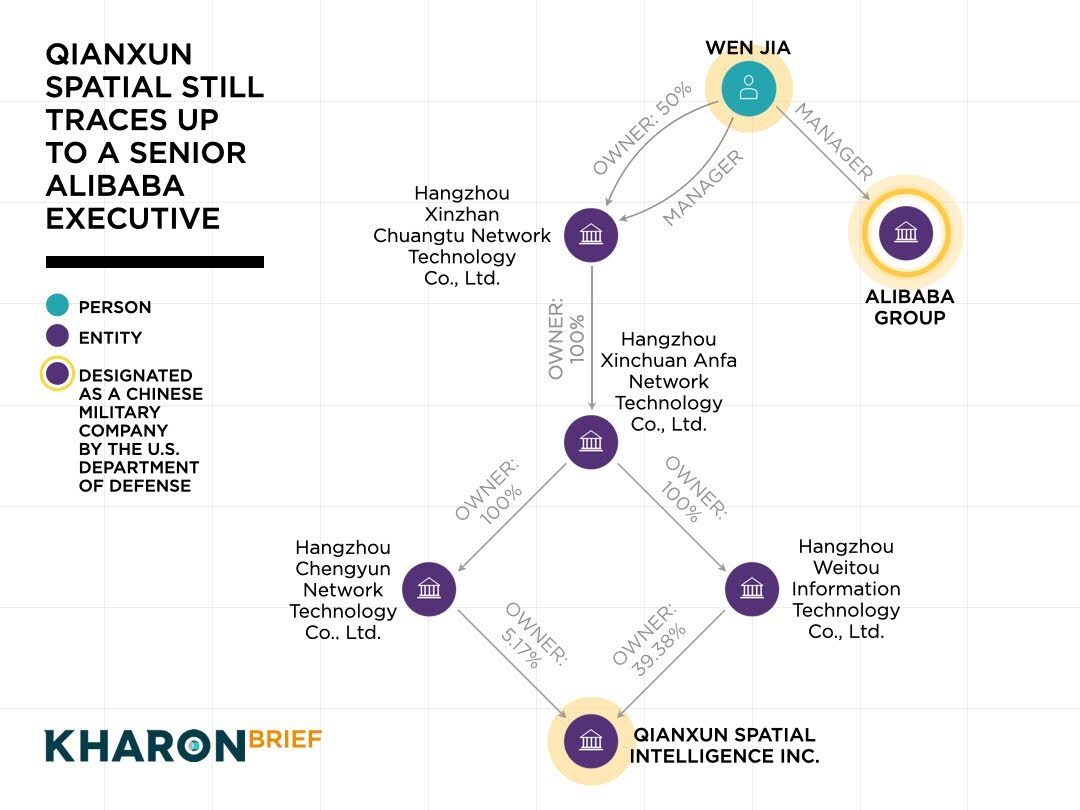
Kharon users can explore this network in greater detail through the ClearView platform.
2. Services: Qianxun Spatial partners with Alibaba Cloud, whose services it leverages to “deliver innovative spatiotemporal intelligence solutions tailored to diverse industries,” as an Alibaba Cloud news release put it last July.
In that release, the Alibaba Group subsidiary touted its “high degree of compatibility” with “high-precision positioning services, enabling it to provide robust support to Qianxun Spatial.”
The military connections and risks
Qianxun Spatial’s chief executive, Chen Jinpei, was interviewed in 2019 by China’s State-owned Assets Supervision and Administration Commission of the State Council (SASAC), the agency that DOD last week named as “indirectly” connected to Alibaba.Qianxun Spatial was established, Chen said, to help “drive the large-scale deployment” of the BeiDou Navigation Satellite System, a state-developed geolocation infrastructure overseen by Chinese government authorities. A “clear alignment between national strategy and societal needs” drove Alibaba and Norinco to team up, he added.
- Since then, Qianxun Spatial has built out the BeiDou Ground-Based Augmentation System, a national network of high-precision positioning infrastructure critical to the BeiDou apparatus.
Two more risk routes:
- Patent data shows that Qianxun Spatial has worked with Norinco on two drone-related patents, including one related to high-precision positioning.
- According to company statements, it also has partnered on BeiDou-related work with Guangzhou Hi-Target Navigation Tech Co., Ltd. and Runjian Co., Ltd., two companies that operate in dual-use technologies and have sold to the PLA.
The bottom line
The law that authorizes the 1260H list offers wide latitude for the Pentagon to designate a company, and its reasoning remains unclear not only for Alibaba but also for the Chinese search titan Baidu, for which it cited the same alleged “affiliations.”But if the U.S. wanted to target Alibaba, connections like Qianxun Spatial’s would help build the case.
Read more from The Brief: