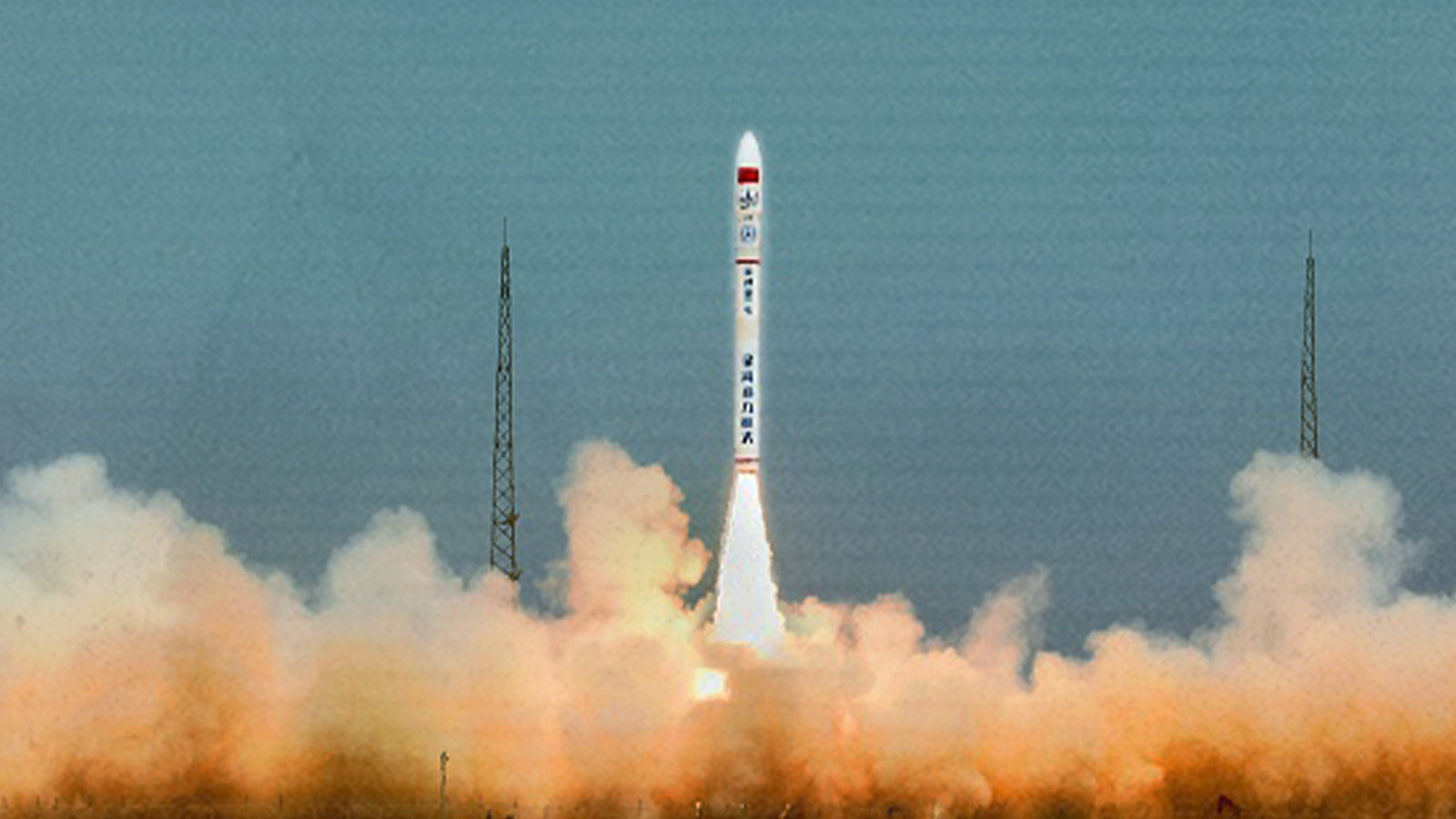
On June 6, 2024, a Ceres-1 rocket lifted off from Jiuquan Satellite Launch Center, a facility in China’s northwest desert operated by the People’s Liberation Army. The mission’s code name was “Love On Top,” but its payload would soon be used for war.
The satellite on board, TEE-01B, was commissioned by The Earth Eye Co., a Beijing export broker specializing in Belt and Road markets, and built by Chang Guang Satellite Technology Co. Official announcements from China’s Ministry of Industry and Information Technology described the satellite as serving “land surveys, disaster monitoring, and geographic mapping.”
By the end of 2024, it was in the hands of Iran’s Islamic Revolutionary Guard Corps (IRGC), monitoring U.S. military bases across the Middle East before and after missile and drone strikes. News of the acquisition, revealed in leaked Iranian military documents reported by the Financial Times, made the satellite one of the most politically sensitive China-linked assets tied to the Iran conflict.
But TEE-01B is not the only private Chinese space asset backed by Beijing’s military being used by Western adversaries. China has been building out its commercial space ecosystem for more than a decade: opening its launch sector to private capital, but embedding state and military oversight at every layer.
A Kharon review of corporate filings and launch records found that China’s broader space ecosystem has also been inserting itself into conflict zones, providing surveillance and launch capabilities not only to Iran but also to Russia.
“China has launched increasing numbers of satellites … significantly enhancing the PLA’s use of space for war fighting,” the U.S.-China Economic and Security Review Commission said in its annual report published in November. “These satellites support both intelligence, surveillance, and reconnaissance (ISR) and positioning, navigation, and timing (PNT) missions as well as provide a suite of counter space capabilities that could monitor, target, deny, degrade, or destroy U.S. and allied space assets.”
Chang Guang had already been sanctioned by the U.S. in 2023 for the use of its satellite imagery by Russian forces in Ukraine, making the U.S. Treasury Department’s designation of the firm earlier this month under Iran-related authorities the second round against the company. Earth Eye was also sanctioned — for the first time — in the same action, as Treasury targeted both companies for aiding Iran’s military operations amid the war.
But the firm that launched the TEE-01B’s rocket, Galactic Energy, has not been targeted with U.S. sanctions. It’s part of a cohort of launch companies that Chinese investors have dubbed the Commercial Space “Five Little Dragons.”
The commercial label, however, masks their military ties.
All five companies rely on state-controlled launch infrastructure, operate under defense-sector regulatory oversight, and hold military production licenses permitting them to develop and supply defense-related equipment. And each is now moving toward listings on Shanghai’s STAR Market.
The satellite on board, TEE-01B, was commissioned by The Earth Eye Co., a Beijing export broker specializing in Belt and Road markets, and built by Chang Guang Satellite Technology Co. Official announcements from China’s Ministry of Industry and Information Technology described the satellite as serving “land surveys, disaster monitoring, and geographic mapping.”
By the end of 2024, it was in the hands of Iran’s Islamic Revolutionary Guard Corps (IRGC), monitoring U.S. military bases across the Middle East before and after missile and drone strikes. News of the acquisition, revealed in leaked Iranian military documents reported by the Financial Times, made the satellite one of the most politically sensitive China-linked assets tied to the Iran conflict.
But TEE-01B is not the only private Chinese space asset backed by Beijing’s military being used by Western adversaries. China has been building out its commercial space ecosystem for more than a decade: opening its launch sector to private capital, but embedding state and military oversight at every layer.
A Kharon review of corporate filings and launch records found that China’s broader space ecosystem has also been inserting itself into conflict zones, providing surveillance and launch capabilities not only to Iran but also to Russia.
“China has launched increasing numbers of satellites … significantly enhancing the PLA’s use of space for war fighting,” the U.S.-China Economic and Security Review Commission said in its annual report published in November. “These satellites support both intelligence, surveillance, and reconnaissance (ISR) and positioning, navigation, and timing (PNT) missions as well as provide a suite of counter space capabilities that could monitor, target, deny, degrade, or destroy U.S. and allied space assets.”
Chang Guang had already been sanctioned by the U.S. in 2023 for the use of its satellite imagery by Russian forces in Ukraine, making the U.S. Treasury Department’s designation of the firm earlier this month under Iran-related authorities the second round against the company. Earth Eye was also sanctioned — for the first time — in the same action, as Treasury targeted both companies for aiding Iran’s military operations amid the war.
But the firm that launched the TEE-01B’s rocket, Galactic Energy, has not been targeted with U.S. sanctions. It’s part of a cohort of launch companies that Chinese investors have dubbed the Commercial Space “Five Little Dragons.”
The commercial label, however, masks their military ties.
All five companies rely on state-controlled launch infrastructure, operate under defense-sector regulatory oversight, and hold military production licenses permitting them to develop and supply defense-related equipment. And each is now moving toward listings on Shanghai’s STAR Market.
The CERES-1 carrier rocket, carrying the TEE-01B satellite and two other satellites, blasts off from the Jiuquan Satellite Launch Center, in northwest China, in June 2024. (Wang Haixia/Xinhua via Getty Images)
The War Record
Galactic Energy founder Liu Baiqi had spent years working at China Aerospace Science and Technology Corporation, the state-owned manufacturer behind China’s Long March rockets, before striking out on his own in 2018. In a 2020 interview, he said 70% of his team were veterans of China’s state aerospace system like him, most with 10 to 20 years of experience.His ambition, he said, was to build a company that “delivers packages to space.” Four others had a similar business model.
Each of the Five Little Dragons — Galactic, LandSpace, CAS Space, iSpace, and Space Pioneer — was founded in the three years after Beijing opened its space sector to private capital in 2015. Each was built around founders and engineers who, like Liu, came from state aerospace institutions with a shared mission: to “catch up” with SpaceX and help China achieve Xi Jinping’s longtime strategic objective of becoming “a space power.”
They marketed themselves to investors as commercial ventures: nimble, private, profit-driven. Their IPO filings and press releases cited payload capacity, repeat clients, and market demand as proof.
Yet that commercial framing hid a deeper entanglement with state-linked aerospace and defense systems, and geopolitical risks. Some of those repeat clients would later be sanctioned for fueling Russia’s war in Ukraine. A Kharon review found that at least three of the five had launched satellites for those sanctioned entities anyway — both before the designations and after.
Beijing has consistently rejected accusations that it supplies weapons or intelligence to Iran and Russia as “fabricated rumors.” The Chinese companies did not respond to requests for comment.
Launches Tied to Russia's and Iran's War Efforts
Kharon found that, across nine launches between 2021 and 2025, Galactic, CAS Space, and LandSpace collectively placed more than 20 satellites into orbit for operators now tied to Russia's war effort, as well as for Iran’s military. Each of those launches took place from the Jiuquan Satellite Launch Center, the PLA-controlled launchpad.
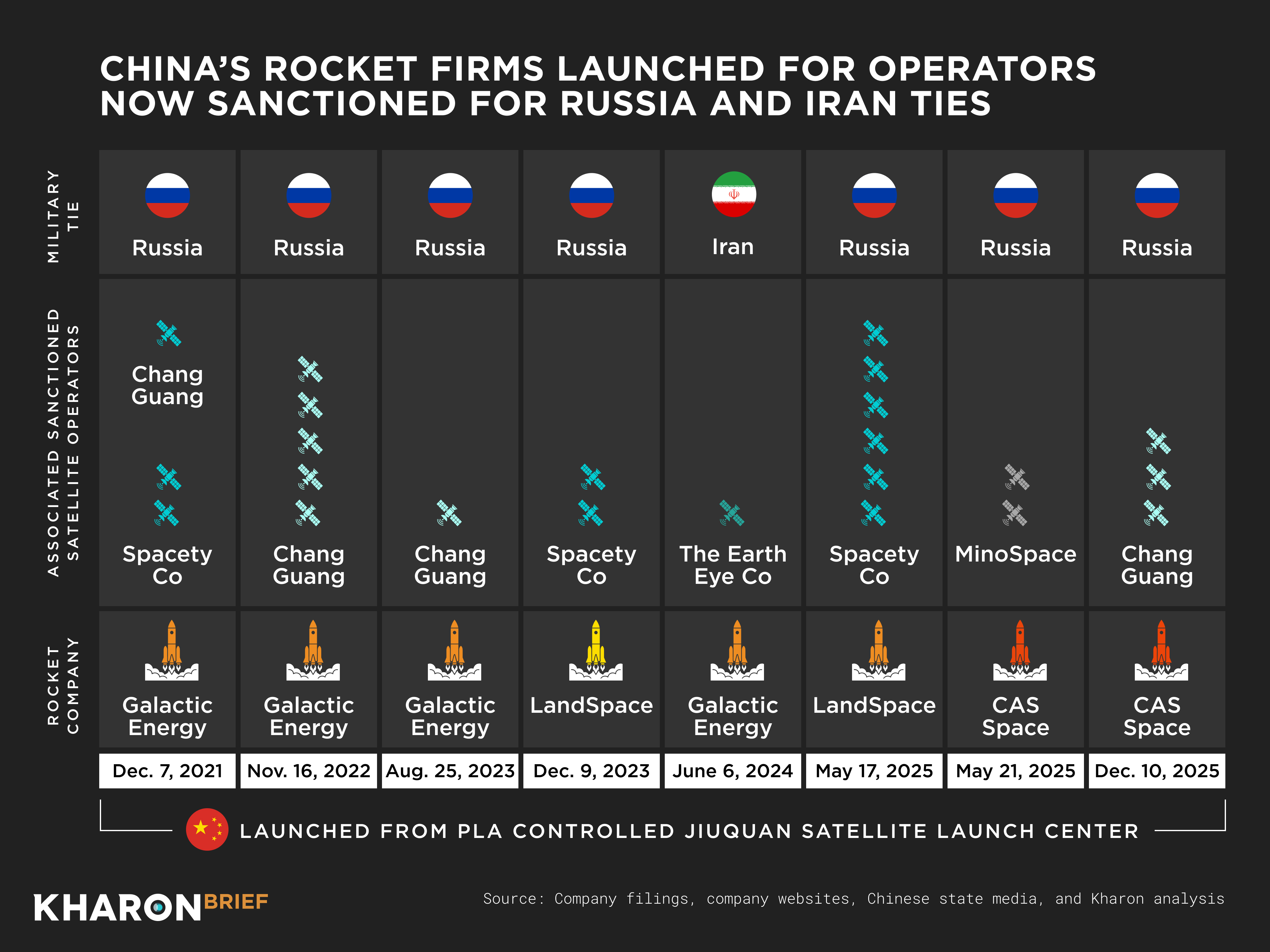
(Yin Liao/Kharon)
Galactic Energy has launched three times for Chang Guang and once for Spacety Co. In early 2023, Spacety became the first Chinese commercial satellite firm to be sanctioned by the U.S., for providing imagery over Ukraine that officials said enabled Wagner Group combat operations. Chang Guang was sanctioned later that year for imagery used to support Russian military operations, with EU sanctions following in June 2024.
“Countries hired mercenaries in the 18th century,” Swope said. “In the 21st century, they buy space services from global companies.”
Hidden Defense Supply Chains
The space sector’s military entanglement runs deeper than the launchpad.
Beyond their launch records, several of the Five Little Dragons maintain direct supply relationships with Chinese military institutions — through subsidiaries that rarely appear in investor materials.
- Chang Guang subsequently terminated its IPO application in December 2024, citing in local media reports U.S. sanctions and ongoing financial losses. By this past January, however, it announced that it would restart its IPO process in Shanghai.
- A satellite built by MinoSpace reportedly was transferred to Russian ownership after launch in 2024 and later used for surveillance over Ukraine.
- LandSpace’s IPO prospectus identifies one prominent client only as “Unit D.” Kharon identified “Unit D” as Spacety by cross-referencing the prospectus with Chinese government launch records and state media reports.
“Countries hired mercenaries in the 18th century,” Swope said. “In the 21st century, they buy space services from global companies.”
Hidden Defense Supply Chains
The space sector’s military entanglement runs deeper than the launchpad.
Beyond their launch records, several of the Five Little Dragons maintain direct supply relationships with Chinese military institutions — through subsidiaries that rarely appear in investor materials.
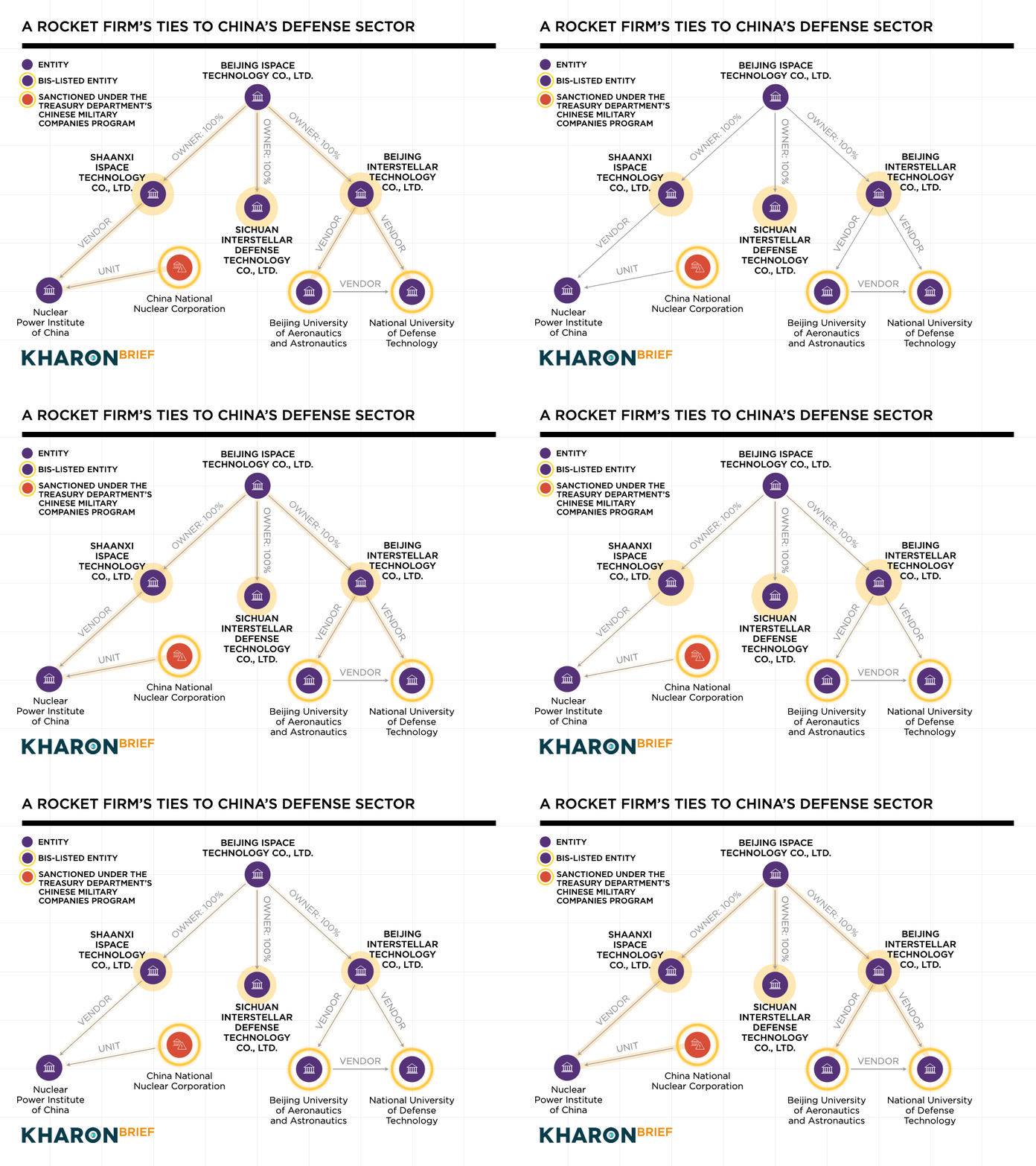
iSpace, for example, describes itself as a private commercial launch provider. But three of its wholly owned subsidiaries have conducted business with entities on U.S. restricted lists or within China’s defense industrial complex.
- Procurement records show that Beijing Interstellar Technology, one of the iSpace subsidiaries, supplied equipment to the National University of Defense Technology, a PLA unit, and to Beihang University of Aeronautics and Astronautics. The U.S. has added both to the Entity List, subjecting them to heightened export controls, for alleged military ties.
- A second subsidiary, Shaanxi iSpace Technology, provided prototype fabrication and testing services to a unit of the U.S.-sanctioned China National Nuclear Corporation, which oversees both civilian and military nuclear programs.
- And a third, Sichuan Interstellar Defense Technology, exhibited at China's Military Intelligent Technology and Equipment Expo in 2025. According to Expo materials reviewed by Kharon, the company described its product portfolio, “built on iSpace's core rocket technology,” as including sounding rockets, small guided weapons, and guided munitions.
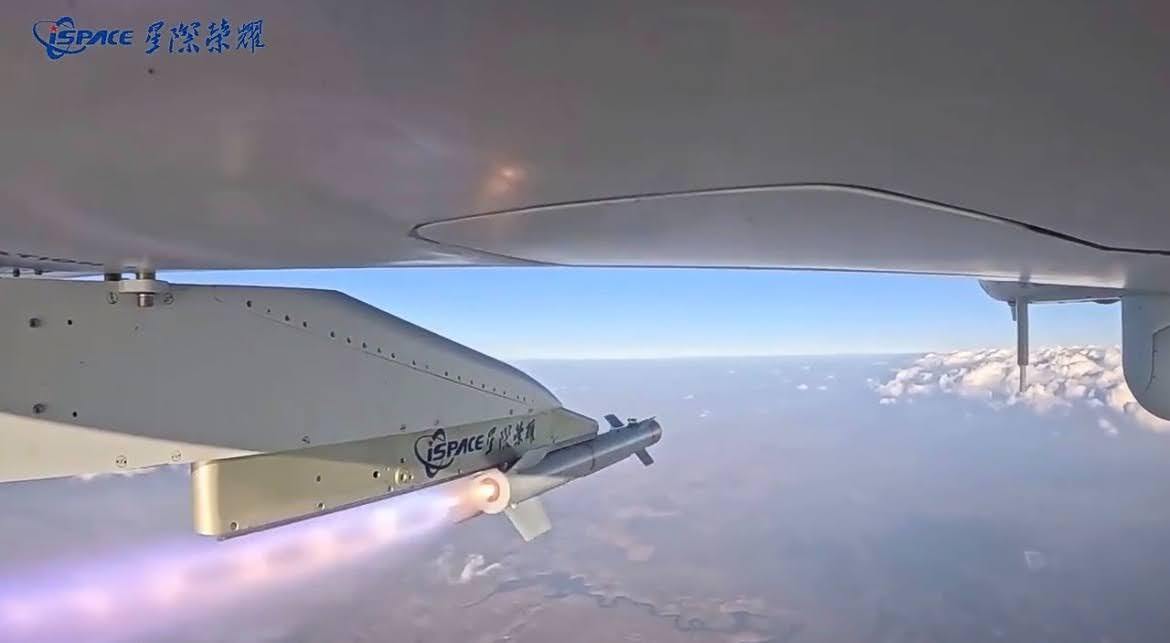
A November 2025 video posted by iSpace shows a “small guided aircraft” weapon developed with an “unspecified unit” completing medium-and long-range test missions, “paving the way for mass production.” (iSpace)
Built to Scale
The Five Little Dragons represent the cusp of a fast-growing Chinese space sector fostered by the central government: At its top political forum this year, Beijing elevated commercial space to an “emerging pillar industry” in its latest five-year plan.“Beijing saw how the United States got national and economic security from a vibrant space industry,” CSIS’s Swope said. “Leaders in China want to create not just the next SpaceX but dozens of them.”
The expansion of China’s commercial space sector has proceeded on two tracks: tighter operational control and broader financial access.
To tighten control, the Chinese agency overseeing military-civil fusion issued new rules in 2025 requiring commercial operators to "report facility data and operational status to central authorities” — giving Beijing's military and intelligence apparatus visibility into every aspect of the sector.
To fuel growth, China's securities regulator extended to commercial space its “fifth listing standard,” rules originally designed to spur funding for unprofitable biotech firms that helped that industry raise more than $10 billion. The Chinese National Space Administration followed with a three-year plan for reusable launch vehicles, and in December the Shanghai Stock Exchange released new listing guidelines designed to “accelerate commercial aerospace innovation and actively serve the aerospace strong-nation strategy.”
The capital markets responded to Beijing’s efforts. In early 2026, a wave of Chinese space companies have, like the Five Little Dragons, moved toward public listings in Shanghai:
- Chang Guang, in restarting its IPO process, secured roughly $70 million in state-linked strategic investment. Despite new U.S. sanctions related to Iran in May, the offering remained on track.
- Spacety entered IPO counseling in February and raised $180 million from government-linked investors two months later.
- MinoSpace Technology filed for a STAR Market listing this month. In its prospectus, the company said its objective was “to serve national strategic goals.” It redacted the names of customers and suppliers and classified its exposure to U.K. sanctions under “geopolitical risk.”
China’s commercial space companies are now “poised to become critical suppliers to flagship programs,” he said, including through cargo services to China’s space station. The influx of capital, Besha added, will enable them to “scale rapidly.”
Commercial launches accounted for more than half of all Chinese launches in 2025, while commercial satellites represented 84% of all satellites placed into orbit that year. By year’s end, China had more than 600 commercial space companies, up more than 20% from a year earlier, according to the China National Space Administration.
“It took China 37 years to complete its first 100 rocket launches,” Liu Zheng, a senior aerospace engineer at China Aerospace Science and Technology Corporation and a delegate to China’s top political advisory body, said in March. “The most recent 100 were completed in just over one year.”
Read more from The Brief: