
The European Union is drafting aggressive new trade measures that would compel European companies to diversify their supply chains away from single-country dependencies, a move meant to counter threats posed by over-reliance on Chinese exports.
EU officials say the proposed framework represents a shift toward so-called structural regulatory requirements that are aimed at insulating the bloc’s industrial base from China’s “weaponization of trade” and a surge in heavily subsidized imports from the country.
China isn’t specifically cited in the proposal. But by mandating structural diversification, EU officials say they hope to mitigate Chinese supply concerns affecting both national and economic security: preventing Beijing from being able to leverage strategic chokeholds on goods and resources, or from flooding markets with subsidized products.
Big picture: The proposal addresses long-running U.S. criticism that Europe has not done enough to counter security risks associated with China’s expanding economic presence across the Atlantic.The trigger
The EU is looking to sidestep traditional strategies used to defend against unfair trade practices that require exhaustive, multi-year investigations under World Trade Organization rules, officials said. To bypass those enforcement bottlenecks, the EU is proposing a law that establishes baseline “structural caps.”
The draft proposal: Businesses could procure only 30-40% of critical components from any single supplier; the rest would have to be sourced from at least three different suppliers, with an explicit restriction that they cannot all reside within the same country.
The idea is in large part a response to Beijing’s recent export controls on critical materials, such as the rare earth magnet restrictions that paralyzed European automotive production lines last year, officials said. But they noted that the framework will also apply to other highly concentrated global resource markets, such as helium and cobalt. The initial phase of the rollout is expected to hit critical industries currently facing markets distorted by a flood of subsidized Chinese imports, notably chemicals and industrial machinery.
Compliance consequences
For compliance officers, the proposed mandate fundamentally would expand the scope of traditional Know Your Customer (KYC) and Know Your Supplier (KYS) protocols. Historically, screening has focused on identity and association—checking whether a third party was owned or controlled by a sanctioned individual or an entity recorded on watchlists such as the EU’s Annex IV, or the U.S. Entity List.
Under the proposed EU rules, however, compliance teams would need to pivot, to screening for geographic concentration and provenance tracking:Case study: A sourcing illusion
Global aerospace and industrial machinery supply chains highlight some of the operational challenges of the EU’s proposal.
A surface-level compliance screening, for instance, of component manufacturers like Aritex Cading, S.A. (Spain) or FACC AG (Austria) would categorize them as domestic European suppliers, seemingly ideal partners to fulfill the EU’s non-China sourcing quotas.
But a deeper mapping of the companies’ ownership chains reveals that both are structurally controlled by the Aviation Industry Corporation of China (AVIC)—a Chinese state-owned aerospace and defense conglomerate designated as a Chinese military company by the U.S. Department of Defense.
EU officials say the proposed framework represents a shift toward so-called structural regulatory requirements that are aimed at insulating the bloc’s industrial base from China’s “weaponization of trade” and a surge in heavily subsidized imports from the country.
China isn’t specifically cited in the proposal. But by mandating structural diversification, EU officials say they hope to mitigate Chinese supply concerns affecting both national and economic security: preventing Beijing from being able to leverage strategic chokeholds on goods and resources, or from flooding markets with subsidized products.
Big picture: The proposal addresses long-running U.S. criticism that Europe has not done enough to counter security risks associated with China’s expanding economic presence across the Atlantic.
The trigger
The EU is looking to sidestep traditional strategies used to defend against unfair trade practices that require exhaustive, multi-year investigations under World Trade Organization rules, officials said. To bypass those enforcement bottlenecks, the EU is proposing a law that establishes baseline “structural caps.” The draft proposal: Businesses could procure only 30-40% of critical components from any single supplier; the rest would have to be sourced from at least three different suppliers, with an explicit restriction that they cannot all reside within the same country.
The idea is in large part a response to Beijing’s recent export controls on critical materials, such as the rare earth magnet restrictions that paralyzed European automotive production lines last year, officials said. But they noted that the framework will also apply to other highly concentrated global resource markets, such as helium and cobalt. The initial phase of the rollout is expected to hit critical industries currently facing markets distorted by a flood of subsidized Chinese imports, notably chemicals and industrial machinery.
Compliance consequences
For compliance officers, the proposed mandate fundamentally would expand the scope of traditional Know Your Customer (KYC) and Know Your Supplier (KYS) protocols. Historically, screening has focused on identity and association—checking whether a third party was owned or controlled by a sanctioned individual or an entity recorded on watchlists such as the EU’s Annex IV, or the U.S. Entity List.Under the proposed EU rules, however, compliance teams would need to pivot, to screening for geographic concentration and provenance tracking:
- Deeper, multi-tier mapping: Businesses would have to conduct exhaustive enhanced due diligence to trace the origins of their raw material inputs and sub-components, to ensure that an intermediary in a “trusted” jurisdiction is not simply repackaging Chinese-origin inputs to bypass the 30-40% ceiling.
- Volume and sourcing analytics: It would become essential for compliance platforms to integrate real-time procurement data, to monitor global sourcing percentages. If a supply chain disruption forces a company to temporarily increase orders from a dominant supplier, automated compliance controls must trigger alerts before the legal threshold is breached.
- Geopolitical risk vectoring: Screening programs would need to map corporate networks against concentrated state-directed industrial policies and export-control regimes. This ensures that a company’s alternative suppliers are insulated from retaliatory trade blockades or sudden regulatory controls.
Case study: A sourcing illusion
Global aerospace and industrial machinery supply chains highlight some of the operational challenges of the EU’s proposal. A surface-level compliance screening, for instance, of component manufacturers like Aritex Cading, S.A. (Spain) or FACC AG (Austria) would categorize them as domestic European suppliers, seemingly ideal partners to fulfill the EU’s non-China sourcing quotas.
But a deeper mapping of the companies’ ownership chains reveals that both are structurally controlled by the Aviation Industry Corporation of China (AVIC)—a Chinese state-owned aerospace and defense conglomerate designated as a Chinese military company by the U.S. Department of Defense.
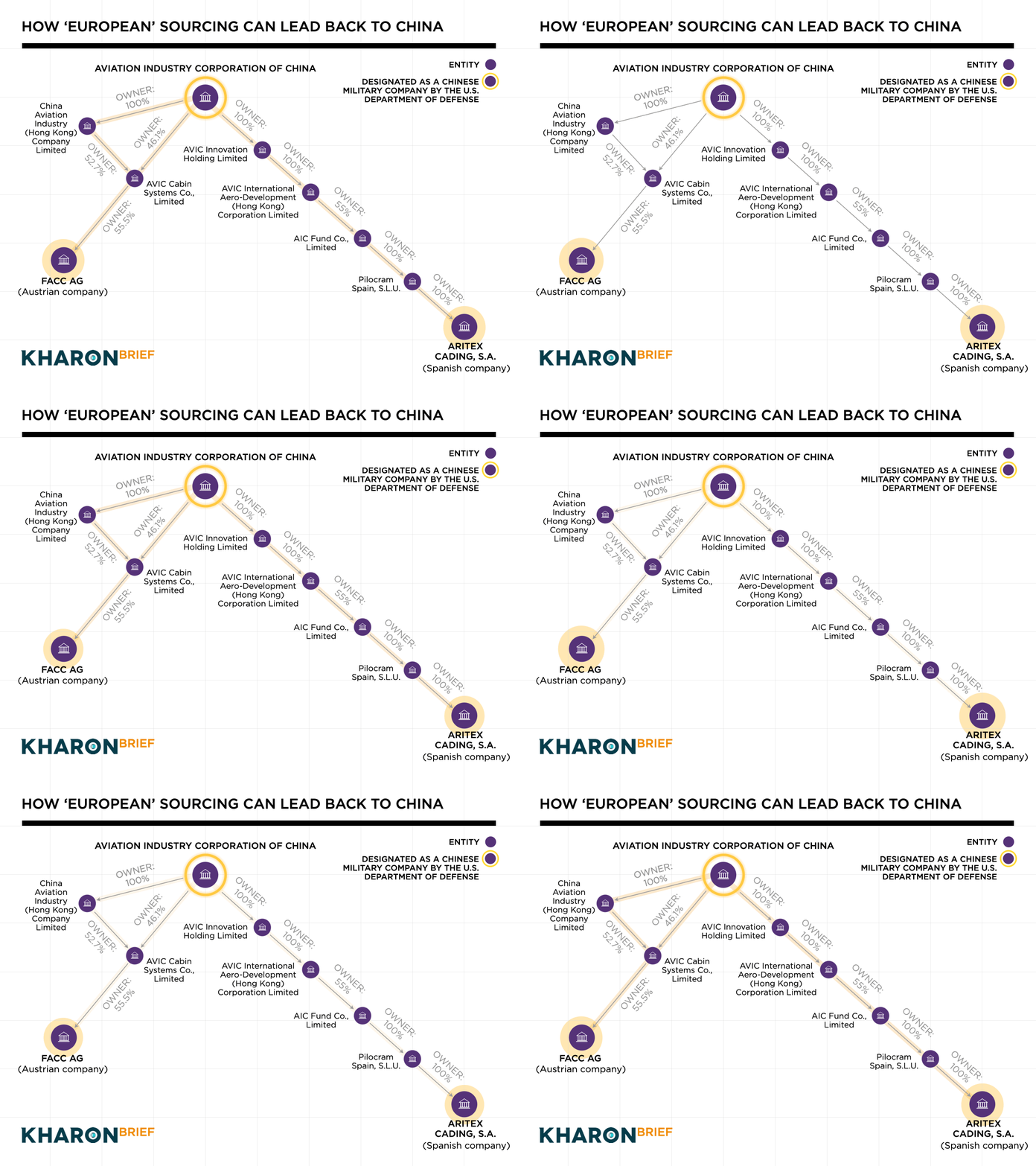
While these European-based companies operate globally and supply major Western aerospace giants, they remain deeply integrated into China’s defense ecosystem, actively supplying other AVIC subsidiaries like the Commercial Aircraft Corporation of China.
The upshot: For corporate buyers, relying on such entities to meet the EU’s 30-40% single-country cap would create a risky compliance blindspot. It could satisfy the letter of the law on paper while leaving a company’s supply chain exposed to Chinese state-directed ownership and potential export controls.
Looking ahead
The EU proposal represents the beginning of an internal tug-of-war that could delay any rollout and water down diversification targets. Debate in the European Parliament probably will hinge on the tradeoffs between corporate costs and national and economic security, as member states weigh how to balance diversification quotas against the operational realities of global supply chains.
While policymakers view the framework through the lens of strategic autonomy, initial market analyses and trade economists warn of significant economic costs, including fueling inflation and whittling profit margins.
The European Commission plans to present these measures during a dedicated meeting on May 29, with potential endorsement by EU leaders at a late-June summit. Depending on the political resistance the proposal faces, the process to potential enactment could take up to two years.
But as Western policymakers recast industrial dependencies as national security risks, corporations will need to embrace supply chain transparency as core to operational resilience. Legal compliance will require organizations to look past basic country-of-origin paperwork to verify the true geographic origin and corporate ownership of everything they buy.
Read more from The Brief:
The upshot: For corporate buyers, relying on such entities to meet the EU’s 30-40% single-country cap would create a risky compliance blindspot. It could satisfy the letter of the law on paper while leaving a company’s supply chain exposed to Chinese state-directed ownership and potential export controls.
Looking ahead
The EU proposal represents the beginning of an internal tug-of-war that could delay any rollout and water down diversification targets. Debate in the European Parliament probably will hinge on the tradeoffs between corporate costs and national and economic security, as member states weigh how to balance diversification quotas against the operational realities of global supply chains.While policymakers view the framework through the lens of strategic autonomy, initial market analyses and trade economists warn of significant economic costs, including fueling inflation and whittling profit margins.
- According to a 2025 survey published by the EU Chamber of Commerce in China, 22% of member companies import critical components for which they have no alternative sources. More than a quarter are able to source replacements but of lower quality, the survey found, and 7% said diversifying would increase costs.
The European Commission plans to present these measures during a dedicated meeting on May 29, with potential endorsement by EU leaders at a late-June summit. Depending on the political resistance the proposal faces, the process to potential enactment could take up to two years.
But as Western policymakers recast industrial dependencies as national security risks, corporations will need to embrace supply chain transparency as core to operational resilience. Legal compliance will require organizations to look past basic country-of-origin paperwork to verify the true geographic origin and corporate ownership of everything they buy.
Read more from The Brief: