
A flood of Chinese artificial intelligence companies are pursuing IPOs this year. And an overwhelming majority are landing in Hong Kong.
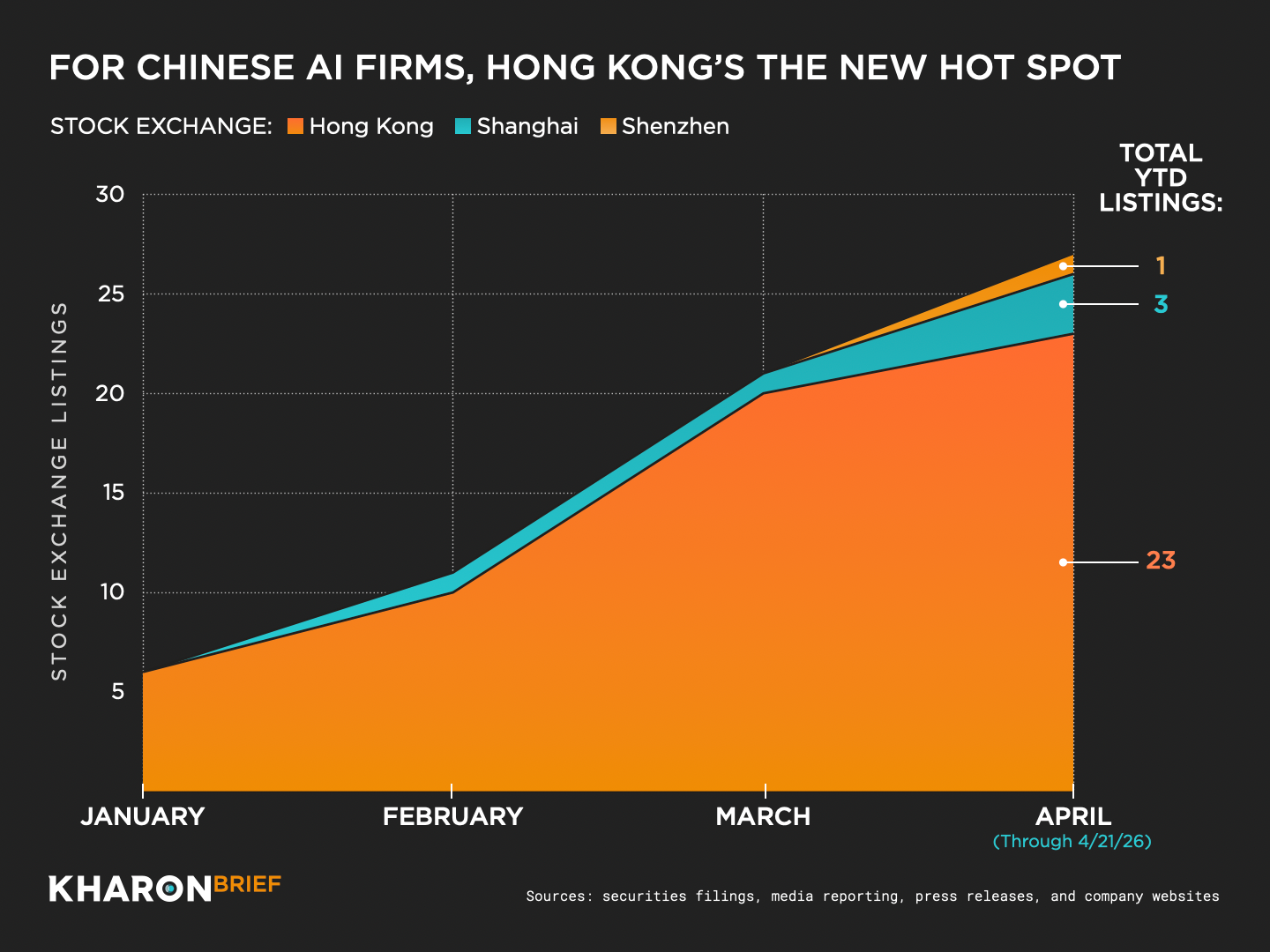
Through Tuesday, more than 85% of Chinese AI-related companies (23 of 27) that have gone public in 2026 have done so on Hong Kong’s stock exchange, a Kharon analysis found. Those numbers dwarf the year’s AI-related listings on Shanghai’s exchange, where China’s most ambitious tech companies have long listed, or Shenzhen’s, a longtime hub for high-growth firms:
Through Tuesday, more than 85% of Chinese AI-related companies (23 of 27) that have gone public in 2026 have done so on Hong Kong’s stock exchange, a Kharon analysis found. Those numbers dwarf the year’s AI-related listings on Shanghai’s exchange, where China’s most ambitious tech companies have long listed, or Shenzhen’s, a longtime hub for high-growth firms:
IPO fundraising on the Hong Kong exchange topped $14 billion all told in the first quarter, Hong Kong chief executive John Lee Ka-chiu said at an investment summit last week. According to the professional services firm KPMG, that’s close to six times the amount raised over the same period in 2025.
Experts told us a few reasons explain the shift.
Beijing’s backing: Beijing’s latest five-year plan promotes AI development as a national priority. It also pledges to “support” Hong Kong in cementing its role as a stable, investor-friendly international trade center amid global uncertainty.
Kyle Chan, a fellow at the Brookings Institution who studies China’s technology sector, noted that Hong Kong has become an offshore fundraising hub for Chinese companies seeking international expansion and R&D investment.
“What we’re seeing in Hong Kong is a pretty clear shift from a global financial center to a very China-focused instrument for Chinese companies to interface with the world,” said Samuel Bickett, a Washington-based lawyer who spent years working in compliance in Hong Kong and has addressed a U.S. congressional panel on the city’s financial system.
Hong Kong’s own push: The city has also been aggressively courting listings. “Hong Kong is cutting listing thresholds and rushing approvals to keep the IPO numbers up,” said Ho-fung Hung, a professor of political economy at Johns Hopkins University. The result, he argues, is “uneven listing quality and weakening regulatory standards.”
In any case, the gambit is working: Lee, the Hong Kong chief executive, said firms in AI, semiconductors, robotics, and autonomous driving were among more than 500 additional companies waiting to list in Hong Kong next.
Experts told us a few reasons explain the shift.
Beijing’s backing: Beijing’s latest five-year plan promotes AI development as a national priority. It also pledges to “support” Hong Kong in cementing its role as a stable, investor-friendly international trade center amid global uncertainty.
Kyle Chan, a fellow at the Brookings Institution who studies China’s technology sector, noted that Hong Kong has become an offshore fundraising hub for Chinese companies seeking international expansion and R&D investment.
“What we’re seeing in Hong Kong is a pretty clear shift from a global financial center to a very China-focused instrument for Chinese companies to interface with the world,” said Samuel Bickett, a Washington-based lawyer who spent years working in compliance in Hong Kong and has addressed a U.S. congressional panel on the city’s financial system.
- Zoom in: A series of prominent AI modeling and training companies, including MiniMax, Biren Technology, and Zhipu AI, all listed in January. Demand came not just from mainland investors but also from investors in the UAE, Singapore, South Korea, Switzerland, and the U.S., according to Hong Kong’s stock exchange operator.
Hong Kong’s own push: The city has also been aggressively courting listings. “Hong Kong is cutting listing thresholds and rushing approvals to keep the IPO numbers up,” said Ho-fung Hung, a professor of political economy at Johns Hopkins University. The result, he argues, is “uneven listing quality and weakening regulatory standards.”
In any case, the gambit is working: Lee, the Hong Kong chief executive, said firms in AI, semiconductors, robotics, and autonomous driving were among more than 500 additional companies waiting to list in Hong Kong next.
Methodology: Kharon compiled listings on the Hong Kong, Shanghai, and Shenzhen stock exchanges from January through the date of publication. Companies were classified as AI-related based on a review of securities filings, corporate websites, and media reporting, assessed against the Outbound Investment Security Program’s current regulations defining AI companies.
The U.S. element: Regulations are shaping companies’ decisions, too. “A company that was big enough would previously have tried to list in New York,” Bickett said. “Now, a lot of them really can’t do that. It’s too risky.”
The Treasury Department’s outbound investment rule, which took effect in January 2025 and has expanded since, is a big factor. While it doesn’t impose a blanket ban, the rule restricts U.S. investment in Chinese companies operating in AI and other advanced tech—and it complicates compliance.
The bottom line: As Hung explained it, the market for China’s AI upstarts is being scrambled by three competing forces: Hong Kong’s push to reassert its financial role, Beijing’s more cautious stance on financial risk before taking action, and continued participation from global investors.
“For now,” he said, “those forces are coexisting. But they may not do so indefinitely.”
James Disalvatore contributed research to this report.
Data Points columns zero in on the trends behind global trade, international sanctions and illicit finance, in one chart.
Read more from The Brief:
The Treasury Department’s outbound investment rule, which took effect in January 2025 and has expanded since, is a big factor. While it doesn’t impose a blanket ban, the rule restricts U.S. investment in Chinese companies operating in AI and other advanced tech—and it complicates compliance.
- Montage Technology, a Shanghai-based chip designer, acknowledged that new reality ahead of its own Hong Kong listing this year. The company’s legal advisor had determined it was a “covered foreign person” under the rule, its prospectus said, meaning U.S. investors may be required to notify Treasury. (That didn’t deter cornerstone investor J.P. Morgan Investment Management Inc.)
The bottom line: As Hung explained it, the market for China’s AI upstarts is being scrambled by three competing forces: Hong Kong’s push to reassert its financial role, Beijing’s more cautious stance on financial risk before taking action, and continued participation from global investors.
“For now,” he said, “those forces are coexisting. But they may not do so indefinitely.”
James Disalvatore contributed research to this report.
Data Points columns zero in on the trends behind global trade, international sanctions and illicit finance, in one chart.
Read more from The Brief: