
Iran relies on “shadow” banking networks — powered by private currency-trading companies and their front companies operating abroad — to get around sanctions-related restrictions on exchanging currency and paying for foreign goods and services. According to the U.S. Treasury Department, such networks have facilitated transactions worth billions of dollars on behalf of sanctioned Iranian actors.
The identities of these front companies, which act as middlemen that pay suppliers on Iran buyers’ behalf, are difficult to establish. But a Kharon investigation found that some Chinese firms have disclosed details of their Iran sales in state financial documents, offering rare apparent visibility into this system and the offshore intermediaries — most of them in Hong Kong — that keep cross-border payments moving.
Many of the named intermediaries, corporate records show, dissolved only two or three years after they were registered, lifespans suggestive of pop-up companies created for the sole purpose of bypassing financial restrictions.
The process of facilitating such indirect payments from Iran, according to the disclosures of multiple Chinese companies, typically involves four steps:
A Kharon review of its financial documents identified more than $6 million worth of trade it sent to Iranian companies that paid through third parties between 2023 and 2024. The group included at least seven now-sanctioned agents across Hong Kong, Singapore, and Türkiye. Two additional Chenguang payment-remitters — both directed by the same Chinese national and both dissolved last year — were registered in London.
The identities of these front companies, which act as middlemen that pay suppliers on Iran buyers’ behalf, are difficult to establish. But a Kharon investigation found that some Chinese firms have disclosed details of their Iran sales in state financial documents, offering rare apparent visibility into this system and the offshore intermediaries — most of them in Hong Kong — that keep cross-border payments moving.
Many of the named intermediaries, corporate records show, dissolved only two or three years after they were registered, lifespans suggestive of pop-up companies created for the sole purpose of bypassing financial restrictions.
The process of facilitating such indirect payments from Iran, according to the disclosures of multiple Chinese companies, typically involves four steps:
- The Iranian customer first pays a local Iranian bank the cost of the goods in local currency.
- The Iranian bank next connects the Iranian customer with an offshore third-party agent.
- The Iranian customer then connects that offshore company with the Chinese supplier.
- The Chinese supplier receives payment from the overseas company in RMB or USD.
A Kharon review of its financial documents identified more than $6 million worth of trade it sent to Iranian companies that paid through third parties between 2023 and 2024. The group included at least seven now-sanctioned agents across Hong Kong, Singapore, and Türkiye. Two additional Chenguang payment-remitters — both directed by the same Chinese national and both dissolved last year — were registered in London.
- The bulk of Chenguang’s Iranian trade, according to its disclosures, has gone to Bazargani Refah Zarei Company, an import-services company.
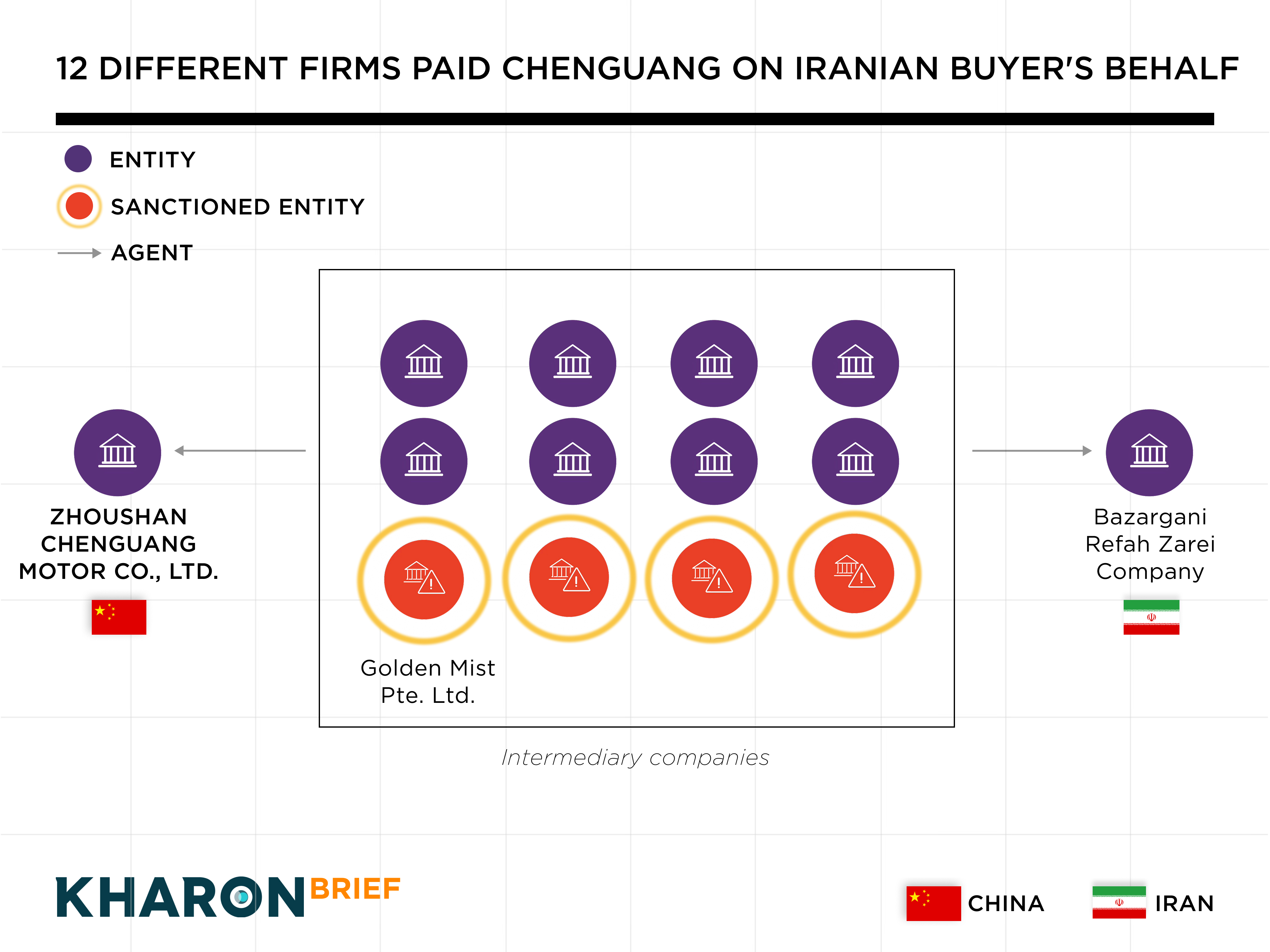
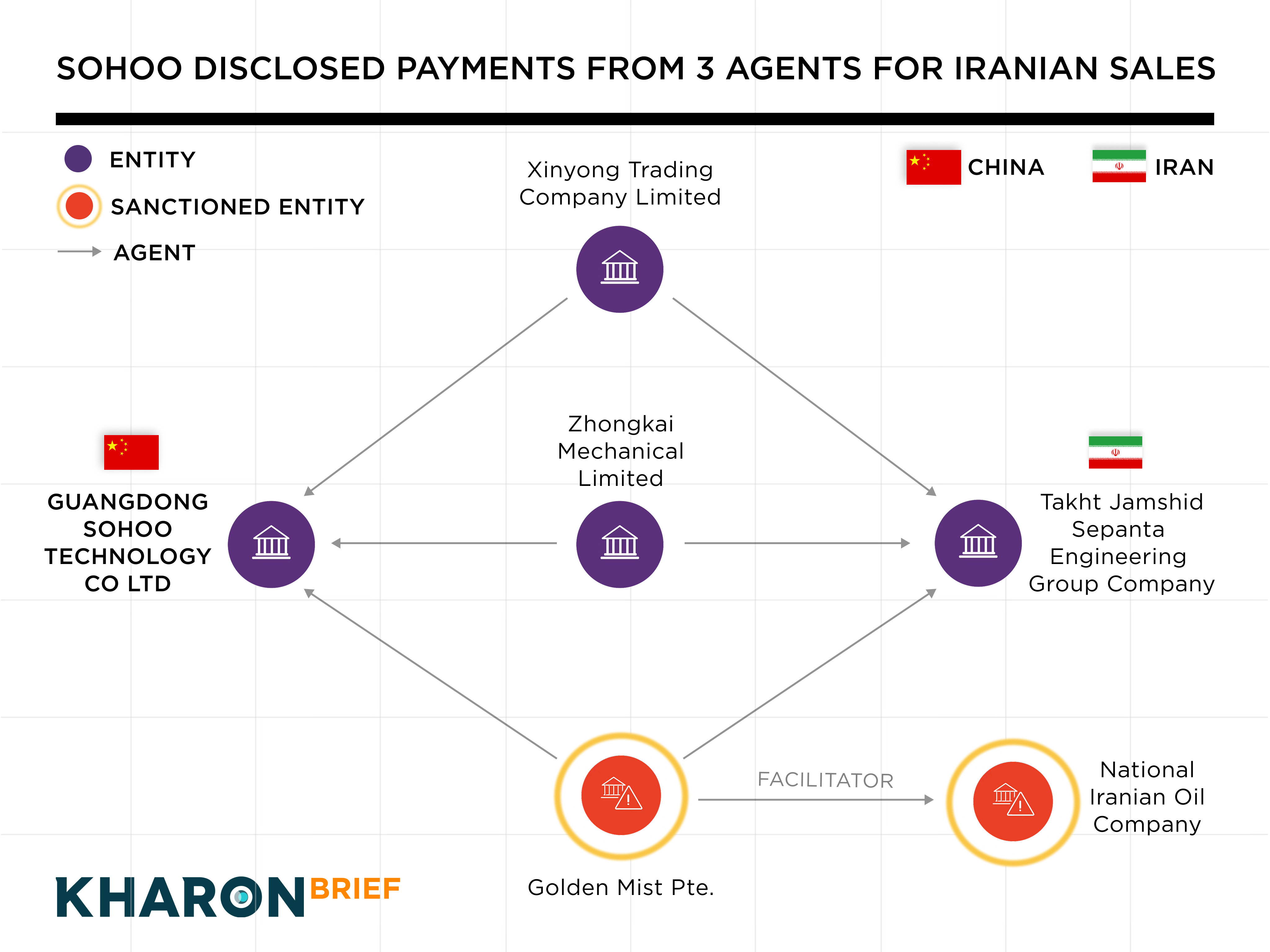
One sanctioned Chenguang intermediary, Singapore-based Golden Mist, has also facilitated the Iran dealings of Guangdong Sohoo Technology Co., Ltd., a computer hardware manufacturer.
Besides Golden Mist, Sohoo disclosed payments from two Hong Kong agents owned and directed by Aria Far Karami, a Turkish national. Karami’s LinkedIn page identifies him as the chief executive of a Shanghai-based import-export firm with business in the Middle East; maritime records, meanwhile, show that a third Hong Kong company he directs owns two ships that have traded in Iran.
- Treasury designated Golden Mist in January for allegedly serving as a “cover company” that paid tens of millions of dollars to the National Iranian Oil Company on behalf of a Hong Kong energy trader.
- Guangdong Sohoo, like the other Iran-supplying Chinese firms Kharon identified, has not been targeted by sanctions itself.
Besides Golden Mist, Sohoo disclosed payments from two Hong Kong agents owned and directed by Aria Far Karami, a Turkish national. Karami’s LinkedIn page identifies him as the chief executive of a Shanghai-based import-export firm with business in the Middle East; maritime records, meanwhile, show that a third Hong Kong company he directs owns two ships that have traded in Iran.
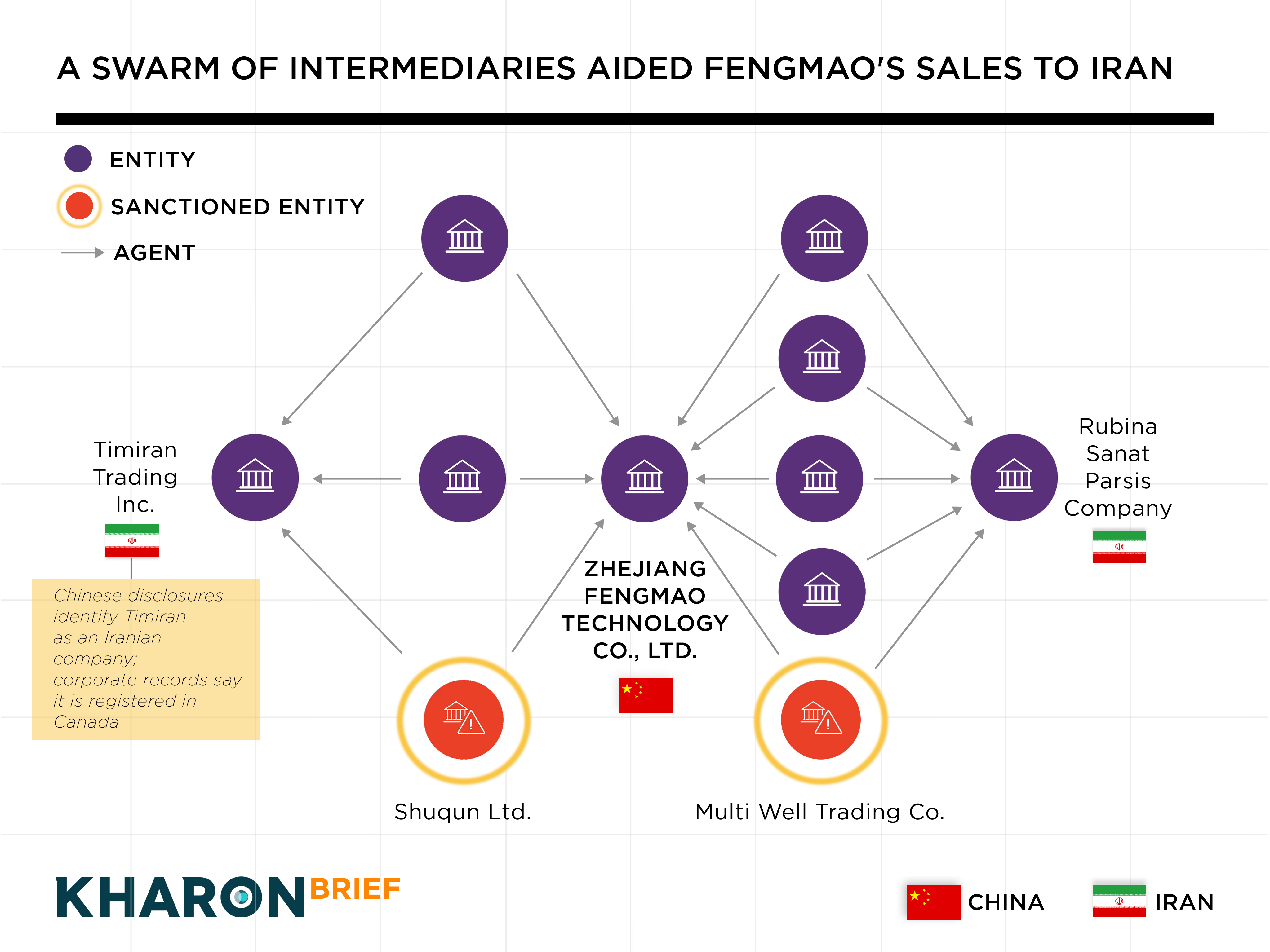
Shenzhen-traded Zhejiang Fengmao Technology Co., Ltd. offers one last example. Fengmao Technology is a manufacturer of precision rubber components, including hoses and automotive transmission belts, that sells both domestically and abroad, including to several repeat customers in Iran.
In a 2023 disclosure, Fengmao explained that its Iranian customers generally did not pay the company directly, on account of Iran’s “foreign exchange controls, insufficient access to foreign currency, and the cost and difficulty of remitting funds abroad.”
Its disclosed third-party payers notably included U.K.-registered Shuqun Ltd. Treasury designated that company in April for allegedly transferring “over $70 million worth of payments for Iranian crude oil and oil distillates” on behalf of the National Iranian Oil Company. Treasury sanctioned a sister “front company” in the U.K. in the same action.
Fengmao said that another of its Iran-payment remitters, Hong Kong’s Multi Well Trading Co., Ltd., covered sales to the Tehran-based Rubina Sanat Parsis Company, a vehicle-components supplier whose website lists sanctioned Iranian actors among its “partners.”
- Treasury sanctioned Multi Well in 2023 over its alleged role as a front company facilitating the Chinese sales of an Iranian energy conglomerate; it dissolved the following year.
Big picture: These cases show how payments for even seemingly routine civilian exports to Iran can pass through the same opaque networks it uses to circumvent sanctions.
Whether in China or elsewhere, companies’ receiving funds from unrelated third parties — particularly remitters that are tied to sanctioned entities or are short-lived firms — may signal risks that are not apparent from their direct customer list alone.
Read more from The Brief:
Whether in China or elsewhere, companies’ receiving funds from unrelated third parties — particularly remitters that are tied to sanctioned entities or are short-lived firms — may signal risks that are not apparent from their direct customer list alone.
Read more from The Brief: