

CubeMars is a Chinese robotics and drone components brand appealing to an English-language market, starting with its name.
The “Mars” stands for “Motivate Advanced Robotic System,” it says on its website, “reflecting our goal of providing reliable robotic power systems to customers.”
That list of clientele has included at least two American tech firms, according to trade data, as well as any buyers of CubeMars products that remain widely available online — long after the U.S. restricted its then-owner, Jiangxi Xintuo Enterprise Co., Ltd., for supplying Russia’s military-industrial complex.
CubeMars sales seem to have persisted stateside because of a fairly simple tactic, a Kharon review found: Shortly after the U.S. first targeted Jiangxi Xintuo, in 2024, it transferred the CubeMars trademark to a brand-new sister firm, in an apparent attempt to side-step scrutiny.
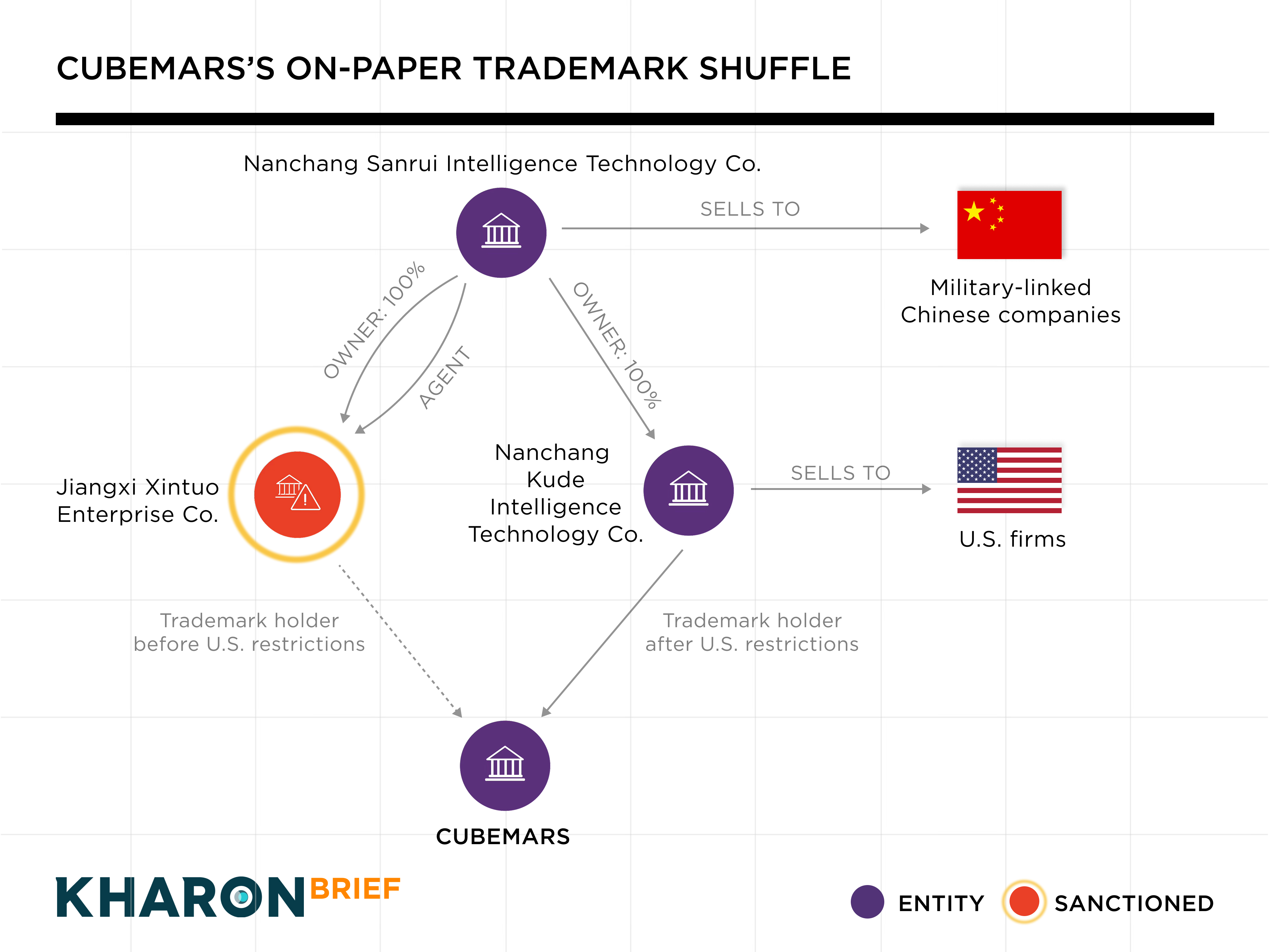
Kharon users can explore networks like this one in greater detail through the ClearView platform.
Big picture: The U.S. government has increasingly sought to curb the import of Chinese drones of late, including through the Federal Communication Commission’s recent addition of new drones and critical drone parts to its restricted sales list.
The FCC said its move followed a review that determined drones and components produced in foreign countries pose “unacceptable risks to the national security of the United States and to the safety and security of U.S. persons,” citing their potential use in attacks, targeting, data theft, or surveillance.
According to Chinese records, Xintuo held CubeMars’s trademark from the start, with an application approved in June 2020. That put the brand under the umbrella of Sanrui Intelligent, Xintuo’s parent and one of China’s largest drone-propulsion suppliers.
It also exposed CubeMars and its customers to a family of companies that was selling to U.S.-flagged customers.
State links: The Chinese agency overseeing military-civil fusion has designated Sanrui as a national “Little Giant” enterprise. That status, reserved for strategically important manufacturers, typically comes with policy support, procurement advantages, and government financing.
Why that matters: U.S. officials for years have raised concerns over China’s civil-military fusion strategy, which authorizes Beijing’s military and security agencies to demand corporate data, including customer data, from any Chinese company. Those concerns extend across Chinese-manufactured products, but the Federal Bureau of Investigation and the Cybersecurity & Information Security Agency have issued specific warnings about Chinese-made drones.
The FCC said its move followed a review that determined drones and components produced in foreign countries pose “unacceptable risks to the national security of the United States and to the safety and security of U.S. persons,” citing their potential use in attacks, targeting, data theft, or surveillance.
Parents selling sensitive tech to China and Russia
The CubeMars website calls itself a “high-tech company” that specializes in motors “widely used in humanoid robots and exoskeleton applications.”According to Chinese records, Xintuo held CubeMars’s trademark from the start, with an application approved in June 2020. That put the brand under the umbrella of Sanrui Intelligent, Xintuo’s parent and one of China’s largest drone-propulsion suppliers.
It also exposed CubeMars and its customers to a family of companies that was selling to U.S.-flagged customers.
- Sanrui’s sales: According to securities disclosures reviewed by Kharon, Sanrui has supplied Chinese firms on the Commerce Department’s Entity List, the Treasury Department’s Chinese Military-Industrial Complex Companies List, and the Defense Department’s 1260H list.
- Xintuo’s sales: Trade records reviewed by Kharon earlier this year showed Xintuo exporting drone products to Russian buyers between 2023 and 2024, a period when it held the CubeMars trademark. Those buyers included at least six entities later placed under U.S. and European sanctions.
State links: The Chinese agency overseeing military-civil fusion has designated Sanrui as a national “Little Giant” enterprise. That status, reserved for strategically important manufacturers, typically comes with policy support, procurement advantages, and government financing.
Why that matters: U.S. officials for years have raised concerns over China’s civil-military fusion strategy, which authorizes Beijing’s military and security agencies to demand corporate data, including customer data, from any Chinese company. Those concerns extend across Chinese-manufactured products, but the Federal Bureau of Investigation and the Cybersecurity & Information Security Agency have issued specific warnings about Chinese-made drones.
- “The use of Chinese-manufactured UAS in critical infrastructure operations risks exposing sensitive information to PRC authorities,” the two agencies said in a joint 2024 alert.
A Kharon investigation this summer identified a cluster of state-aligned Chinese space startups enabling military operations for Iran and Russia.
Sanctions and a corporate reshuffle
The U.S. Bureau of Industry and Security (BIS) was the first agency to target Xintuo, in April 2024, when it named the company to the Entity List for its role in “the procurement, development, and proliferation of Russian unmanned aerial vehicles.”The next month, Sanrui founded a new subsidiary in the same industrial park as Xintuo, corporate records show. That subsidiary, Nanchang Kude Intelligent Technology, applied to take over the CubeMars trademark shortly thereafter.
Records show the transfer was completed in November 2024, shortly before further Western actions would target Xintuo.
- The State Department sanctioned it in January 2025, citing Xintuo’s supply of more than $9 million worth of items to sanctioned Russian companies and others in the country’s military-industrial complex.
- The EU then placed Xintuo under export restrictions of its own this past April.
Since its trademark transfer, it now names Nanchang Kude on its website’s “About Us” page, along with Sanrui, its ultimate, unchanged parent.
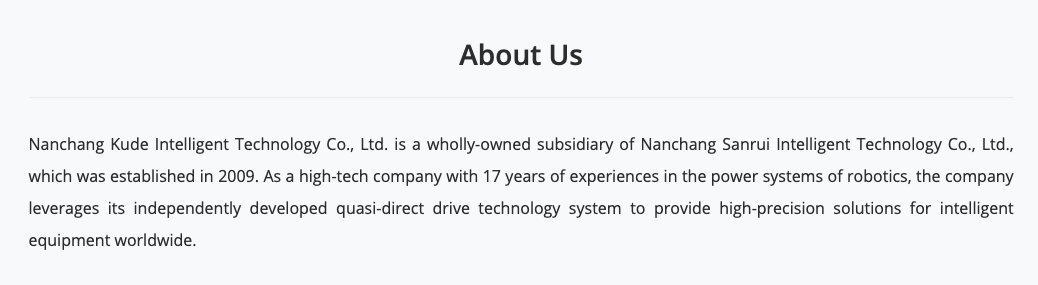
(CubeMars)
CubeMars did not respond to emailed questions from The Brief about the circumstances of its founding, its current relationship to Xintuo, or whether it has sold to parties involved in the Russian military-industrial complex itself.
Ongoing sales, under an unrestricted owner
Even before Jiangxi Xintuo’s sanctions, trade data reviewed by Kharon did not record exports from it to the United States. But CubeMars products — under the brand’s new owner — appear to be readily available in the U.S. now.According to trade data, Nanchang Kude’s recent direct customers have included California-based Nimble Robotics, an autonomous shipping-fulfillment company, and Texas-based Serve Operating Co., a manufacturer of food-delivery robots; Nanchang Kude exported motors to the latter as recently as August. (Serve and Nimble did not respond to requests for comment.)
Additional U.S. online retailers, meanwhile, widely list CubeMars components for sale.
One of them, Pendulum Robotics, advertises a range of CubeMars motors, touting itself on its homepage as an “Authorized US distributor” for the Chinese brand out of its Los Angeles warehouse. Pendulum did not respond to messages seeking comment.
In brief
While the CubeMars trademark changed hands on paper, it stayed in the same U.S.-flagged, state-tied corporate ecosystem, in a Chinese sector under growing scrutiny.Reshuffles like these are common after an Entity List addition or sanctions, whether with companies in China or Russia-linked shadow fleet vessels. But they rarely change the operational reality of what kind of company, or risks, are involved.
Ian Talley and Edmund Xu contributed to this report.
Read more from The Brief: