
When Jiangsu Xinhua Semiconductor Technology Co. filed for an initial public offering in Shanghai early this year, it presented itself as a symbol of China’s push for semiconductor “self-sufficiency.”
The company, commonly known as Sinvar, boasts in its prospectus that it achieved a goal Chinese officials and industry leaders had long sought: breaking the foreign monopoly over electronics-grade polysilicon, the ultra-pure material used to make silicon wafers for semiconductor chips. Having captured more than half the domestic market, Sinvar says, it also has “entered the supply chains of two of the world’s five largest silicon-wafer makers.”
For the global semiconductor industry, which for years has assumed its inputs to be free of forced-labor risks in China, that rise could introduce a problem. A Kharon investigation into Sinvar’s ownership, executives, and suppliers found multiple links to companies and facilities operating in Xinjiang, the far-northwest region of China that has long faced international scrutiny over forced labor, or otherwise tied to that region’s polysilicon industry.
Those Xinjiang links, which Sinvar does not call out in its prospectus, flow through some entities targeted by the U.S. directly, and repeatedly, for forced-labor enforcement.
Big picture: Xinjiang produces roughly 44% of the world’s polysilicon, while China as a whole accounts for more than 70%. That dominance has made polysilicon one of the focal points of U.S. enforcement under the Uyghur Forced Labor Prevention Act, or UFLPA.
But semiconductor-grade polysilicon requires exacting levels of purity far beyond, say, solar panels, and for years the semiconductor industry said Chinese producers lacked the “equipment and know-how” to produce it “at scale.”
Now, Sinvar says it has overcome that barrier.
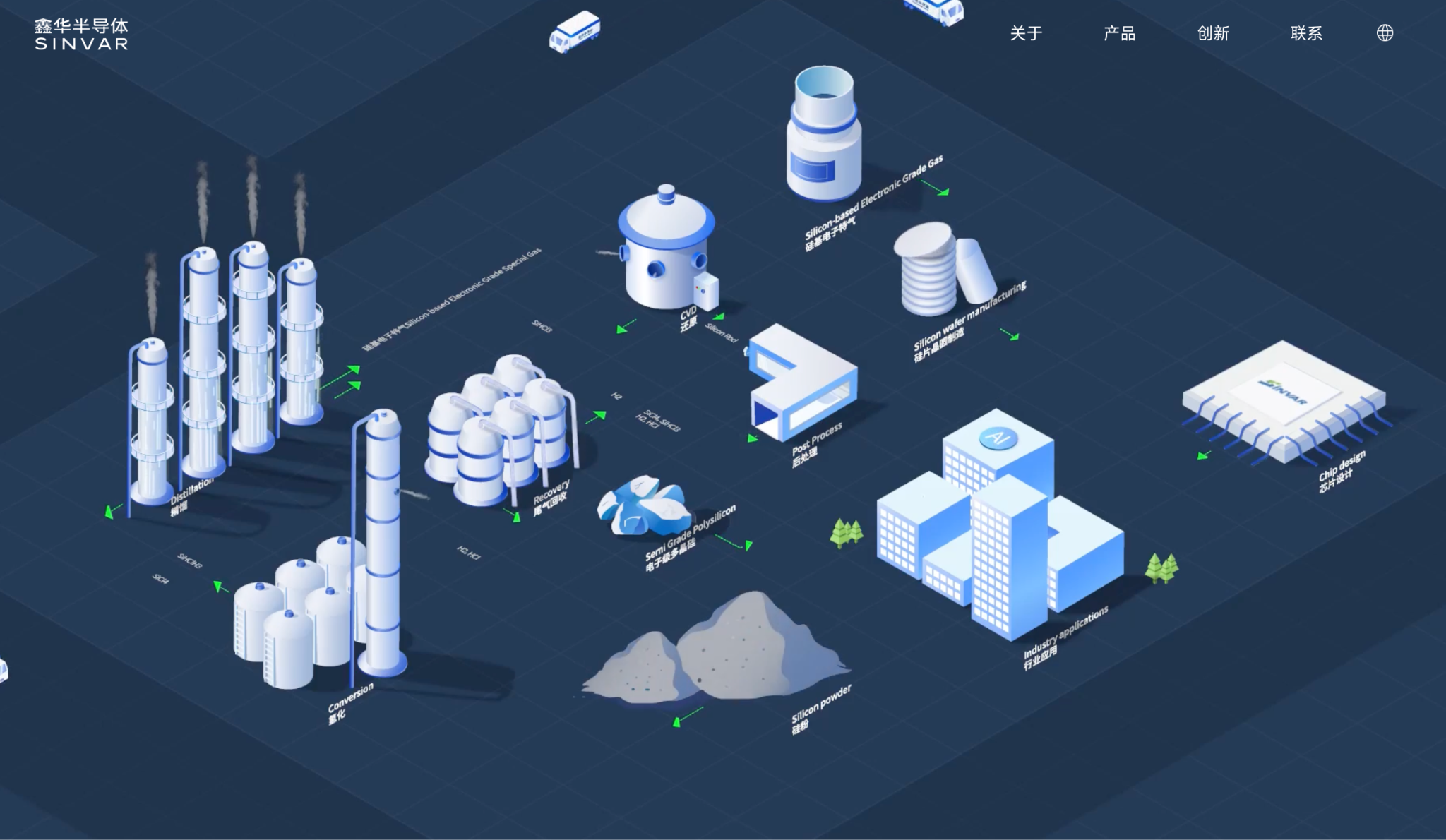
Sinvar’s website showcases the production process from raw silicon powder into high-purity, electronics-grade polysilicon and finally into chips. (Sinvar)
Sinvar, Silicon, and Xinjiang
Sinvar was founded in 2015, as a joint venture between a state-backed investment fund and Jiangsu Zhongneng Polysilicon Technology, a silicon raw-material supplier.Sinvar says in its prospectus that its overseas sales, for now, remain small; it does not identify which of the five leading manufacturers the company supplies, nor to what extent. But the filing charts Sinvar’s ambition to feed into more of them, estimating that they together supply 80% of the global silicon-wafer market.
In a 2023 interview, Sinvar’s then-CEO said its mandate was to “break through technological barriers in electronics-grade polysilicon” and to carry “the strategic mission entrusted to us by the Chinese government.”
- Zoom in: Electronics-grade polysilicon must reach 99.999999999% purity, a level sometimes called “eleven nines.”
- Sinvar says it processes raw silicon powder through a series of chemical steps into trichlorosilane, which is then repeatedly distilled and purified before it’s converted into polysilicon. The company has also bought trichlorosilane directly.
The parent company: Zhongneng, which owns about a 25% stake in Sinvar, has been its largest raw-material supplier since at least 2022, according to corporate records and Sinvar’s IPO disclosures. It has supplied Sinvar with trichlorosilane, that middle-step input of the polysilicon production process.
But Zhongneng was also, until 2024, a significant shareholder in a Xinjiang company: Xinjiang Goens Energy Technology Co., which the U.S. government has singled out for its forced-labor risks.
- The Bureau of Industry and Security subjected Goens, under a different name it was using at the time, to heightened export controls in 2021 “for accepting or utilizing forced labor.” The Department of Homeland Security added it to the UFLPA Entity List the next year, then flagged its new alias in an update last month.
- Sinvar’s deputy chairman, Jiang Wenwu, was previously Goens’s engineering manager and chairman when, in 2020, Chinese state media reported that it had participated in a labor-transfer program involving workers from Xinjiang, a prominent red flag for forced-labor risks.
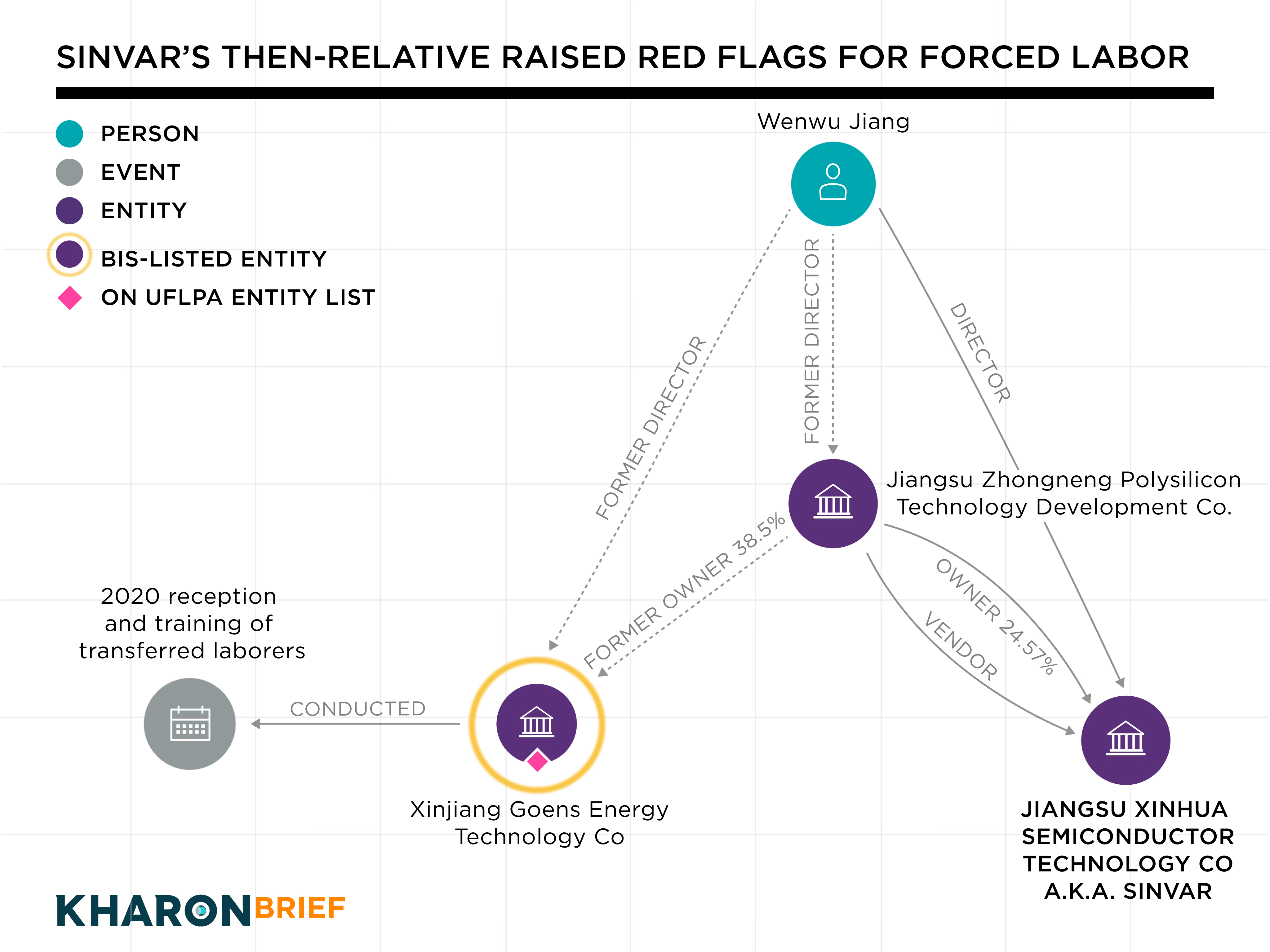
Kharon users can explore this network in greater detail through the ClearView platform.
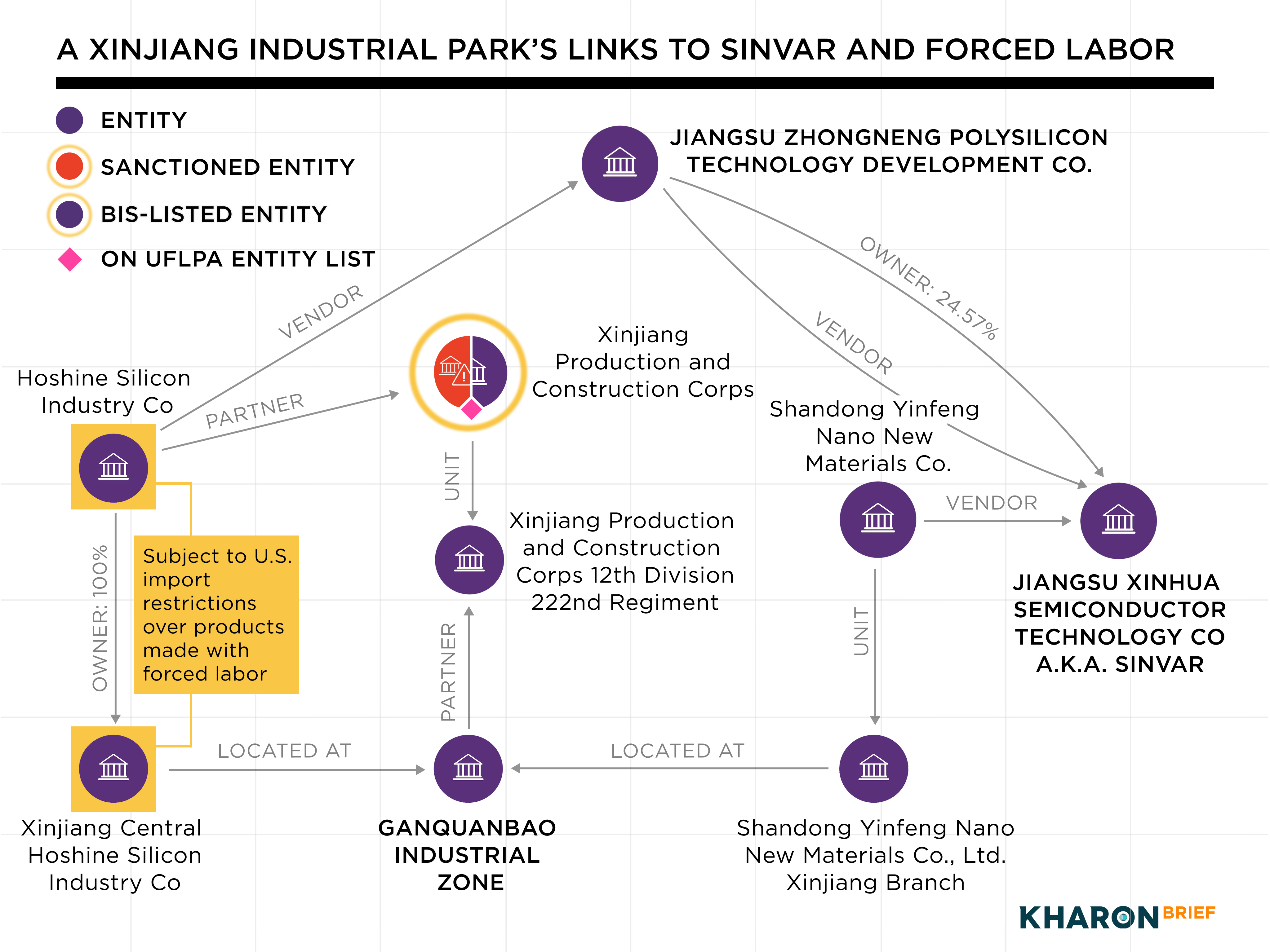
The powder supplier: In 2023, Sinvar says in its prospectus, it began “gradually shift[ing]” toward producing more of its trichlorosilane in-house, by increasing its purchases of silicon powder. According to the disclosures, Shandong Yinfeng Nano New Materials became its largest silicon-powder supplier by 2024.
Yinfeng has two production bases, including one located in a high-risk Xinjiang industrial park.
Yinfeng has two production bases, including one located in a high-risk Xinjiang industrial park.
- In a 2024 news release, the Xinjiang Production and Construction Corps, or XPCC, described cooperating with the park on its operation and development. The U.S. has sanctioned and otherwise targeted the XPCC since 2019 over its central alleged role in human-rights abuses in Xinjiang, including forced labor and the detention of ethnic minorities.
- Hoshine Silicon, a major Chinese silicon producer and an XPCC partner, operates a large factory in the same park. In 2021, U.S. Customs and Border Protection began blocking imports of silica-based products made by Hoshine and its subsidiaries over forced-labor concerns. Hoshine has disclosed less information about its customers in public filings since, but in a 2020 response to an investor question, the company confirmed that Zhongneng was a “current customer of industrial silicon products.” Hoshine previously had referred to their “close business partnership.”
The Bottom Line
Yinfeng’s operation of the Xinjiang plant, like Zhongneng’s connections to U.S.-flagged Hoshine and Goens, does not prove that raw materials supplied to Sinvar were produced in Xinjiang.But the relationships introduce pathways through which Xinjiang-origin material could enter Sinvar’s production process — and, from there, the global chip market.
Read more from The Brief: