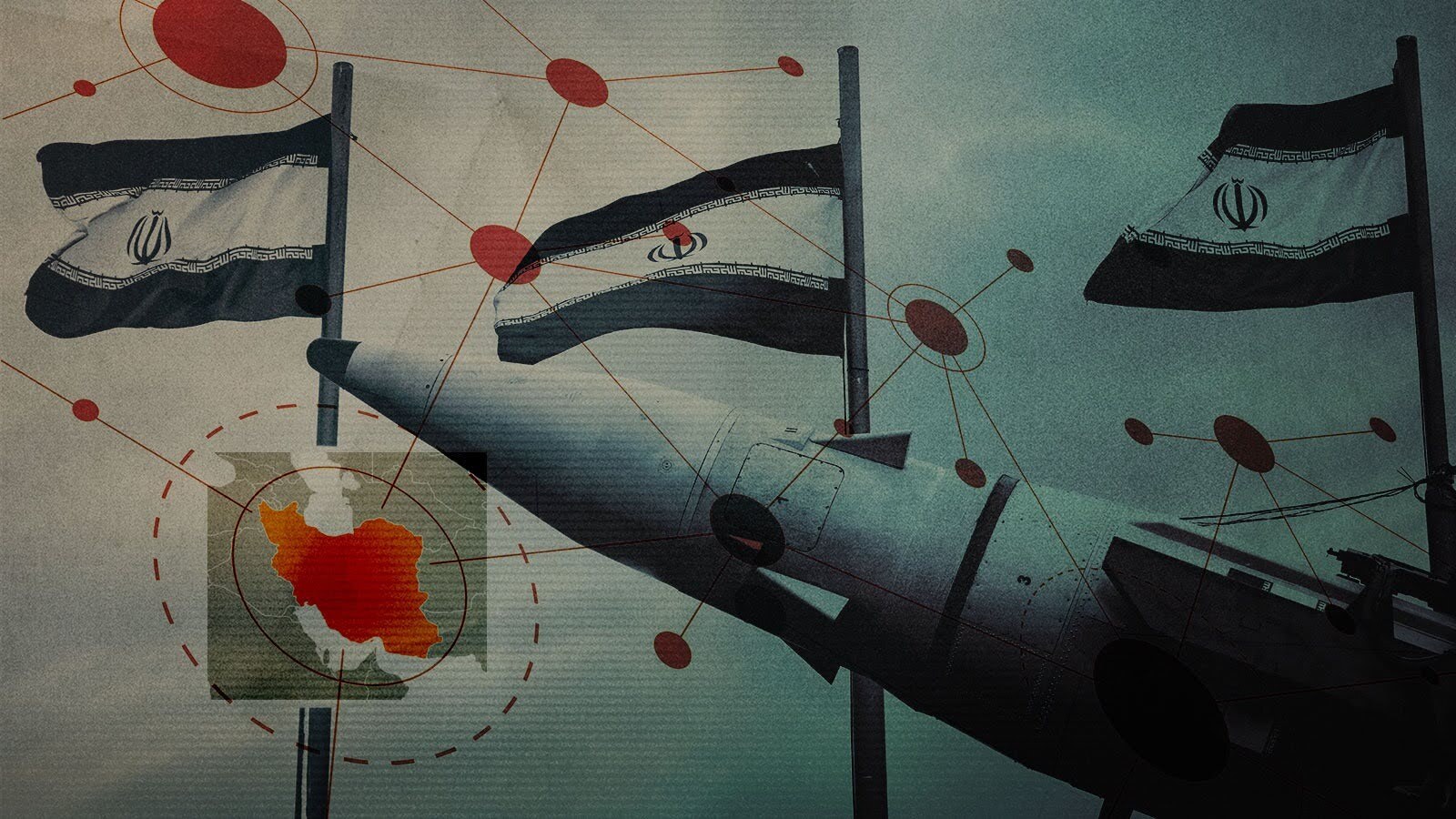
In four rounds of sanctions over the past eight months, the U.S. has sought to disrupt a key supply line for Iran’s ballistic missile capacity: a network of food traders and other firms that the Treasury Department branded the “MVM partnership,” after the three men who run it.
“As the United States continues to deplete Iran’s ballistic missile inventories, the regime is seeking to reconstitute its production capacity,” Treasury noted in its April designation targeting the group.
But like the regime’s broader “Resistance Economy,” the MVM partnership appears to be built to withstand Western sanctions: Shortly after the first wave of U.S. designations hit it in November, a Kharon investigation found, the network adapted its operations — and it’s continued to procure products used in ballistic missiles.
Two weeks after Treasury designated the “V” in the partnership, Iranian businessman Vahid Qayumi, he signed over one of his Turkish import-export companies to a new owner with the same surname, corporate filings show. Two months later, a Qayumi-chaired supplier of a raw material needed for ballistic missile propellant received a fresh delivery at an Iranian port in the Caspian Sea.
Still open for business: In all, despite U.S. sanctions against nearly a dozen MVM-tied individuals and businesses, Kharon identified nearly a dozen additional companies controlled or owned by the network that still appear to be operational.
“As the United States continues to deplete Iran’s ballistic missile inventories, the regime is seeking to reconstitute its production capacity,” Treasury noted in its April designation targeting the group.
But like the regime’s broader “Resistance Economy,” the MVM partnership appears to be built to withstand Western sanctions: Shortly after the first wave of U.S. designations hit it in November, a Kharon investigation found, the network adapted its operations — and it’s continued to procure products used in ballistic missiles.
Two weeks after Treasury designated the “V” in the partnership, Iranian businessman Vahid Qayumi, he signed over one of his Turkish import-export companies to a new owner with the same surname, corporate filings show. Two months later, a Qayumi-chaired supplier of a raw material needed for ballistic missile propellant received a fresh delivery at an Iranian port in the Caspian Sea.
Still open for business: In all, despite U.S. sanctions against nearly a dozen MVM-tied individuals and businesses, Kharon identified nearly a dozen additional companies controlled or owned by the network that still appear to be operational.
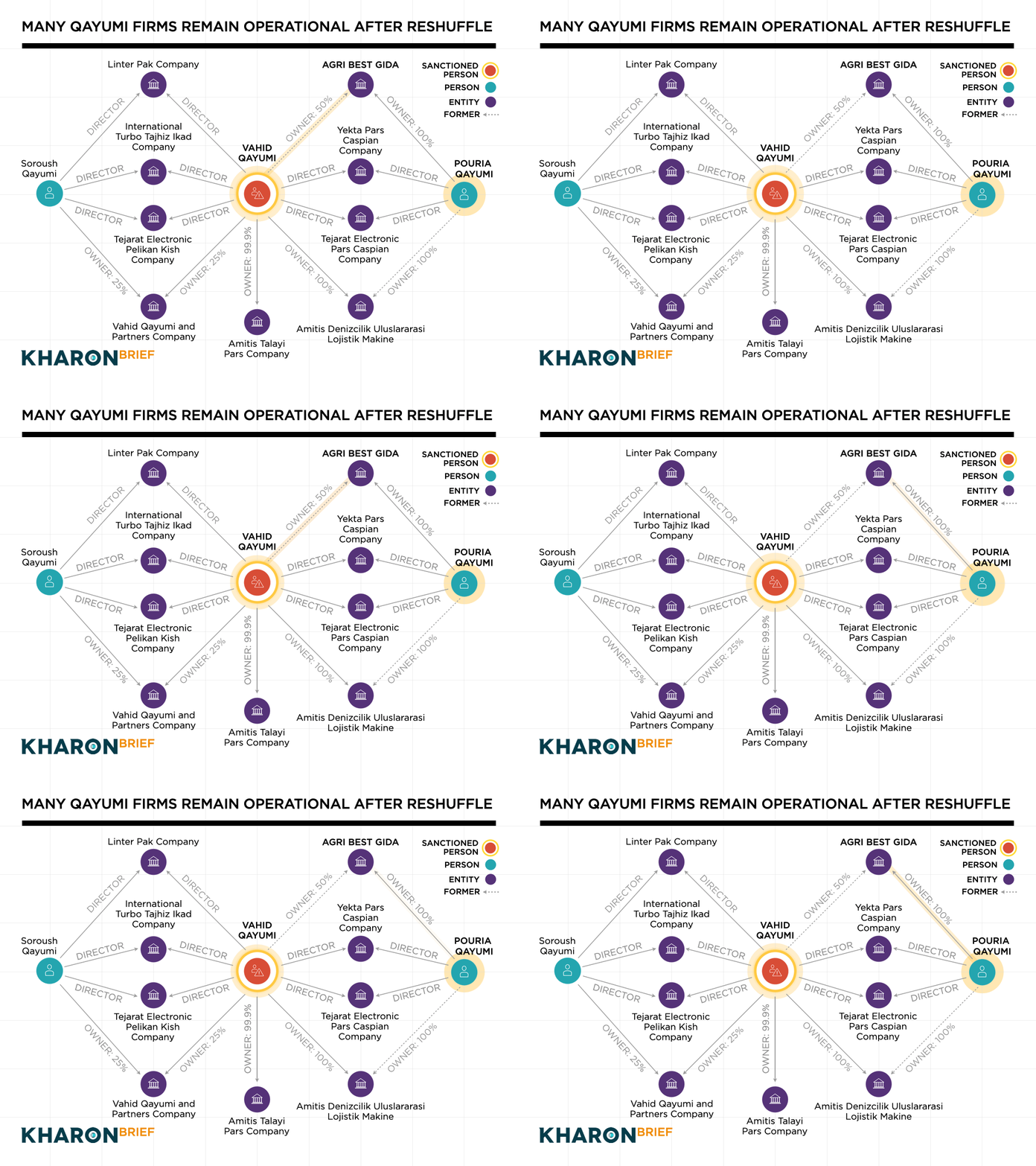
Kharon users can explore this network in greater detail through the ClearView platform.
From food trading companies to logistics firms and a currency exchange, these entities provide the network with the infrastructure to keep procuring prohibited goods from abroad for Iran.
Big picture: As peace talks between the U.S. and Iran enter a new phase, the network’s ongoing supply-chain operations suggest Iran retains some capacity to replenish its ballistic missile stockpiles should hostilities resume in full — despite one of the most comprehensive economic pressure campaigns in modern history.
“This is a logistics procurement ecosystem that’s built to withstand targeting for sanctions, military targeting,” said Greg Gatjanis, a former top Treasury official who is now a senior policy adviser at the law firm Fluet, as well as a member of Kharon’s Strategic Advisory Board. "Sanctions target the nodes — the points of transfer, the points of trade. But procurement systems are designed to be networks. Cut one node, and the network routes around it."
According to Treasury and to corporate and trade records reviewed by Kharon:
Big picture: As peace talks between the U.S. and Iran enter a new phase, the network’s ongoing supply-chain operations suggest Iran retains some capacity to replenish its ballistic missile stockpiles should hostilities resume in full — despite one of the most comprehensive economic pressure campaigns in modern history.
“This is a logistics procurement ecosystem that’s built to withstand targeting for sanctions, military targeting,” said Greg Gatjanis, a former top Treasury official who is now a senior policy adviser at the law firm Fluet, as well as a member of Kharon’s Strategic Advisory Board. "Sanctions target the nodes — the points of transfer, the points of trade. But procurement systems are designed to be networks. Cut one node, and the network routes around it."
The Partnership, the Purchaser and the Products
MVM associates, Treasury said, have used their businesses to source hundreds of metric tons of missile-propellant ingredients for Iran’s Parchin Chemical Industries (PCI), a branch of Iran’s state defense conglomerate. Those ingredients, including cotton byproducts and foundational chemicals, can also produce ammunition and explosives.According to Treasury and to corporate and trade records reviewed by Kharon:
- Qayumi was responsible for the partnership’s chemical operations inside Iran, including through import-export companies in Turkey and Iran that nominally trade agricultural commodities.
- Marco Klinge, a U.A.E.-based German national and former CEO of Desai Agrifoods, one of India’s leading fruit exporters, handled the partnership’s procurement from India and China, liaising between the network and its suppliers.
- Majid Dolatkhah, who also operates firms in Iran and Turkey and manages several fruit-and-vegetable import businesses, was responsible for procurement from Turkey and served as a liaison between Klinge and Iran’s PCI.
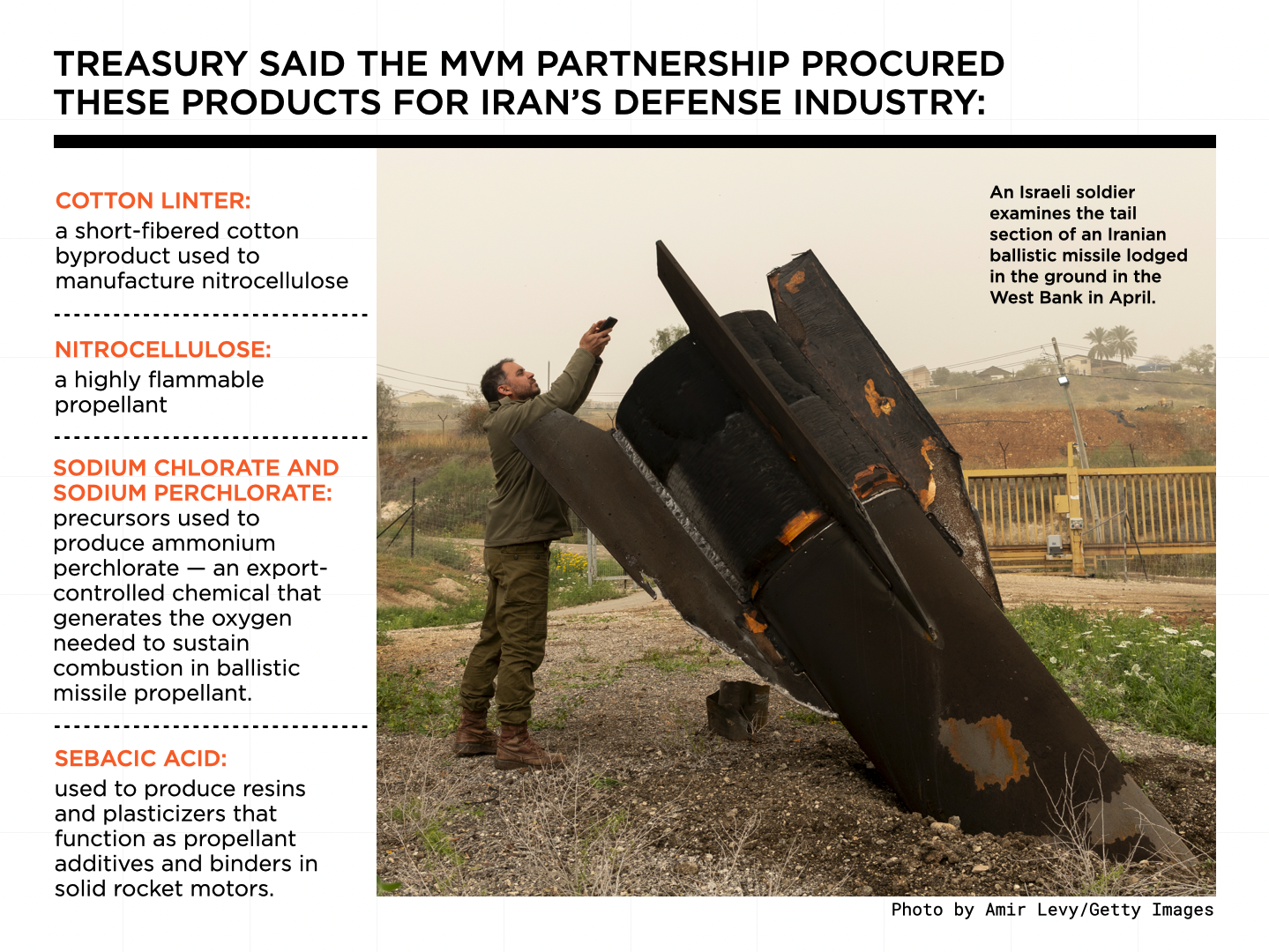
But amid Treasury’s sanction barrage, it appears the MVM network is using other pathways to keep procurement lines running.
For example, the Linter Pak Company— an Iranian cellulose manufacturer that Qayumi chairs, according to Iran’s official corporate gazette — received fresh cotton linter deliveries at the Caspian Sea port of Amirabad in February, according to social media posts. The company’s website lists nitrocellulose, the base propellant in solid-fuel rocket motors, among the military applications of its products.
In social media posts in October and January, an Agri Best agent marketed caustic soda, which is commonly used in the production of nitrocellulose to purify cotton linter and essential for production of sebacic acid, and monoethylene glycol, a critical ingredient in the production of several types of propellants, including solid rocket fuel.
- (None of the companies or individuals, contacted either directly or through associates, responded to requests by The Brief for comment.)
Active and Trading
The network’s resilience is seen in part through its ongoing trade and a slew of companies listed as still active in corporate registries. Those records suggest Qayumi has the deepest bench of firms that haven’t been targeted with sanctions.For example, the Linter Pak Company— an Iranian cellulose manufacturer that Qayumi chairs, according to Iran’s official corporate gazette — received fresh cotton linter deliveries at the Caspian Sea port of Amirabad in February, according to social media posts. The company’s website lists nitrocellulose, the base propellant in solid-fuel rocket motors, among the military applications of its products.
- Connecting the dots: Linter Pak’s former managing director is Mostafa Rostami Sani, the sanctioned director of an Iranian company that Treasury also sanctioned for procuring propellant precursors in this network.
In social media posts in October and January, an Agri Best agent marketed caustic soda, which is commonly used in the production of nitrocellulose to purify cotton linter and essential for production of sebacic acid, and monoethylene glycol, a critical ingredient in the production of several types of propellants, including solid rocket fuel.
- According to an archived version of Agri Best’s website from late 2024, Agri Best previously marketed fuses and PETN-based detonating cord, critical components widely used in military explosives and combat demolitions.
Trade records show that Agri Best in 2023 had received 174 metric tons of cotton cellulose labeled as “GOST 595-75,” the Soviet-era standard specifically intended for nitrocellulose production, from Uzbekistan-based Raw Materials Cellulose. That company was sanctioned by the U.K. in December for “making available goods or technology” that harm Ukraine.
Three companies, for example, give the network continued access to markets through Turkey:
- Flashback: A Kharon investigation last year found that Raw Materials Cellulose and another firm had supplied more than $170 million worth of cellulose to Russian munitions factories, defense contractors, and other military end-users since the start of the war.
Three companies, for example, give the network continued access to markets through Turkey:
- Districo Anatolia Meyve Sebze Gida, a fruit products company co-directed by Klinge and Dolatkhah.
- Ami̇ti̇s Deni̇zci̇li̇k Uluslararasi Loji̇sti̇k Maki̇ne, a logistics firm owned by Qayumi.
- Ankara-based Peraco Selüloz, owned by Klinge and Dolatkhah.
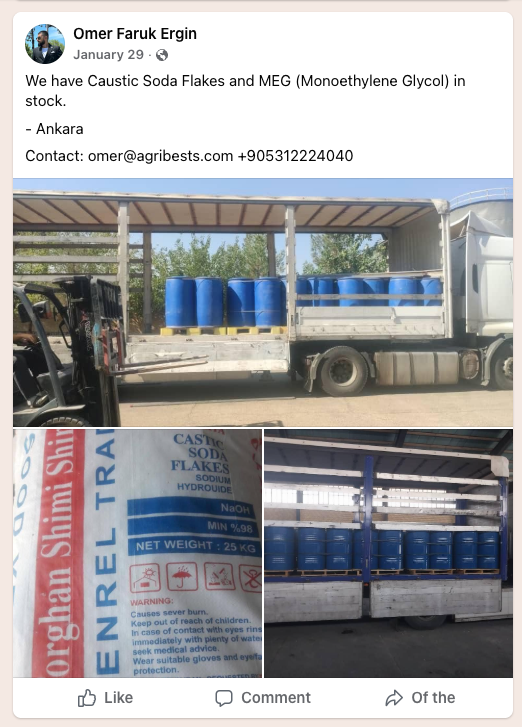
An Agri Best agent offers caustic soda for sale in January, on a Facebook group page for industrial chemical trade. The post was given a “thumbs up” by Pouria Qayumi, to whom sanctioned Vahid Qayumi transferred ownership of his Turkish companies.
Resilience Mechanisms
The MVM network’s durability under sanctions pressure is not accidental: Its architecture bears the hallmarks of networks designed to sidestep Western restrictions.One of Qayumi’s cryptocurrency ventures, Iran-based Pelican Kish, is explicitly marketed as a payment route that circumvents the restrictions of conventional banking. “The only provider of a real, instantly traceable cryptocurrency wallet on all fully domestic [ledgers] and without the risk of sanctions,” the platform’s parent company says in Persian on one of its social media accounts.
- Qayumi’s related Pelican Exchange boasted in a brochure for the 2026 Iran Expo, held in June, that it has the infrastructure to expedite foreign exchange transactions for companies and banks outside Iran, including through offices and proxy firms registered in the UAE, Qatar, and Oman.
- In line with MVM’s broader business profile, the exhibition entry also lists Pelican Exchange’s sectors not only as “financial” and “business infrastructure services” but also “fruit and vegetables” and “condiments.”
Qayumi had done that with Agri Best, two weeks after his November designation. But that same day, according to Turkish records:
- He also transferred his shares of a “Pelikan”-branded Turkish software company to that same person sharing his surname, Pouria Qayumi, who is also registered as a director at several other firms that Vahid Qayumi controls in Iran. (The software company was dissolved June 8.)
- Pouria Qayumi, in turn, transferred ownership of his own Turkish logistics firm to Vahid.
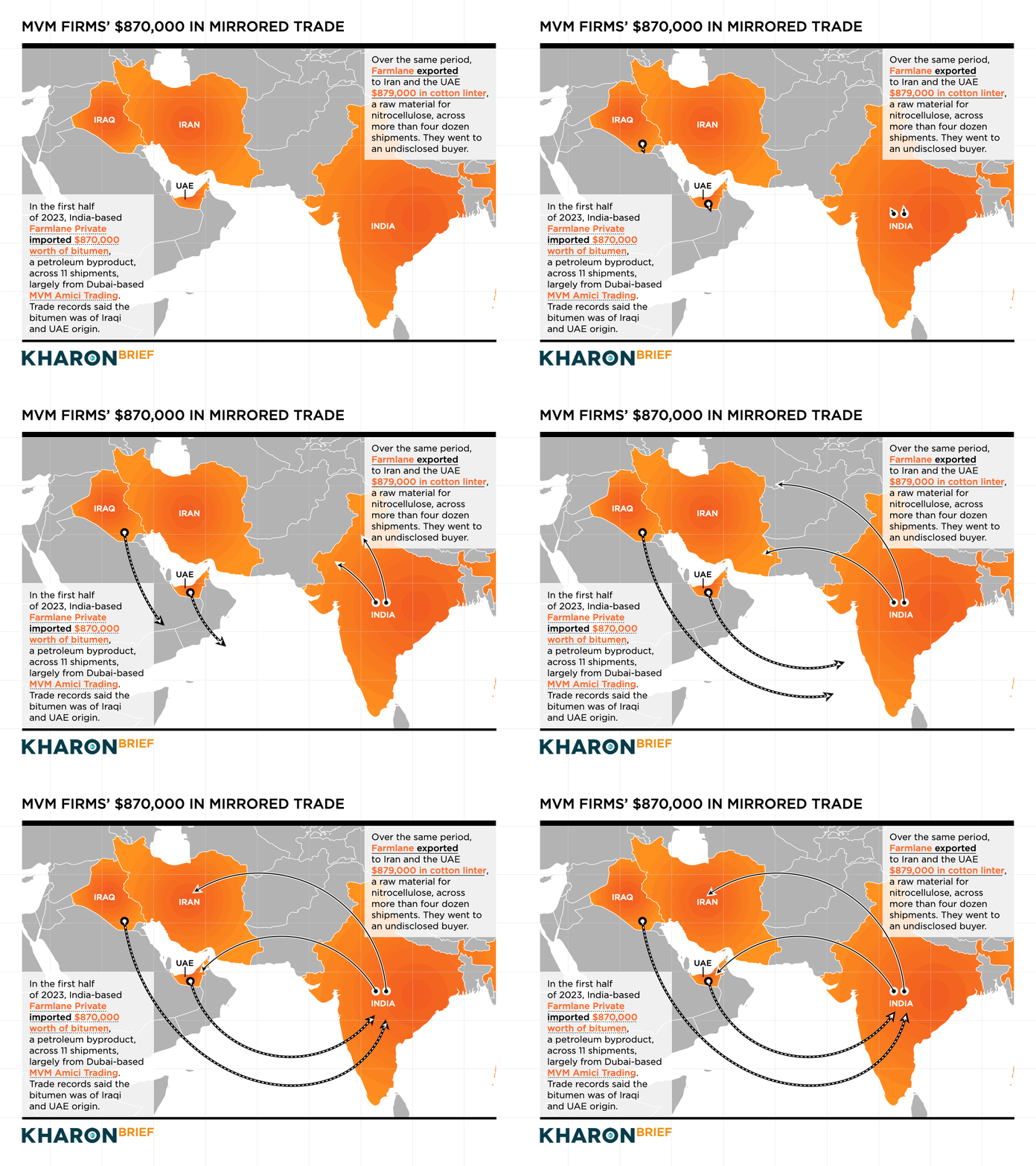
- How it works: Associated companies pay for goods across borders outside the banking system — historically the front lines for intelligence on illicit finance — through an exchange of shipments whose values offset each other.
- One common tactic, former Treasury officials say, is to misinvoice Iranian petroleum products as being of Iraqi or UAE origin. The two MVM companies here, MVM Amici Trading and Farmlane Private, appear to illustrate this dynamic in action.
An Extended Network
Beyond its documented propellant supply chain, MVM’s network gives it access to other types of export-restricted goods that Iran has used to manufacture weapons and other military materiel.- Qayumi is a co-director, for instance, of Iran-based International Turbo Tajhiz Ikad, alongside three foreign nationals running associated firms in Pakistan and Spain. According to their corporate websites, those companies have access to Western industrial goods, including bearings, which are essential in weapons systems.
- According to social media and corporate records, Pelican Kish’s former chief executive is now a sales rep for two European machine companies. At the same time, he’s head of Iran-based Ervin Sanat, a company that specializes in Computer Numerical Control machines, which are used in manufacturing artillery, rocket casings, armored vehicle components and uranium enrichment centrifuge production.
“Iran’s incentive to rebuild this capacity will likely increase after a conflict,” Gatjanis said. “They’re going to have other entities that would be able to sustain the trade if any of their primary ones were to be shut down or sanctioned.”
Read related coverage from The Brief: