
Rollouts of recent U.S. and EU measures guarding against Chinese firms are cementing supply chain resilience as a national security mandate.
And the Farnborough International Airshow, a premier showcase for NATO’s defense establishment that returns to England next week, is onboard with that goal.
“Disruptions, whether geopolitical, economic or environmental, can impact major programmes for years,” organizers say on the event’s website. “FIA fosters the relationships and strategic insight to build a more adaptive and future-proof supply chain.”
But the kinds of supply chain risks that Western officials increasingly are raising surface even at alliance-centric events like Farnborough. Among the hundreds of aerospace exhibitors set to hawk their products and services just west of London, Kharon identified more than a dozen companies involved in China’s military-industrial complex, including two on U.S. national security export-control lists.
“The two most common sources of intel collection for foreign agents are solicitations for email and trade shows,” said Jerry McGinn, a former DOD official who now heads the Center for the Industrial Base at the Center for Strategic and International Studies (CSIS).
Broader trend: Those designations and affiliations do not prohibit companies from exhibiting at industry events like Farnborough. One exhibitor, a drone-jamming company called Beijing Lizheng Technology that has supplied the People’s Liberation Army, also has pitched itself at a Turkish conference in May, at Eurosatory in Paris last month, and at NATO’s Future Forces expo.
And the Farnborough International Airshow, a premier showcase for NATO’s defense establishment that returns to England next week, is onboard with that goal.
“Disruptions, whether geopolitical, economic or environmental, can impact major programmes for years,” organizers say on the event’s website. “FIA fosters the relationships and strategic insight to build a more adaptive and future-proof supply chain.”
But the kinds of supply chain risks that Western officials increasingly are raising surface even at alliance-centric events like Farnborough. Among the hundreds of aerospace exhibitors set to hawk their products and services just west of London, Kharon identified more than a dozen companies involved in China’s military-industrial complex, including two on U.S. national security export-control lists.
“The two most common sources of intel collection for foreign agents are solicitations for email and trade shows,” said Jerry McGinn, a former DOD official who now heads the Center for the Industrial Base at the Center for Strategic and International Studies (CSIS).
Broader trend: Those designations and affiliations do not prohibit companies from exhibiting at industry events like Farnborough. One exhibitor, a drone-jamming company called Beijing Lizheng Technology that has supplied the People’s Liberation Army, also has pitched itself at a Turkish conference in May, at Eurosatory in Paris last month, and at NATO’s Future Forces expo.

The state-owned Commercial Aircraft Corporation of China (COMAC) exhibits two models of passenger jets during the most recent Farnborough International Airshow, in 2024. (Stephen Chung/Xinhua via Getty Images)
Western officials’ growing concern: that Chinese suppliers in strategic supply chains could open up risks of corporate espionage, defective parts, and resource constraints that give up key economic leverage. Such concerns have spurred export controls, foreign investment and tech restrictions, and more tools likely to come.
For businesses, those regulations can mean compliance challenges.
A Chinese attendee and a well-connected parent
One 2026 exhibitor typifies the Chinese-military ties that Western governments and contractors will have to vet.On the Farnborough website, Sichuan Forge Future calls itself “one of the largest commercial-aviation ring-forging manufacturers in Asia” and “a core supplier in the Asia-Pacific region to all the world’s top commercial aero-engine manufacturers.” According to corporate disclosures under the name it uses in China, Forge Future’s 100% parent company is Guizhou Aviation Technology Development — which the U.S. has listed as both a Military End User and, under the Pentagon’s 1260H list, as a Chinese military firm.
- Zoom in: U.S. law now prohibits the Department of Defense from entering into or renewing contracts for goods or services with 1260H-listed entities or their subsidiaries, like Forge Future. The restrictions will begin applying to any indirectly procured components starting next year.
Three other customers, the state-owned Aviation Industry Corporation of China, China Aerospace Science and Industry Corporation, and China Aerospace Science and Technology Corporation, represent the full sweep of China’s military aerospace sector: combat and transport aircraft, ballistic missiles, space launch, and satellite systems.
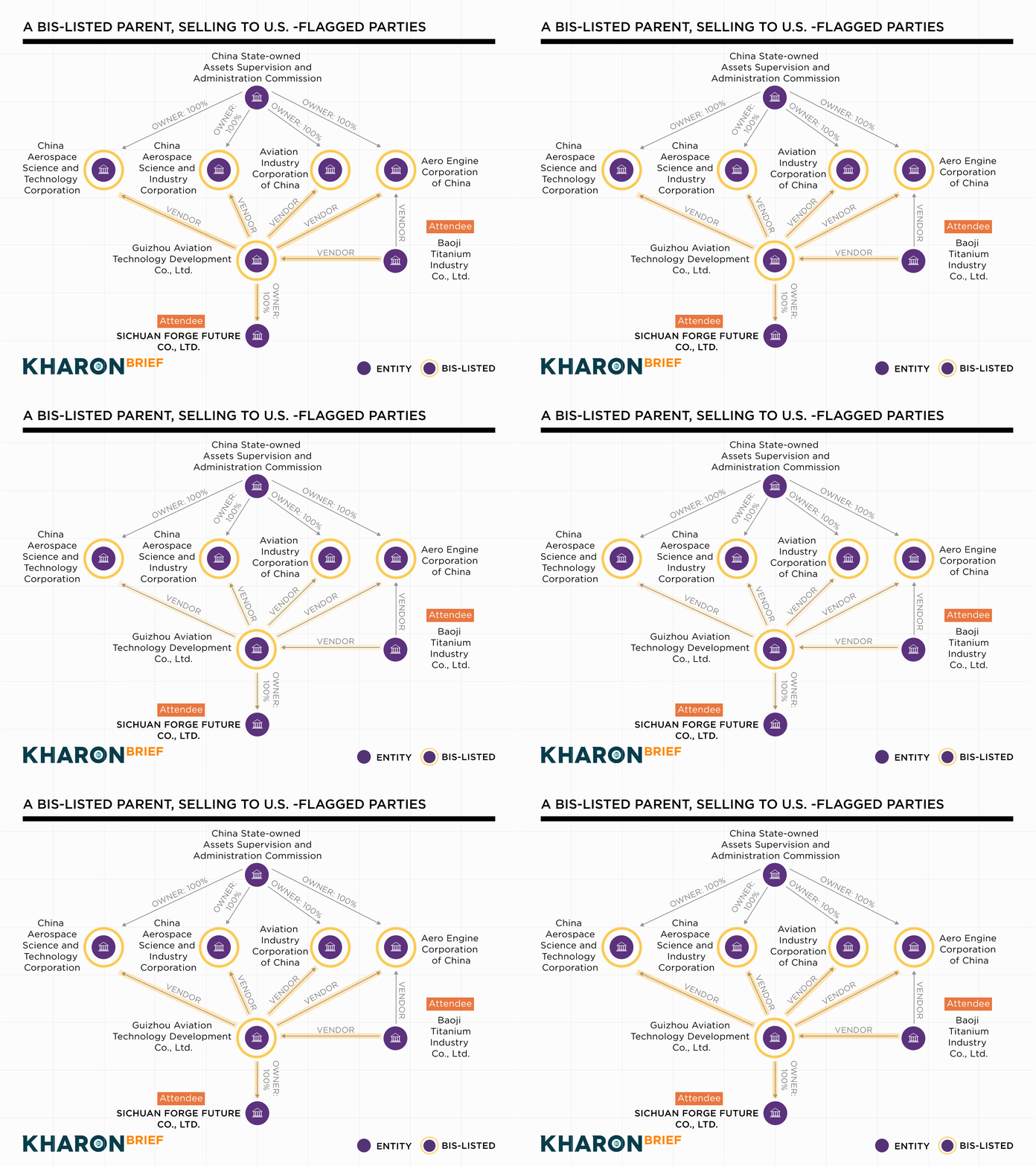
- The U.S. Bureau of Industry and Security (BIS) restricted exports to the last of those companies in 2022 for “acquiring and attempting to acquire U.S.-origin items” supporting China’s military modernization efforts.
Farnborough and the Chinese exhibitors Kharon identified didn’t respond to requests for comment about their participation in the airshow.
Supply chain blind spots and military licenses
A U.S. Government Accountability Office report last year found that while the Pentagon had gained some transparency into contractor supply chain risks for major subsystems and components, its efforts ultimately “have provided little insight into the vast majority of suppliers.”- In evaluating the supply chain for the F-35, for example, DOD officials said they had collected country-of-origin information on less than 10% of all suppliers that provide components and raw materials for those parts.
- The F-35 program experienced six-month production stoppages in 2023 and 2024 when Chinese magnets were identified on the aircraft and had to be replaced, the GAO said.
Current and former U.S. officials have argued that no commercial relationship with a Chinese entity can be treated as purely civilian, pointing to Military-Civil Fusion laws that compel Chinese companies to support military objectives when instructed.
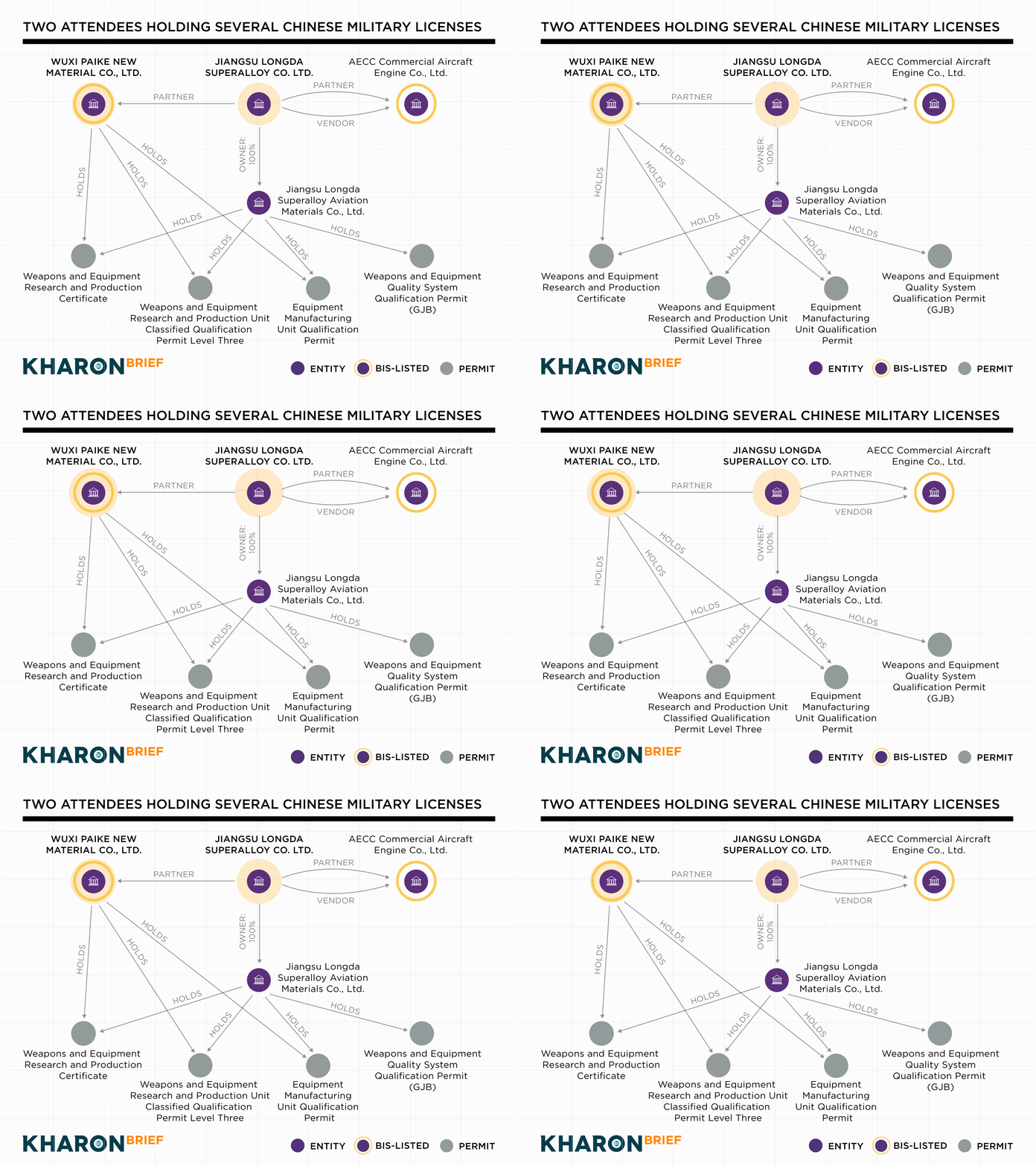
Paper trails: Some of Farnborough’s 2026 exhibitors, such as Baoji Titanium, Jiangsu Longda Superalloy Aviation Materials, and Wuxi Paike New Material, have secured high-level certifications allowing them to work on China’s weapons programs, according to corporate disclosures.
Government warning: In a report last December on China’s military and security developments, the DOD said the PLA was “systematically targeting U.S. intellectual property, defense technology, and other critical sectors,” aided by “economic espionage.”
“They’re not going to have substantive discussions with companies without some level of due diligence,” CSIS’s McGinn said. “If they do develop a business relationship with Chinese companies, it does create risk.”
Read more from The Brief:
- Rep. Raja Krishnamoorthi (D-Ill.), the ranking member of the House Select Committee on the Chinese Communist Party, linked the Commercial Aircraft Corporation of China, another Farnborough 2026 exhibitor, to “industrial espionage” in a letter last year. The DOD has included COMAC, the state-controlled crown jewel of China’s aerospace ambitions, on its 1260H list, too.
“They’re not going to have substantive discussions with companies without some level of due diligence,” CSIS’s McGinn said. “If they do develop a business relationship with Chinese companies, it does create risk.”
Read more from The Brief: