New U.S. sanctions levied last week against two Cuban companies mark a structural shift in the White House’s escalating pressure campaign against Havana. It’s already sent one publicly traded Canadian owner into a tailspin.
Most of Cuba’s battered economy had been off-limits to U.S. businesses previously, largely under the authority of the Trading With the Enemy Act, in an embargo that dates to the Cold War.
But now, under an executive order it issued earlier this month, the Trump administration is forcing a fundamental rethink in the risk calculus for foreign companies and investors doing business with Cuba, too. That includes those in U.S.-allied countries.
“We would like to see the regime there change,” Secretary of State Marco Rubio told the Senate Foreign Relations Committee in late January. The authority that codified the decadeslong Cuba embargo, he said, “requires regime change” in order to lift it.
The day after Rubio spoke, the White House invoked the International Emergency Economic Powers Act (IEEPA), launching a new front in the administration’s campaign of financial coercion. It first tried to impose “secondary tariffs” on goods from countries that sell oil to Cuba, effectively creating an economic blockade.
Why that matters: Using IEEPA allows the administration to go beyond the limitations of the embargo, by targeting the foreign finance and trade flows that keep Cuba’s economy afloat and its regime in power.
That’s because the Trump administration is wielding so-called secondary sanctions here: Any foreign financial institution handling transactions for a sanctioned entity risks being sanctioned themselves.
“This secondary sanctions authority significantly raises the sanctions risk profile for non-U.S. financial institutions that facilitate transactions related to Cuba and represents a fundamental shift in how the U.S. government can enforce its Cuba policy extraterritorially,” the law firm King & Spalding wrote in a client alert last week.
The wrinkle: Both GAESA and MNSA had already been subject to U.S. sanctions under the older powers. But as long as firms doing business with Cuba isolated those dealings from U.S. transactions, they were largely insulated from U.S. prosecution or fines.
The new secondary-sanctions element transformed those risks.
The impacts: MNSA had continued operating unhindered in Cuba after its initial U.S. sanctions, but its new designation sent Sherritt scrambling. The Toronto-traded firm’s share price tumbled, losing nearly half its value.
“Sherritt has suspended its direct participation in joint venture activities in Cuba, effective immediately,” the company had said after the White House issued its executive order. Then, on the day its joint venture was sanctioned, three of its board members resigned. A few days later, it postponed its latest quarterly report and began petitioning the Canadian judiciary for permission to continue overall business operations with a smaller board.
Analysis: “This was definitely a shot across the bow to non-U.S., non-Cuban companies. … It should make non-U.S. companies with some subsidiary active in Cuba quite nervous,” Stephanie Connor, a former senior official in the Treasury Department’s Office of Foreign Assets Control now at law firm Holland & Knight, told Kharon’s Andrew Sobotka in a webinar Thursday.
The secondary-sanctions risk, Connor added, could prompt foreign banks to stop processing transactions linked to Cuba, even if they are legally allowed under U.S. law. Because the new authority applies to entire sectors of Cuba’s economy, the administration “can designate hundreds of entities in one fell swoop,” she said.
That’s why Sherritt could herald a wider collapse in Cuban trade and foreign investment, for an economy that already was suffocating.
Most of Cuba’s battered economy had been off-limits to U.S. businesses previously, largely under the authority of the Trading With the Enemy Act, in an embargo that dates to the Cold War.
But now, under an executive order it issued earlier this month, the Trump administration is forcing a fundamental rethink in the risk calculus for foreign companies and investors doing business with Cuba, too. That includes those in U.S.-allied countries.
Inside the new sanctions
Trump’s Cuba policy has systematically reversed the Obama administration’s diplomatic overtures to Havana, including through a January 2021 redesignation of Cuba’s government as a “State Sponsor of Terror.” In Trump’s second term, his administration has gone further.“We would like to see the regime there change,” Secretary of State Marco Rubio told the Senate Foreign Relations Committee in late January. The authority that codified the decadeslong Cuba embargo, he said, “requires regime change” in order to lift it.
The day after Rubio spoke, the White House invoked the International Emergency Economic Powers Act (IEEPA), launching a new front in the administration’s campaign of financial coercion. It first tried to impose “secondary tariffs” on goods from countries that sell oil to Cuba, effectively creating an economic blockade.
- Except … the next month, the Supreme Court ruled the administration’s IEEPA tariffs unconstitutional.
Why that matters: Using IEEPA allows the administration to go beyond the limitations of the embargo, by targeting the foreign finance and trade flows that keep Cuba’s economy afloat and its regime in power.
That’s because the Trump administration is wielding so-called secondary sanctions here: Any foreign financial institution handling transactions for a sanctioned entity risks being sanctioned themselves.
- That’s a risk few will be willing to bear, because of the threat of losing access to the U.S. dollar and to the world’s deepest and most liquid financial markets.
“This secondary sanctions authority significantly raises the sanctions risk profile for non-U.S. financial institutions that facilitate transactions related to Cuba and represents a fundamental shift in how the U.S. government can enforce its Cuba policy extraterritorially,” the law firm King & Spalding wrote in a client alert last week.
Business panic
For last week’s first use of the IEEPA authority against Cuba, the State Department sanctioned two companies:- Grupo De Administracion Empresarial S.A., or GAESA, the military-run conglomerate that controls much of the Cuban economy.
- MOA Nickel S.A., or MNSA, a joint venture between the state-owned La Compania General de Niquel and the Canadian mining outfit Sherritt International.
The wrinkle: Both GAESA and MNSA had already been subject to U.S. sanctions under the older powers. But as long as firms doing business with Cuba isolated those dealings from U.S. transactions, they were largely insulated from U.S. prosecution or fines.
The new secondary-sanctions element transformed those risks.
The impacts: MNSA had continued operating unhindered in Cuba after its initial U.S. sanctions, but its new designation sent Sherritt scrambling. The Toronto-traded firm’s share price tumbled, losing nearly half its value.
“Sherritt has suspended its direct participation in joint venture activities in Cuba, effective immediately,” the company had said after the White House issued its executive order. Then, on the day its joint venture was sanctioned, three of its board members resigned. A few days later, it postponed its latest quarterly report and began petitioning the Canadian judiciary for permission to continue overall business operations with a smaller board.
Analysis: “This was definitely a shot across the bow to non-U.S., non-Cuban companies. … It should make non-U.S. companies with some subsidiary active in Cuba quite nervous,” Stephanie Connor, a former senior official in the Treasury Department’s Office of Foreign Assets Control now at law firm Holland & Knight, told Kharon’s Andrew Sobotka in a webinar Thursday.
The secondary-sanctions risk, Connor added, could prompt foreign banks to stop processing transactions linked to Cuba, even if they are legally allowed under U.S. law. Because the new authority applies to entire sectors of Cuba’s economy, the administration “can designate hundreds of entities in one fell swoop,” she said.
That’s why Sherritt could herald a wider collapse in Cuban trade and foreign investment, for an economy that already was suffocating.
- Cuban Minister of Energy and Mines Vicente de la O Levy told state-run media this week that the country had run out of oil for domestic use and power plants.
Geopolitical frictions
Many of Cuba’s most important trade partners are, like Canada, U.S. allies. The European Union took in roughly half of the country’s exports last year, according to International Monetary Fund data, with Spain representing the lion’s share of that trade.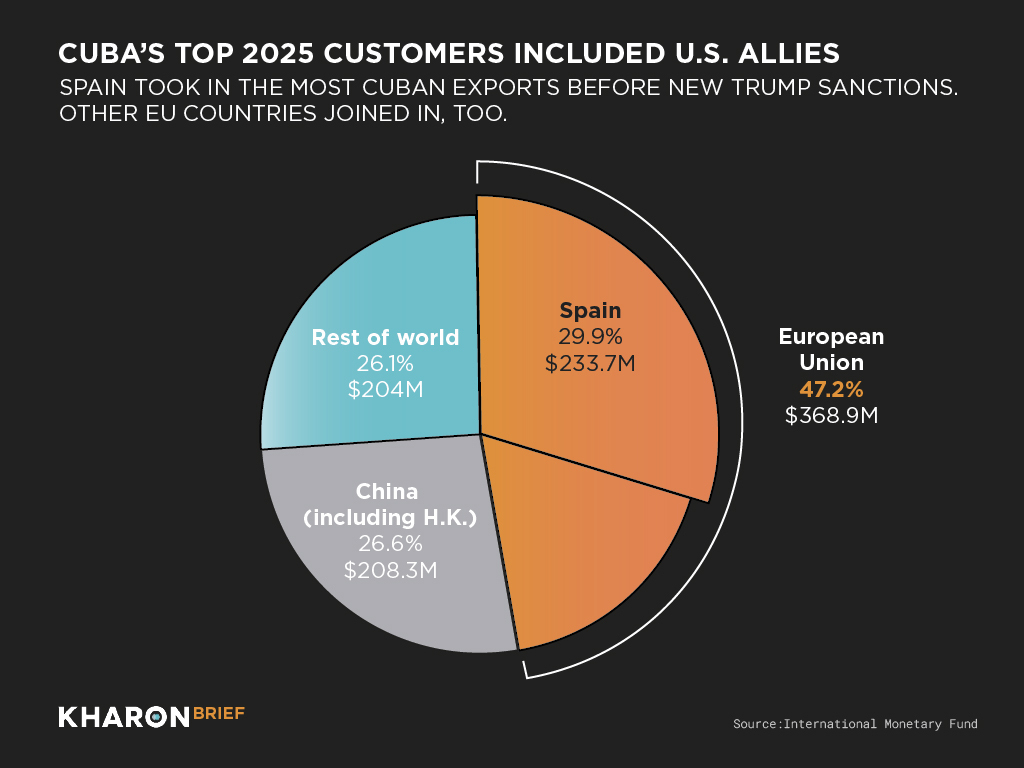
“In Cuba, the quarter was significantly affected by the United States’ intervention in the region at the beginning of the year,” Palma de Mallorca-based Melia Hotels International, which manages more than 30 hotels in Cuba, said in its first-quarter results.
The Trump administration’s Cuba sanctions policy has fueled tensions as a result. E.U. nations have historically bridled at the use of secondary sanctions where they have impinged on their companies and run counter to their foreign policy.
In May, the Spanish Ministry of Foreign Affairs issued a rare joint statement with its Mexican and Brazilian counterparts, expressing “our deep concern regarding the serious humanitarian crisis the Cuban people faces” and emphasizing “the need to respect at all times international law and the principles of territorial integrity, sovereign equality and the peaceful settlement of disputes, as enshrined in the United Nations Charter.”
Mexico’s state-owned oil company, Pemex, had halted oil deliveries to Cuba in January in the face of the secondary-tariff threats. But Mexican President Claudia Sheinbaum voiced opposition to aggressive U.S. measures against the island on Monday, at a regular press conference.
“We do not agree, nor have we ever agreed … with the blockade against Cuba,” Sheinbaum said.
Read more from The Brief:
The Trump administration’s Cuba sanctions policy has fueled tensions as a result. E.U. nations have historically bridled at the use of secondary sanctions where they have impinged on their companies and run counter to their foreign policy.
In May, the Spanish Ministry of Foreign Affairs issued a rare joint statement with its Mexican and Brazilian counterparts, expressing “our deep concern regarding the serious humanitarian crisis the Cuban people faces” and emphasizing “the need to respect at all times international law and the principles of territorial integrity, sovereign equality and the peaceful settlement of disputes, as enshrined in the United Nations Charter.”
Mexico’s state-owned oil company, Pemex, had halted oil deliveries to Cuba in January in the face of the secondary-tariff threats. But Mexican President Claudia Sheinbaum voiced opposition to aggressive U.S. measures against the island on Monday, at a regular press conference.
“We do not agree, nor have we ever agreed … with the blockade against Cuba,” Sheinbaum said.
Read more from The Brief: