The Trump administration’s renewed economic pressure campaign is driving Iran’s currency to record lows. To accelerate that pressure, the U.S. is zeroing in on one of Tehran’s last financial lifelines: gold.
It may take looking into bell peppers, eggplants, and tomatoes.
Nearly $200 million in gold, a Kharon investigation found, flowed into the country from Türkiye last year through one network of Iranian companies that purport not to be involved in currency or precious metals but mostly in greenhouse-grown fruits and vegetables. Iran’s agriculture sector, unlike its gold sector, is largely exempt from Western sanctions.
The half-dozen Iranian companies that Kharon identified are controlled by the directors of state-tied Amin Exchange, which the U.S. sanctioned in May for allegedly facilitating “hundreds of millions of dollars in foreign transactions for sanctioned Iranian persons,” including state oil and petrochemical companies.
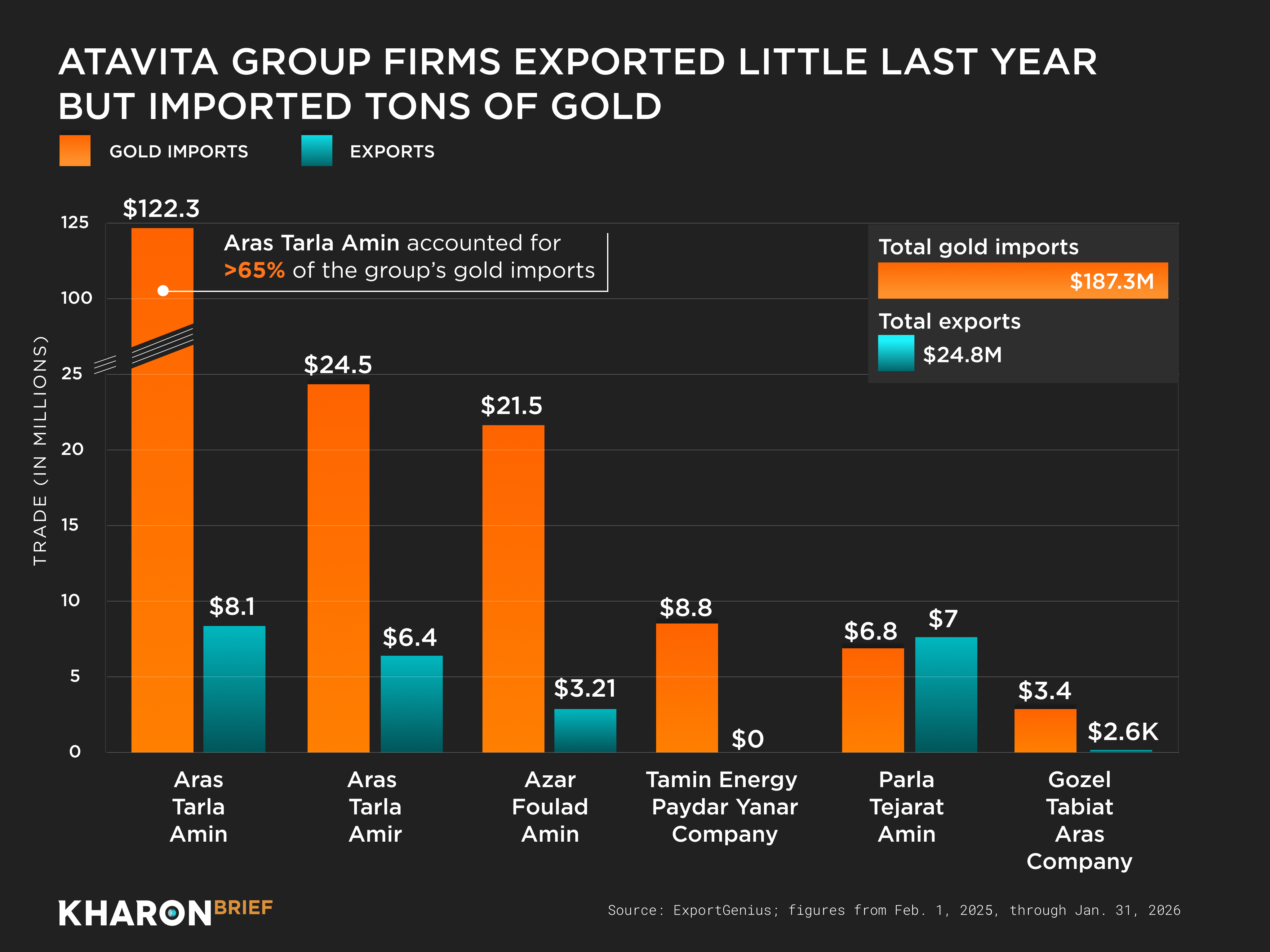
The value of the network’s gold imports outpaced the value of their exports by 8 to 1, according to available trade data.
The disparity, said Marshall Billingslea, Treasury’s former chief for terrorist financing, suggests only one plausible explanation: “Sanctions evasion.”
Big picture: Gold offers Tehran an alternative to the international banking system from which sanctions have largely severed it. Treasury’s Financial Crimes Enforcement Network has long warned financial institutions about Iran’s use of gold and other precious metals as a high-priority “red flag” for sanctions evasion and illicit finance.
“Our objective is to sever every economic lifeline that sustains the tyrannical regime until Tehran stands alone,” Treasury Secretary Scott Bessent said in announcing the new authorities.
In targeting it, Treasury said two brothers, Yousef and Mahmoud Ebrahimi, and the exchange’s chief executive, a former Islamic Revolutionary Guard Corps officer, had operated a widespread network of front companies in the UAE, Türkiye, and Hong Kong to launder money in support of sanctioned importers and exporters. The network made them “indispensable to Iran’s banking sector,” Treasury said.
- U.S. federal prosecutors, for example, accused Türkiye’s Halkbank in 2019 of laundering tens of billions of dollars’ worth of oil sales for Iran through gold transactions. (The Trump administration settled the case earlier this year.)
“Our objective is to sever every economic lifeline that sustains the tyrannical regime until Tehran stands alone,” Treasury Secretary Scott Bessent said in announcing the new authorities.
Imports and Imbalances
Amin Exchange’s May designation did not cite any gold operations.In targeting it, Treasury said two brothers, Yousef and Mahmoud Ebrahimi, and the exchange’s chief executive, a former Islamic Revolutionary Guard Corps officer, had operated a widespread network of front companies in the UAE, Türkiye, and Hong Kong to launder money in support of sanctioned importers and exporters. The network made them “indispensable to Iran’s banking sector,” Treasury said.
- A trove of leaked documents uploaded to WikIran last fall had purported to reveal details about the state ties and foreign dealings of Amin Exchange’s leadership, including what it said was Yousef Ebrahimi’s Turkish passport. Another image showed an IRGC-stamped identification document for Samad Nemati, the exchange’s chief executive, seen in uniform.
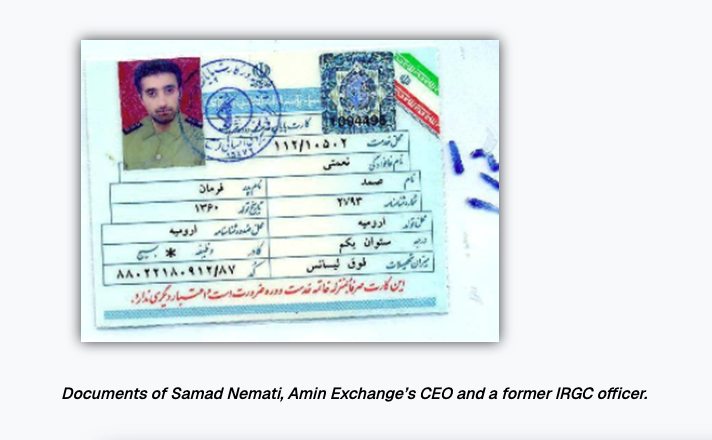
(WikIran)
Treasury added eight of Amin Exchange’s alleged front companies to its sanctions list, too.
But six other companies the Ebrahimi brothers own or control combined to import $187.3 million in gold bullion last year, according to trade data reviewed by Kharon.
Zoom in: The lion’s share of those gold imports flowed through four firms under the Atavita Group, whose hydroponic greenhouse complexes produce a wide variety of fruits, vegetables, and medicinal plants in the northwest corner of Iran.
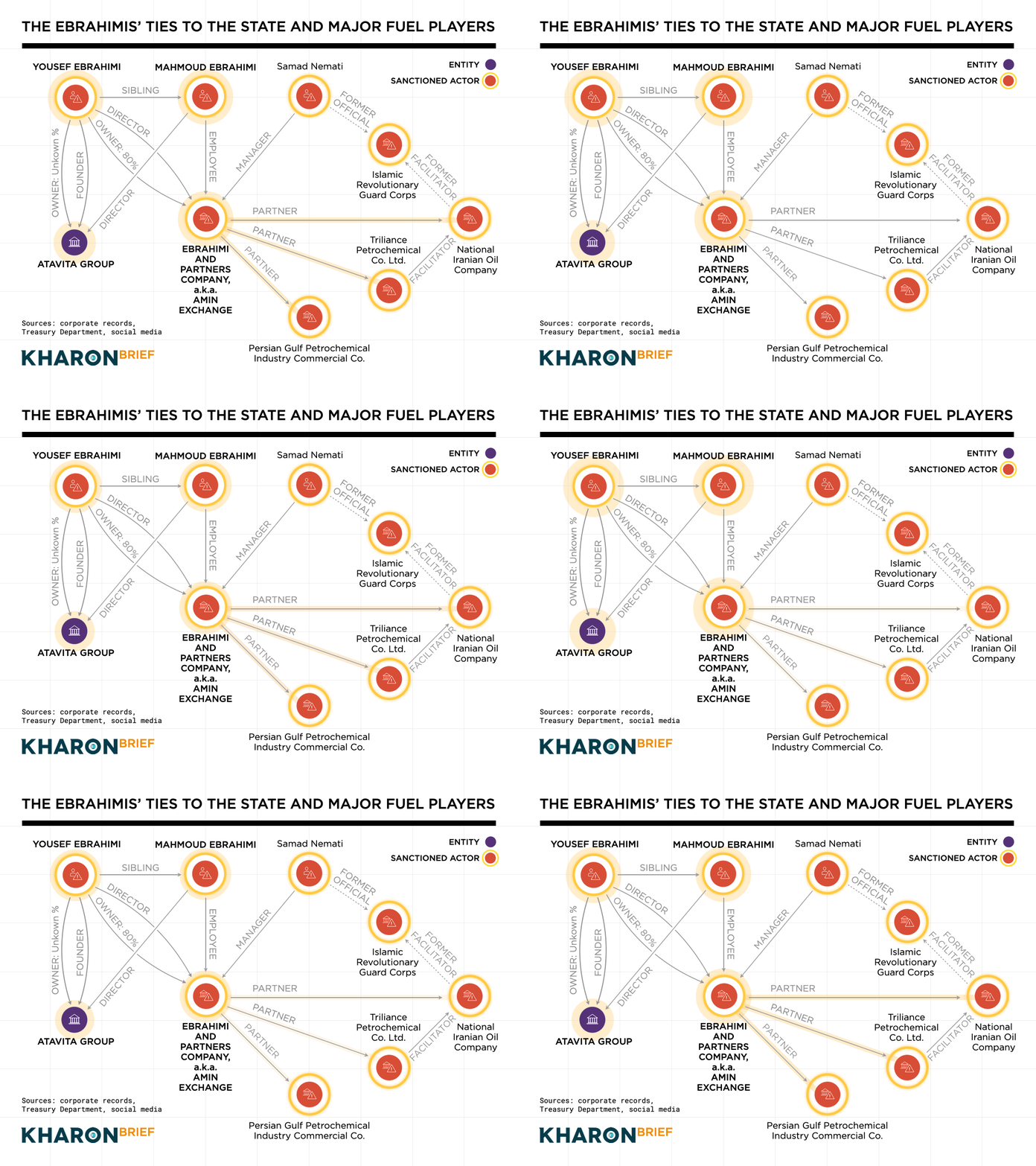
The Ebrahimi brothers direct those subsidiaries, according to Iranian records, alongside Ali Hazrati Chakherlo, a Türkiye-based Iranian national whom Treasury sanctioned in the same May action.
One Atavita Group subsidiary, Aras Tarla Amin, exported $8.1 million worth of goods across 352 shipments between February 2025 and January of this year, according to the trade data reviewed by Kharon. Over the same period, that produce company imported $122.3 million in gold, all from Türkiye.
Analysis: Agricultural companies would provide “a very convenient cover mechanism,” said Billingslea, now a senior fellow at the Hudson Institute, because sanctions carve-outs mean they would face fewer restrictions on cross-border transactions. They also can provide the trucks, cargo containers, and logistics infrastructure that are needed to move gold.
Such an operation, Billingslea said, would almost certainly run with the state’s knowledge and backing, likely in support of its shadow financial system. “You are not bringing gold into Iran without the IRGC being aware,” he said.
The line between state interests and private profit is deliberately blurred in Iran, noted Norman Roule, who ran Middle East-related programs at the CIA before serving as the U.S. national intelligence manager for Iran. With IRGC-linked entities holding stakes across the economy, it is reasonable to assume that at least some of the Ebrahimi firms’ gold trade has been conducted on behalf of the state itself, he said.
“This is a regular supply of gold as an alternative [finance and trade] settlement structure that benefits the stability of Iran,” said Roule, a senior nonresident advisor at the Center for Strategic and International Studies. “There’s no reason for the Iranians not to exploit this asset class.”
One Atavita Group subsidiary, Aras Tarla Amin, exported $8.1 million worth of goods across 352 shipments between February 2025 and January of this year, according to the trade data reviewed by Kharon. Over the same period, that produce company imported $122.3 million in gold, all from Türkiye.
- Similarly, sister greenhouse company Aras Tarla Amir recorded $6.43 million worth of exports across 504 shipments last year, compared with $24.5 million in gold imports in less than two dozen shipments.
Analysis: Agricultural companies would provide “a very convenient cover mechanism,” said Billingslea, now a senior fellow at the Hudson Institute, because sanctions carve-outs mean they would face fewer restrictions on cross-border transactions. They also can provide the trucks, cargo containers, and logistics infrastructure that are needed to move gold.
Such an operation, Billingslea said, would almost certainly run with the state’s knowledge and backing, likely in support of its shadow financial system. “You are not bringing gold into Iran without the IRGC being aware,” he said.
The line between state interests and private profit is deliberately blurred in Iran, noted Norman Roule, who ran Middle East-related programs at the CIA before serving as the U.S. national intelligence manager for Iran. With IRGC-linked entities holding stakes across the economy, it is reasonable to assume that at least some of the Ebrahimi firms’ gold trade has been conducted on behalf of the state itself, he said.
“This is a regular supply of gold as an alternative [finance and trade] settlement structure that benefits the stability of Iran,” said Roule, a senior nonresident advisor at the Center for Strategic and International Studies. “There’s no reason for the Iranians not to exploit this asset class.”
Chinese commercial space startups are enabling military operations for Iran and Russia, a Kharon investigation found. The “Five Little Dragons” are at the heart of it.
A diversified portfolio: Besides their exchange and agricultural businesses, the Ebrahimis’ network also includes energy, steel, and industrial firms in Iran, according to corporate records and social media profiles. Two of them, Azar Foulad Amin and Tamin Energy, also imported millions of dollars’ worth of gold last year.
The network appears to have gained a corporate foothold in the U.K. recently as well, through two companies based at the same address in Cardiff, Wales:
Beyond the Ebrahimi network, a Kharon review identified as much as $2.6 billion in gold imports that flowed into Iran through 11 additional entities over the last year. Total imports of gold are reported by Iranian state media as far higher, but tracing those transactions are complicated by the fact that Iran’s trade data is opaque. And Iranian customs reports don’t always reflect shipments’ true cargo, analysts say.
Like the Ebrahimi network, the values of most of these companies’ gold imports dwarf their exports.
The network appears to have gained a corporate foothold in the U.K. recently as well, through two companies based at the same address in Cardiff, Wales:
- the software and accounting firm Nova Future Flow Ltd., formed in late February by a financial advisor for Atavita Group, Hossein Jalilpour Saberjouy.
- the fruit and vegetable company Atavita Foods Ltd., which Yousef Ebrahimi founded using his Turkish passport just a few days later.
Another $2.6 Billion in Gold
The network’s operations speak to gold’s broader role in Iran’s sanctions- and war-battered economy, one that is designed to side-step Western sanctions pressure.Beyond the Ebrahimi network, a Kharon review identified as much as $2.6 billion in gold imports that flowed into Iran through 11 additional entities over the last year. Total imports of gold are reported by Iranian state media as far higher, but tracing those transactions are complicated by the fact that Iran’s trade data is opaque. And Iranian customs reports don’t always reflect shipments’ true cargo, analysts say.
Like the Ebrahimi network, the values of most of these companies’ gold imports dwarf their exports.
- One exception: Black Gold Trading Development Company, a firm that calls itself Iran’s largest non-state producer of bitumen, a petroleum product used to build roads.
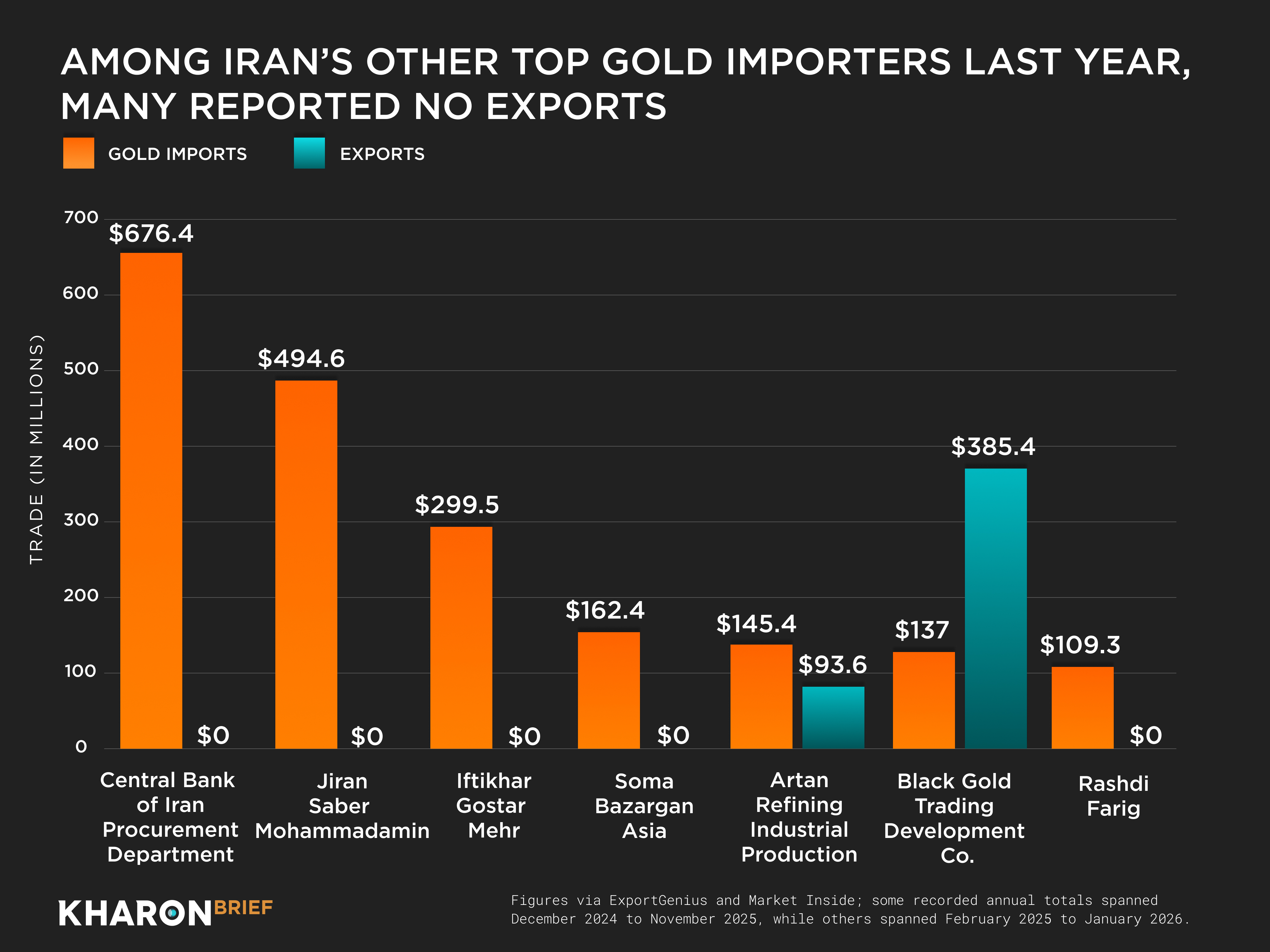
Much of the 11 entities’ gold was recorded as having been imported from Türkiye and the UAE, two of the few countries with refineries capable of producing gold to monetary standards.
Trend line: Iranian customs statistics reportedly plummeted in the first five months of this year compared to the same period last year. That decline coincides with a reported wartime drop in Iran’s oil exports to China — a relationship that Treasury alleges is in part facilitated by payments to Tehran in gold.
The bottom line: Enforcement of the new U.S. sectoral sanctions targeting gold will be the hard part, Roule said.
Treasury Secretary Scott Bessent, in announcing the gold and other sanctions last month, said teams from his office, State, and the U.S. military were meeting with global counterparts to warn them that the U.S. expects action. Cracking down, Roule said, will require pushing a small number of countries — especially Iran’s main trading partners, in Iraq, Türkiye, and the UAE — to make policing their gold exports a priority, then building the institutional architecture to back it up.
Treasury has already begun prodding those nations, sanctioning a UAE-based Egyptian bank and a Turkish bank in successive weeks. The UAE in mid-August said it would shut down trade with Iran, a move broadly applauded by Western analysts. But the U.S. has historically struggled to get Dubai’s government to disentangle its prodigious gold and exchange markets from Tehran’s complex financing operations, former officials have said.
Washington must demonstrate now that it’s not waging a “temporary campaign,” Roule said, and “that we will not accept a situation where some countries comply to their financial disadvantage while others are allowed to fill that gap with their own businesses.”
Read more from The Brief on Iran: